Free Cursive Letter E Worksheet — Printable PDF Practice Sheets
Practice cursive handwriting with this free cursive letter e worksheet collection from Book and Pencil. These printable PDF worksheets help students learn cursive capital E and lowercase e through tracing, grid practice, and sentence writing activities. Each worksheet is designed for Grade 1 to 3 students, homeschool learners, classroom handwriting practice, and adults improving cursive writing skills. All worksheets are free to download with no account or sign-up required.
Letter Tracing and Word Practice
Uppercase Grid Practice
Lowercase Grid Practice
Upper and Lowercase
Passage Writing Practice
What These Cursive Letter E Worksheets Include
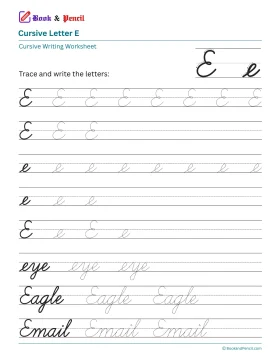
This cursive letter e worksheet set includes four free PDF handwriting practice pages that help learners build confidence with both uppercase and lowercase cursive E.
Worksheet 1 — Uppercase Cursive Letter E Practice Worksheet
This worksheet focuses only on cursive capital E tracing. Students begin with heavily dotted uppercase E examples before progressing to lighter guides and finally blank grid boxes for independent writing. The boxed layout helps learners maintain consistent letter height and spacing.
Worksheet 2 — Lowercase Cursive Letter e Practice Worksheet
The lowercase cursive e worksheet provides repeated tracing practice for the small looping e shape. Students trace dotted lowercase e letters and then continue practicing independently inside blank handwriting grids. This sheet helps learners control the rounded loop that makes cursive e recognizable.
Worksheet 3 — Uppercase and Lowercase Ee Worksheet
This combined worksheet alternates between uppercase E and lowercase e across each row. Students practice switching naturally between both forms, similar to real writing situations where uppercase E starts names like Emma and lowercase e continues inside words like envelope or elephant.
These printable cursive e worksheets are completely free PDF downloads from Book and Pencil.
Worksheet 4 — Free Printable Cursive Letter E Worksheets
The passage worksheet helps students practice cursive E in connected writing instead of isolated letters. Learners trace and rewrite the sentence:
“Emma and Ed each ate an egg near the edge of tree. Every evening the flew east and ended.”
This activity gives repeated exposure to lowercase e in words like each, egg, edge, evening, east, and ended, while also practicing uppercase E in names like Emma, Ed, and Every. After tracing the dotted text, students rewrite the passage independently on lined rows.
How to Write Cursive Letter E
How to Form Uppercase Cursive E
Cursive uppercase E starts near the top line with a small curved hook moving slightly right before curving downward to the left. The stroke continues into a large open curve at the bottom, similar to a cursive C shape. After rounding the bottom curve, the pencil moves upward slightly and forms a short horizontal shelf near the middle of the letter before exiting to the right. The top hook and middle shelf are what separate cursive E from other curved uppercase letters.
How to Form Lowercase Cursive e
Lowercase cursive e begins at the midline with a short rightward entry stroke. The pencil then loops upward and curves back around to the left in a small rounded loop before closing near the middle line. The letter finishes with a slight upward exit stroke that connects smoothly into the next letter. The loop must remain open and balanced so the e does not look like a cursive l or c.
Words like eagle, elephant, and envelope are excellent practice examples because they repeat the cursive e shape naturally throughout the word.
Tips for Practicing Cursive Letter E
Keep the Lowercase Loop Open
Many learners close the lowercase e loop too tightly, making the letter difficult to read. Leave a small open space inside the loop so the shape stays clear.
Avoid Flattening the Midline Shelf
The uppercase E includes a short shelf near the middle. If this shelf becomes too long or too flat, the letter may lose its proper cursive appearance.
Watch the Exit Stroke
Lowercase e connects directly into following letters. Practice finishing with a smooth upward exit stroke so words like elephant and envelope connect naturally.
Do Not Oversize Uppercase E
Uppercase E should be tall but still controlled inside the headline and baseline space. Oversized curves can make the letter look uneven beside smaller lowercase letters.
Frequently Asked Questions (FAQs)
Why is lowercase cursive e difficult for beginners?
Lowercase cursive e uses a tight loop that must stay open and rounded at the same time. Many beginners either close the loop too much or make it too wide.
How does lowercase cursive e connect to other letters?
Lowercase e ends with an upward exit stroke that connects smoothly into letters like l, n, r, and v in words such as elephant and every.
What is the best way to practice cursive capital E?
Tracing uppercase E repeatedly inside grid boxes helps learners control the large bottom curve and middle shelf while maintaining consistent proportions.