Free Cursive Letter G Worksheet — Printable PDF Practice Sheets
Learning to write the cursive letter G helps students develop control over rounded strokes, loop formation, and connected handwriting. This free cursive letter G worksheet set from Book and Pencil includes five printable PDF worksheets designed for beginners and developing writers. Students can practice both cursive capital G and lowercase g through tracing, independent writing, word practice, and sentence work. All worksheets are available as free downloads with no account or sign-up required.
Letter Tracing and Word Practice
Uppercase Grid Practice
Lowercase Grid Practice
Upper and Lowercase
Passage Writing Practice
What’s Included in the Cursive Letter G Worksheet Set
This worksheet collection provides multiple levels of practice so learners can move from tracing to independent cursive writing.
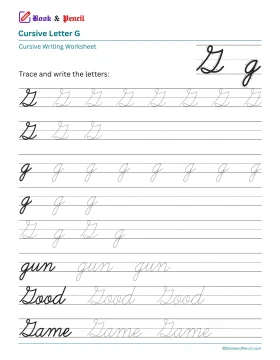
Worksheet 1 — Letter Tracing and Word Practice
Students trace and write uppercase G and lowercase g before practicing complete words. The worksheet includes the words gun, good, and game, allowing learners to see how cursive G connects naturally within everyday words.
Worksheet 2 — Uppercase Letter G Practice
This worksheet focuses only on cursive capital G. Learners trace several rows of uppercase G before using blank practice boxes to write the letter independently. The grid format helps maintain consistent letter height and spacing.
Worksheet 3 — Lowercase Letter G Practice
This worksheet provides concentrated practice for lowercase g. Because lowercase g includes a descender loop that extends below the baseline, repeated tracing helps students build control and maintain consistent letter proportions.
Worksheet 4 —Uppercase and Lowercase Gg Practice
Students alternate between uppercase G and lowercase g throughout the tracing section. This format helps learners compare the two letter forms and recognize their different sizes, shapes, and writing zones.
Worksheet 5 — Cursive Passage Writing Practice
Students trace and rewrite the following cursive passage:
“Grace walked through the green garden near the gate. A gentle goat grazed on grass while gray geese gathered nearby.”
The passage provides repeated exposure to uppercase and lowercase G while strengthening letter connections within complete sentences.
How to Write Cursive Letter G
Writing cursive letter G requires smooth curved movement and controlled loop formation.
Uppercase Cursive G
Begin near the top writing line and create a small loop at the upper left. Continue into a large curved stroke that sweeps downward and around, forming the main body of the letter. Finish with a curved stroke that extends slightly upward to create the distinctive ending shape of cursive capital G.
Lowercase Cursive g
Start with a small oval similar to cursive a. After closing the oval, continue the stroke downward below the baseline into the descender zone. Form a narrow loop underneath the baseline, then curve back upward and finish with a rightward exit stroke for connecting to the next letter.
Practicing both forms helps students develop circular stroke control, loop consistency, and awareness of different writing zones.
Why Letter G Is an Important Handwriting Skill
The cursive letter G combines several foundational handwriting movements. Uppercase G strengthens large circular motions and directional control, while lowercase g introduces descender management below the baseline.
These skills support:
- Rounded letter formation
- Continuous pencil movement
- Loop control
- Consistent letter sizing
- Smooth letter connections in cursive words
Words such as gate, green, garden, goat, and grass give students opportunities to apply these movements in meaningful reading and writing activities.
Tips for Practicing Cursive Letter G
Complete the Main Curve Before Finishing the Letter
Many learners rush the ending stroke of uppercase G. Focus on forming the large curved body first before adding the finishing sweep.
Keep the Lowercase Loop Narrow
A common mistake is creating a descender loop that is too wide. A smaller, controlled loop improves readability and consistency.
Maintain Smooth Motion Through the Descender
Avoid stopping at the baseline. Continue the stroke into the lower loop using one fluid movement.
Watch the Height Difference Between G and g
Uppercase G should extend much higher than lowercase g. Practicing both together helps reinforce correct sizing.
Letter Sound and Phonics Practice
The letter G commonly represents the /g/ sound heard in words such as gate, green, garden, goat, and grass. While tracing, encourage children to say each word aloud and identify the beginning sound. Combining handwriting practice with phonics instruction helps strengthen letter recognition and early reading skills.
Simple Learning Activities
Garden Word Hunt
Ask children to find and circle words beginning with G in books, worksheets, or classroom materials.
Green Object Collection
Collect green items around the classroom or home and discuss their names while emphasizing the /g/ sound.
Goat Sound Matching
Show pictures of objects and have learners identify which words begin with the G sound.
Trace and Write Challenge
After tracing, have students write gate, green, and garden independently using cursive handwriting.
Frequently Asked Questions (FAQs)
How is cursive uppercase G different from print G?
Cursive uppercase G uses a continuous looping stroke and curved finishing line, while print G is formed using separate strokes.
What is the most difficult part of lowercase cursive g?
Most learners find the descender loop below the baseline challenging because it requires controlled movement into a lower writing zone.
Why does lowercase g extend below the baseline?
The descender loop is part of the standard cursive formation and helps distinguish g from similar letters.
How does cursive g connect to the next letter?
The letter finishes with a rightward exit stroke that links smoothly to the following letter in connected cursive writing.
What mistakes do students commonly make when writing cursive G?
Common errors include incomplete curves, oversized descender loops, uneven letter proportions, and stopping the pencil before completing the stroke.