
Kindergarten Numbers 50–100 Quiz – Free Number Practice
Learning numbers beyond 50 is an important step in early math development. Once children become comfortable recognizing smaller numbers, they can begin working with larger numbers, counting through groups of ten, and noticing how numbers change as they move along the number sequence.
This Kindergarten Numbers 50–100 Quiz gives children an interactive way to practice recognizing, ordering, and working with numbers from 50 through 100. Instead of focusing only on memorizing numerals, the questions encourage children to think about what comes before and after a number, find missing numbers, compare numbers, and follow number sequences.
The quiz also includes questions that cross important tens boundaries, such as 59 → 60 → 61 and 79 → 80 → 81. These transitions can help children become more confident when counting forward and understanding how numbers are organized.
With three difficulty levels, the activity can be used for independent practice, classroom review, homeschool lessons, or a quick math check at home.
Ready to practice numbers 50–100? Enter your name and start the quiz!
Math: Kindergarten Numbers 50–100
Great Work!
You completed the quiz!
Explore More Free Kindergarten Quizzes by Subject
Choose a subject below to find free kindergarten quizzes and practice activities. Each section focuses on age-appropriate skills commonly introduced during kindergarten.
Kindergarten Reading & Phonics Skills
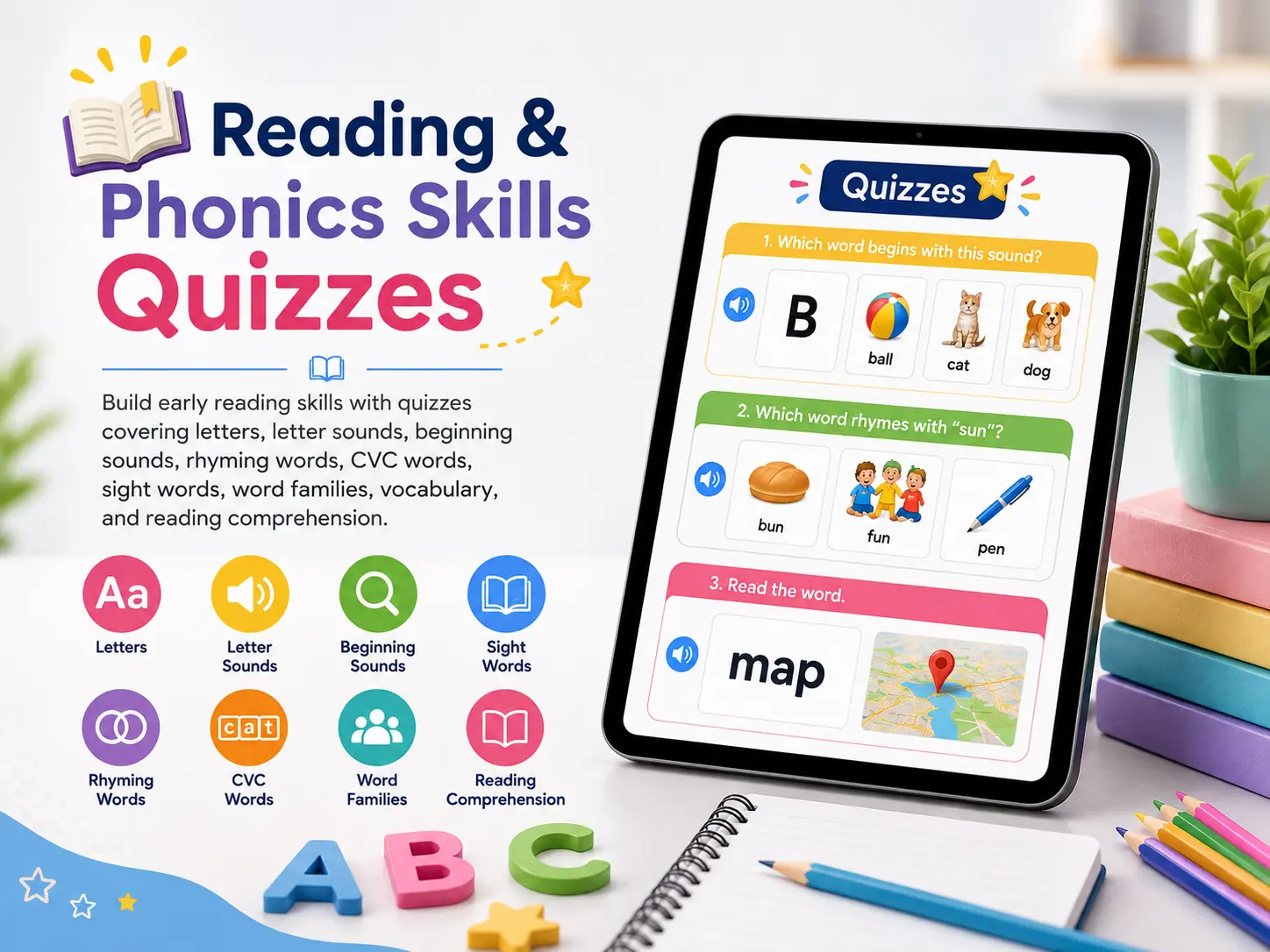
Build early reading skills with quizzes covering letters, letter sounds, beginning sounds, rhyming words, CVC words, sight words, word families, vocabulary, and reading comprehension.
Kindergarten Science Quizzes
Introduce and review basic science concepts with kindergarten science quizzes. Children can practice identifying animals, plants, the five senses, weather, seasons, and other simple science topics through age-appropriate questions.

Kindergarten English & Language Quizzes
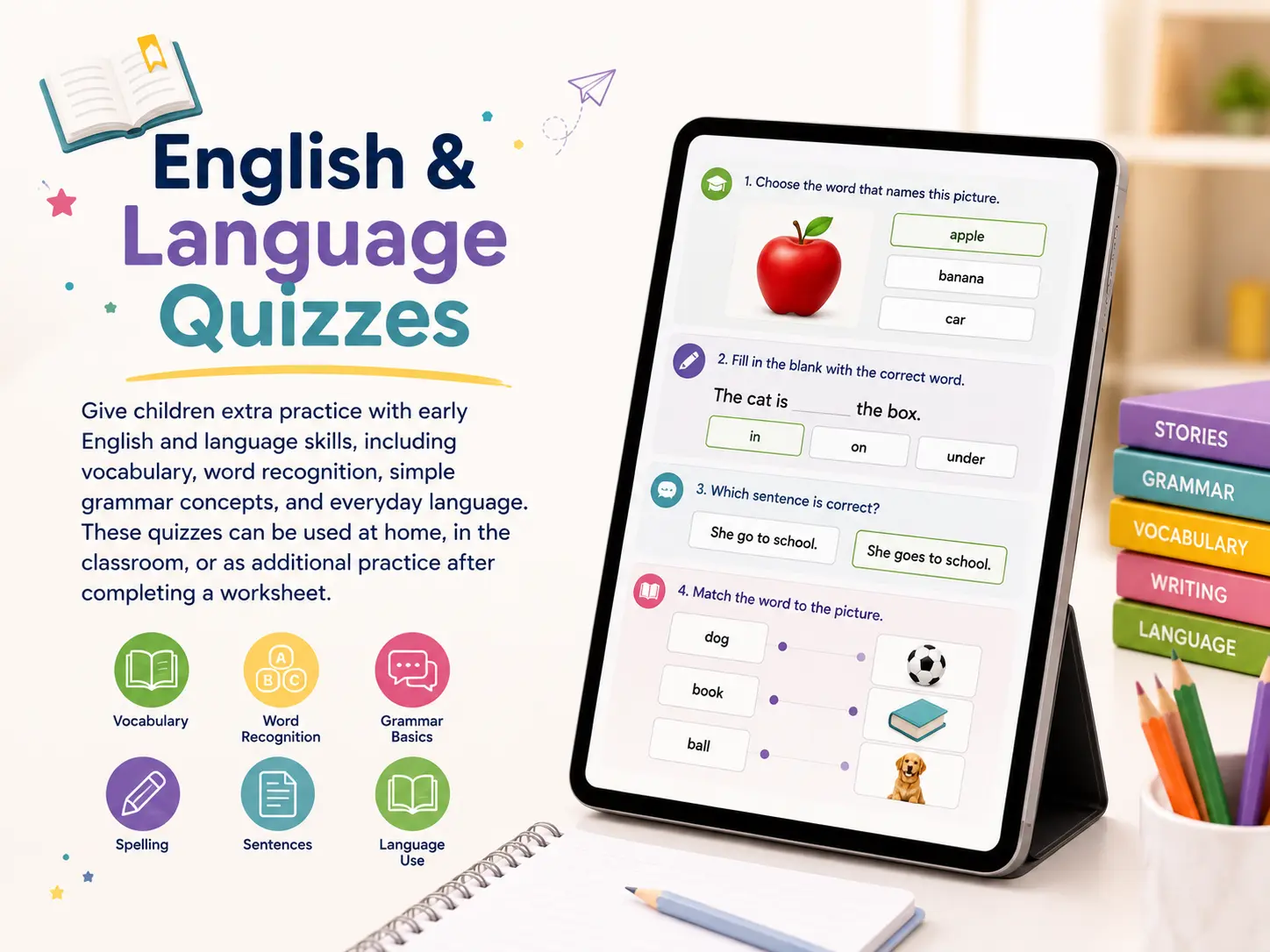
Give children extra practice with early English and language skills, including vocabulary, word recognition, simple grammar concepts, and everyday language. These quizzes can be used at home, in the classroom, or as additional practice after completing a worksheet.
Kindergarten General Knowledge
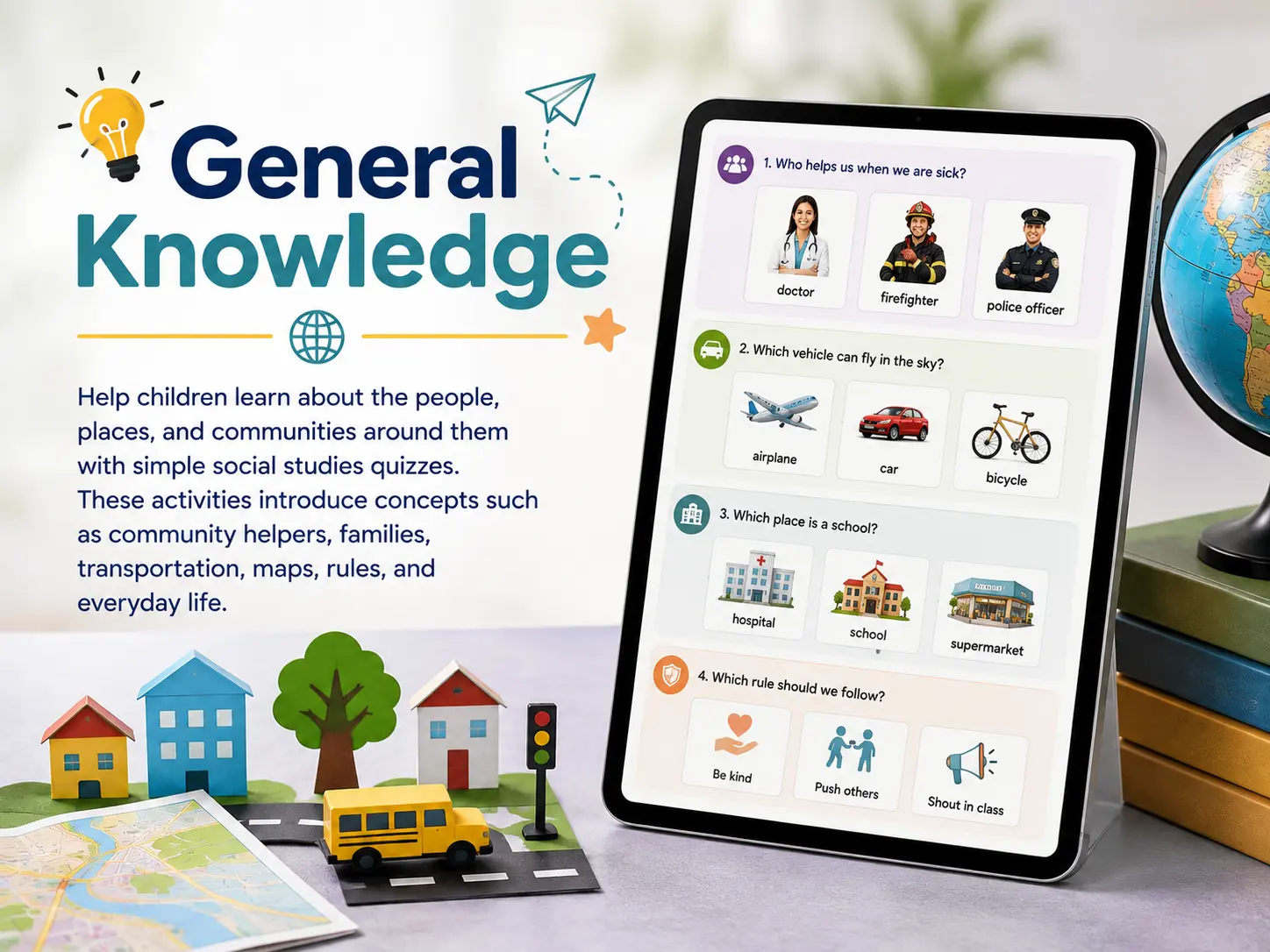
Help children learn about the people, places, and communities around them with simple kindergarten social studies quizzes. These activities introduce concepts such as community helpers, families, transportation, maps, rules, and everyday life.
What Does This Numbers 50–100 Quiz Practice?
This quiz focuses on the number range 50 through 100 and gives children opportunities to work with numbers in several different ways.
Children can practice:
- Recognizing numbers from 50 to 100
- Counting forward through the 50–100 range
- Counting backward from larger numbers
- Finding missing numbers in sequences
- Identifying the number before another number
- Identifying the number after another number
- Finding numbers between two given numbers
- Ordering numbers from least to greatest
- Comparing two numbers
- Comparing several numbers
- Recognizing tens patterns
- Crossing from one group of ten into the next
- Understanding numbers using tens and ones
- Connecting number names with numerals
- Building confidence with larger kindergarten numbers
The goal is not simply to recognize a number when it appears on the screen. Children should gradually understand where a number belongs, how it relates to nearby numbers, and how numbers change as they move through the sequence.
Understanding Numbers in Groups of Ten
Numbers from 50 to 100 become easier to understand when children notice the pattern in the tens.
For example:
50 = 5 tens
60 = 6 tens
70 = 7 tens
80 = 8 tens
90 = 9 tens
100 = 10 tens
Children can also look at the tens and ones in numbers such as:
- 54 = 5 tens and 4 ones
- 67 = 6 tens and 7 ones
- 82 = 8 tens and 2 ones
- 95 = 9 tens and 5 ones
This helps children see that the digits in a two-digit number have different roles. The first digit shows the number of tens, while the second digit shows the number of ones.
Practicing Number Changes Across Tens
The quiz can be organized into three levels so children can gradually build their skills.
Some number sequences become more challenging when they reach a new group of ten.
For example:
57 → 58 → 59 → 60 → 61
The number after 59 is not 510 or another unrelated number. The sequence moves to the next group of ten:
59 → 60
Children can practice similar transitions throughout the quiz:
69 → 70
79 → 80
89 → 90
99 → 100
These transitions provide useful practice with counting forward and understanding how numbers are organized.
How to Use the Kindergarten Numbers 50–100 Quiz
This interactive quiz can be used in several learning situations.
For Parents
Use the quiz after your child has practiced counting and recognizing numbers through 100. If your child has difficulty with a question, pause and talk through the number sequence rather than focusing only on the final score.
A number chart from 1–100 can also be helpful when reviewing questions about missing, before, and after numbers.
For Teachers
Teachers can use the quiz as a short classroom activity, review exercise, or informal check of number understanding.
It can be especially useful after lessons involving counting, number sequences, or tens and ones.
For Homeschoolers
Add the quiz to a kindergarten math routine alongside number tracing, counting activities, place-value practice, and printable math worksheets.
The different difficulty levels allow children to continue practicing as their confidence develops.
QUIZ LEVELS
Kindergarten Numbers 50–100 Quiz Levels
The quiz includes three levels with increasingly varied number relationships.
Easy Level
The Easy level introduces straightforward recognition and sequencing.
Children practice:
- Recognizing numbers
- Counting forward
- Identifying numbers immediately before or after
- Completing simple sequences
- Recognizing common number patterns
Moderate Level
The Moderate level requires children to look more carefully at relationships between numbers.
Questions may involve:
- Missing numbers
- Numbers between two values
- Comparing numbers
- Ordering numbers
- Counting across tens
- Number names
- Simple tens-and-ones thinking
Advanced Level
The Advanced level introduces more reasoning within the 50–100 range.
Children may need to:
- Analyze longer sequences
- Count backward
- Compare several numbers
- Identify number relationships
- Work with tens and ones
- Solve descriptive number problems
- Determine which number satisfies a condition
- Reason through number sequences rather than simply recognize a numeral
