
Kindergarten Subtraction Quiz – Free Subtraction Practice
Learning subtraction becomes easier when children understand that subtraction means taking away, finding what remains, or finding the difference between numbers. This free Kindergarten Subtraction Quiz gives young learners a chance to practice these ideas through short, age-appropriate multiple-choice questions.
The quiz focuses mainly on subtraction within 10 and uses different types of problems instead of repeating the same subtraction facts. Children may work with simple equations, visual groups, number lines, missing numbers, and everyday situations.
Practice subtraction numbers with simple, fun questions for kindergarten kids.
Ready to practice? Start the quiz and see how many subtraction problems you can solve!
Math: Kindergarten Subtraction
Great Work!
You completed the quiz!
Explore More Free Kindergarten Quizzes by Subject
Choose a subject below to find free kindergarten quizzes and practice activities. Each section focuses on age-appropriate skills commonly introduced during kindergarten.
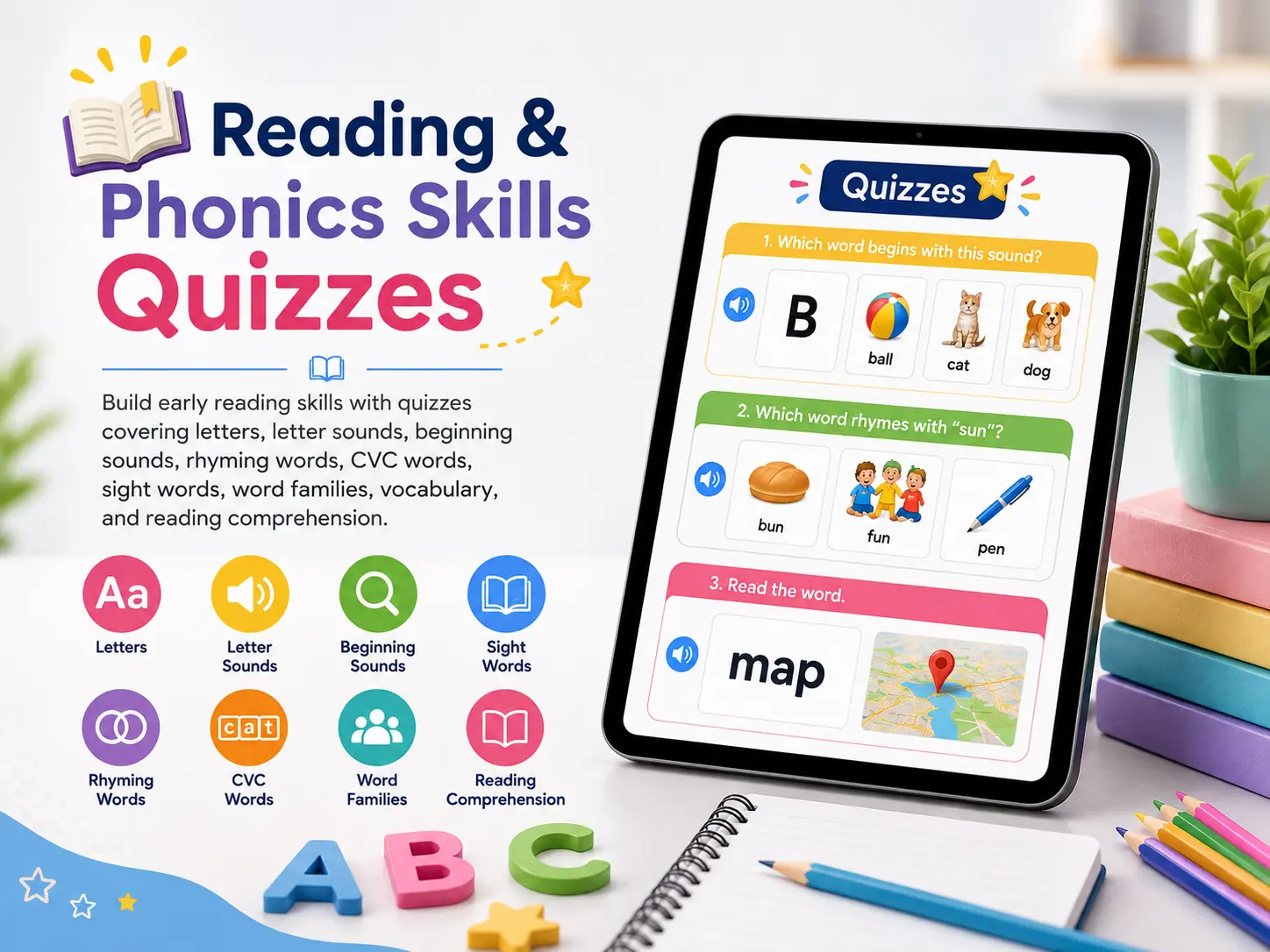
Kindergarten Reading & Phonics Skills
Build early reading skills with quizzes covering letters, letter sounds, beginning sounds, rhyming words, CVC words, sight words, word families, vocabulary, and reading comprehension.
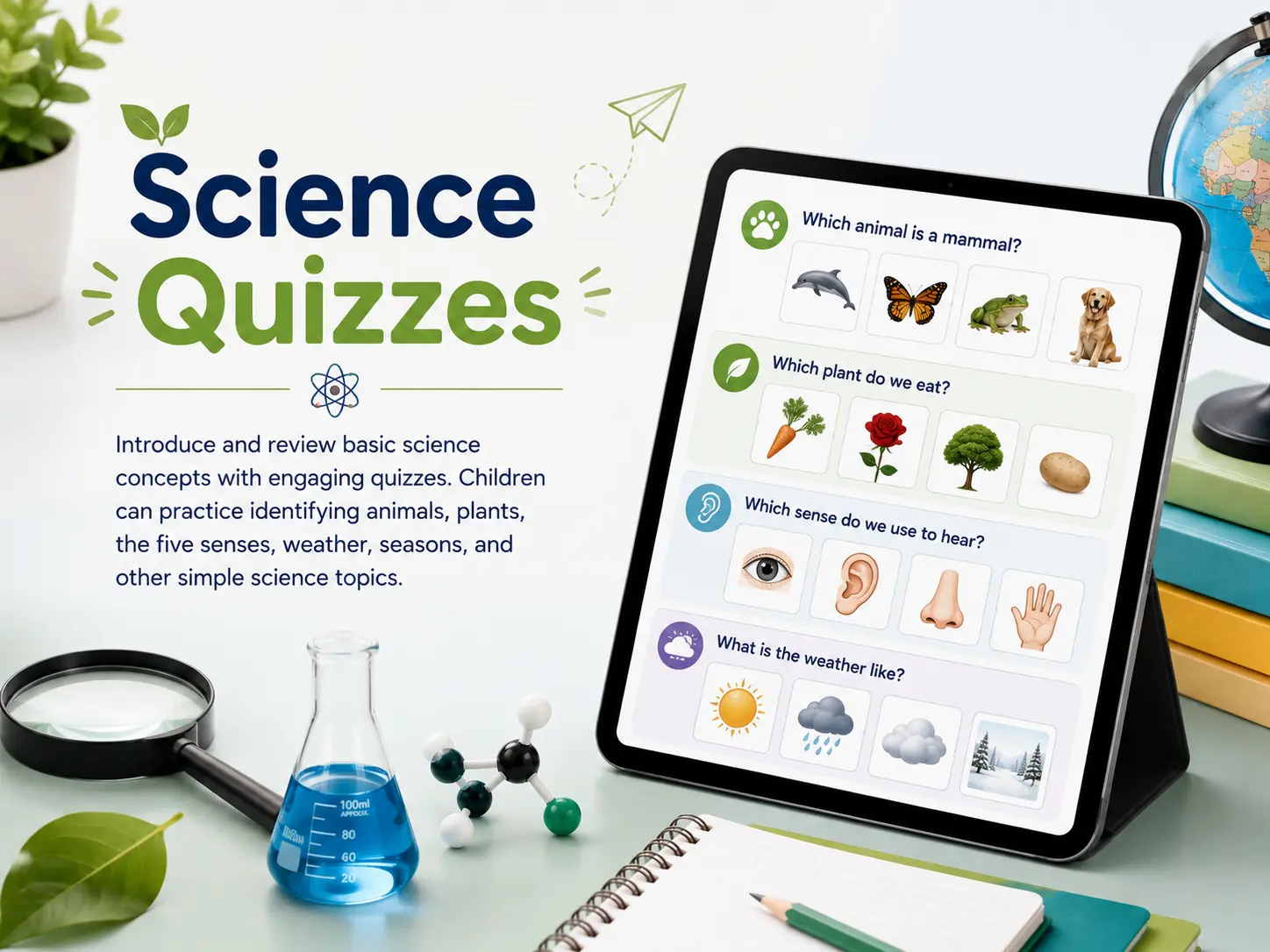
Kindergarten Science Quizzes
Introduce and review basic science concepts with kindergarten science quizzes. Children can practice identifying animals, plants, the five senses, weather, seasons, and other simple science topics through age-appropriate questions.
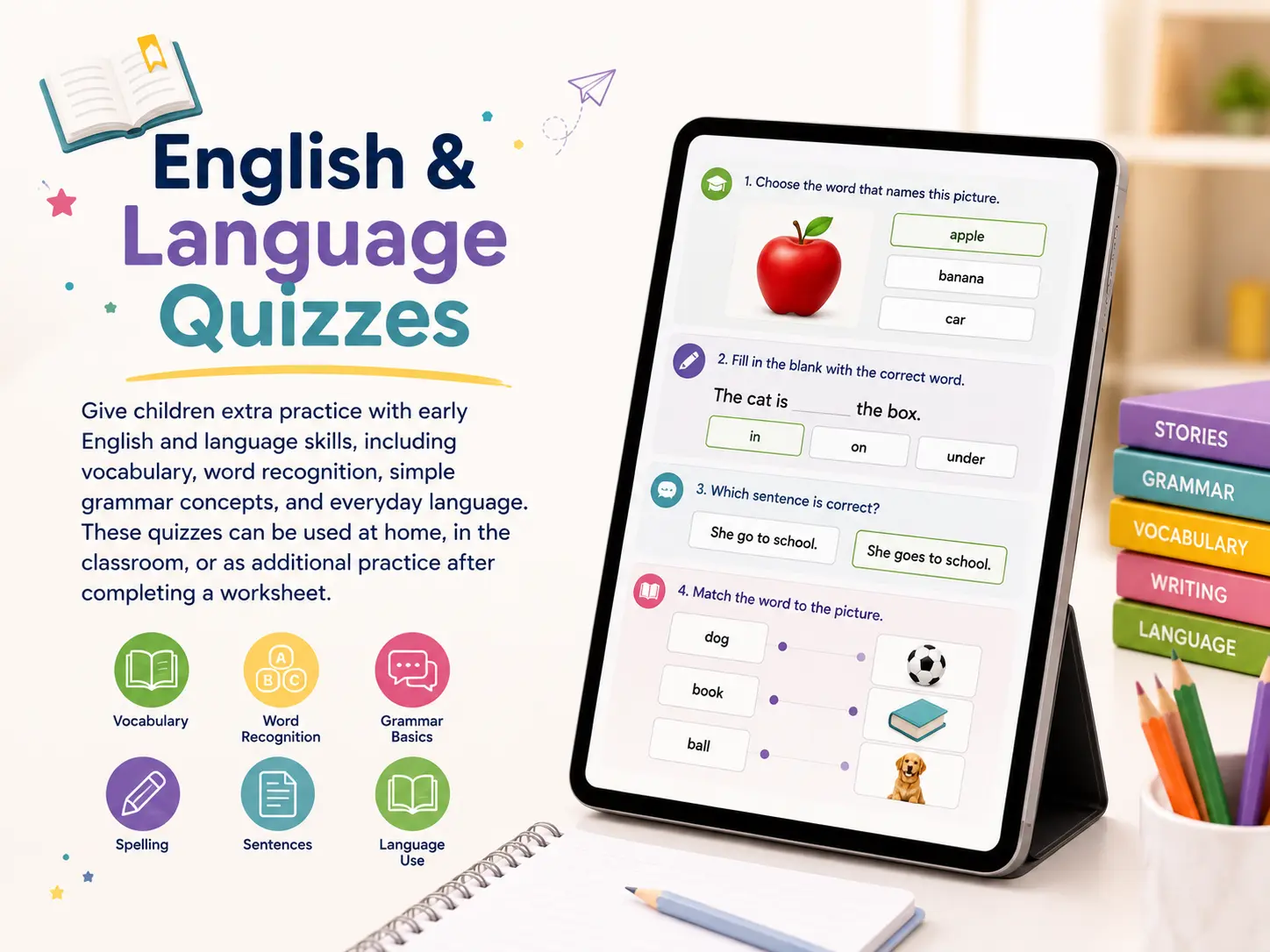
Kindergarten English & Language Quizzes
Give children extra practice with early English and language skills, including vocabulary, word recognition, simple grammar concepts, and everyday language. These quizzes can be used at home, in the classroom, or as additional practice after completing a worksheet.
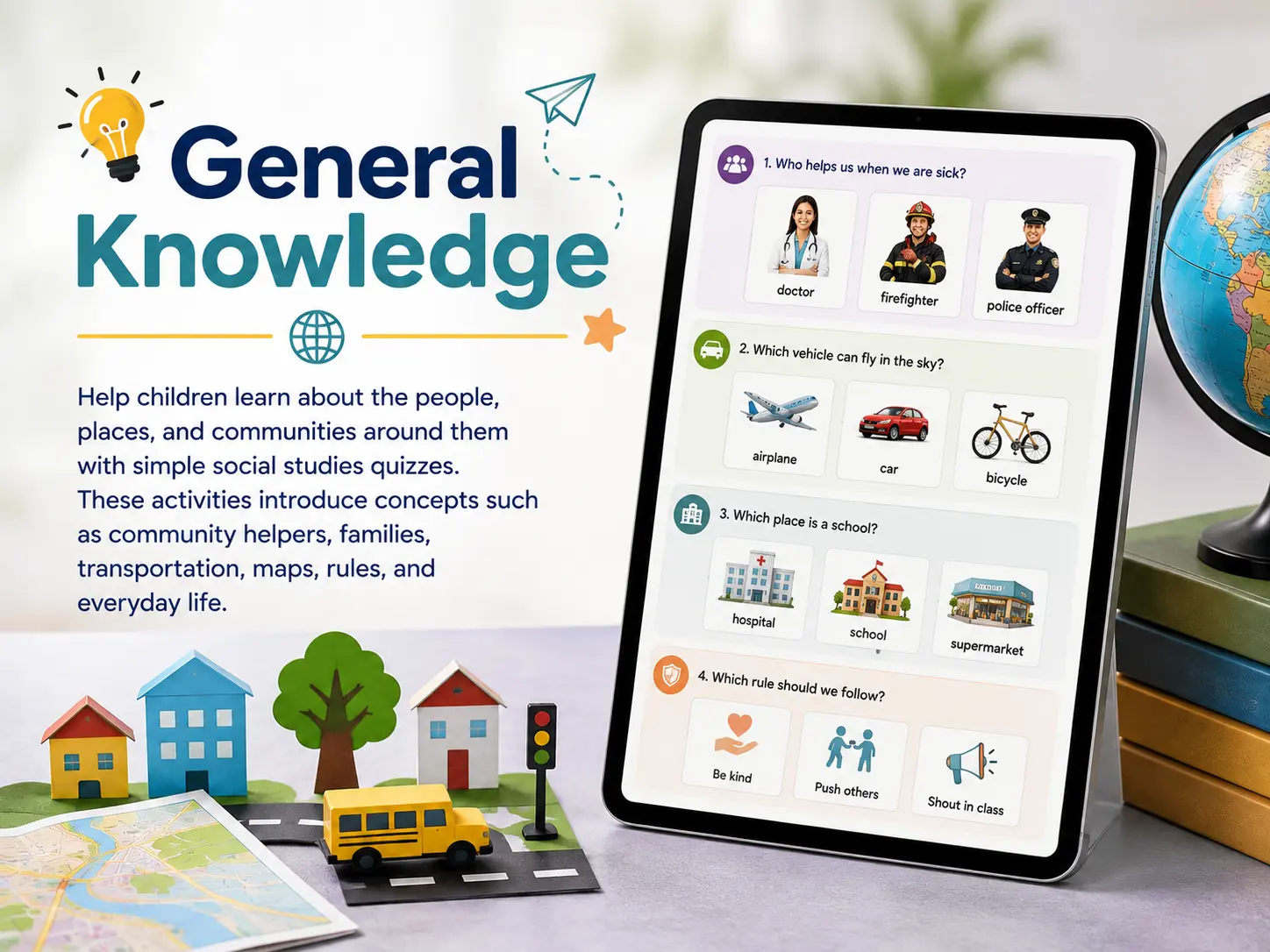
Kindergarten General Knowledge
Help children learn about the people, places, and communities around them with simple kindergarten social studies quizzes. These activities introduce concepts such as community helpers, families, transportation, maps, rules, and everyday life.
What Will You Practice in This Kindergarten Subtraction Quiz?
This quiz helps children develop several early subtraction skills:
- Taking objects away from a group
- Finding how many objects are left
- Solving subtraction equations
- Understanding the meaning of the minus sign
- Subtracting within 5
- Subtracting within 10
- Using number lines to subtract
- Finding missing numbers in subtraction equations
- Recognizing zero as the result when all objects are taken away
- Solving simple subtraction word problems
- Checking whether an answer makes sense
Instead of only asking children to calculate, some questions encourage them to think about what is happening in the problem.
How Does Subtraction Work?
Subtraction tells us that something is being taken away from a group.
For example:
● ● ● ● ●
If we take away 2 circles:
● ● ~~● ~~ ●
There are 3 circles left.
So we can write:
5 − 2 = 3
Here:
- 5 is the starting number.
- 2 is the number being taken away.
- 3 is the number left.
Children can also think about subtraction by counting backward on a number line.
For example:
7 − 3 = 4
Start at 7 and move backward three steps:
7 → 6 → 5 → 4
So the answer is 4.
Learn Subtraction with Objects
Young children often understand subtraction more easily when they can picture the objects being removed.
Imagine there are 8 blocks:
■ ■ ■ ■ ■ ■ ■ ■
If 3 blocks are taken away:
■ ■ ■ ■ ■ ■ ■ ■
There are 5 blocks remaining.
So:
8 − 3 = 5
Visual thinking can help children connect the numbers in an equation with a real action: start with a group, take some away, and count what remains.
Picture-based subtraction and “cross out and count” activities are commonly used for kindergarten subtraction practice.
Subtraction Using a Number Line
A number line gives children another way to see subtraction.
Suppose the problem is:
9 − 4 = ?
Start at 9 and move backward four spaces:
9 → 8 → 7 → 6 → 5
You land on 5, so:
9 − 4 = 5
When solving the quiz, encourage children to imagine the jumps backward if they are not sure of an answer.
Subtraction Is More Than Finding the Answer
Subtraction is not just about memorizing facts.
Children can also learn to ask:
“How many were there at the beginning?”
“How many were taken away?”
“How many are left?”
For example:
Mia has 7 stickers. She gives 2 stickers to her friend. How many stickers does Mia have now?
The starting number is 7.
The number taken away is 2.
So:
7 − 2 = 5
Mia has 5 stickers left.
Simple word problems like these help children connect subtraction with everyday situations. Kindergarten standards also emphasize representing and solving addition/subtraction situations using objects, drawings, words, and equations.
What Makes This Quiz Different?
This Kindergarten Subtraction Quiz does not rely only on straightforward equations.
Questions gradually move from basic subtraction facts to more thoughtful problems.
Children may encounter:
Easy Questions
Simple subtraction with small numbers and familiar visual groups.
Moderate Questions
Subtraction within 10, number-line thinking, missing numbers, and slightly less obvious equations.
Advanced Questions
Short reasoning problems, missing-number situations, comparison of subtraction results, and everyday scenarios where children must decide what information matters.
This progression gives children opportunities to practice both calculation and mathematical thinking.
Three Levels of Kindergarten Subtraction Practice
Easy – Build the Basics
The Easy level introduces children to subtraction with small numbers.
Children practice:
- Taking away objects
- Subtracting within 5
- Basic subtraction facts
- Counting what remains
- Simple visual subtraction
The goal is to build confidence with the basic idea of subtraction.
Moderate – Practice and Think
The Moderate level increases the challenge.
Children may need to:
- Subtract within 10
- Use backward counting
- Complete missing-number equations
- Interpret simple situations
- Connect pictures with subtraction equations
Advanced – Think Carefully
The Advanced level asks children to apply subtraction in less obvious ways.
Questions can include:
- Missing numbers
- Short word problems
- Choosing the correct subtraction equation
- Finding which situation represents subtraction
- Reasoning about how many objects remain
- Comparing possible answers
- Using subtraction concepts rather than simply recalling a fact
The purpose is not to make kindergarten subtraction unnecessarily difficult, but to encourage children to understand why an answer is correct.
Who Can Use This Kindergarten Subtraction Quiz?
This free online quiz can be useful for:
Parents
Use it as a quick way to give your child extra subtraction practice at home.
Teachers
Use the questions as informal practice after introducing subtraction in class.
Homeschool Families
Add the quiz to a kindergarten math practice routine.
Kindergarten Learners
Practice subtraction independently and see which questions you can solve correctly.
How to Use the Quiz
- Read each subtraction question carefully.
- Think about what is being taken away.
- Count the remaining objects if a picture is provided.
- Use a number line or count backward when helpful.
- Choose the answer you think is correct.
- Continue through the questions.
- Review your result when you finish.
- Try the quiz again if you want more practice.
If a question feels difficult, don’t guess immediately. Try drawing the objects or counting backward to work it out.
Helpful Subtraction Strategy for Kindergarten
When a child gets stuck, use the Start → Take Away → Count strategy.
1. Start
Find the number you have at the beginning.
Example:
6 − 2
Start with 6.
2. Take Away
Take away 2.
You can imagine removing two objects.
3. Count
Count what remains.
6 → 5 → 4
Therefore:
6 − 2 = 4
This simple process helps children understand subtraction instead of relying only on memorization.
Practice Subtraction with Real Objects
Children can also practice subtraction away from the screen.
Try using:
- Blocks
- Buttons
- Small toys
- Pencils
- Counters
- Paper shapes
For example, place 7 blocks on a table.
Ask:
“What happens if we take away 3?”
Let the child physically remove three blocks and count what remains.
Then write:
7 − 3 = 4
This connects hands-on learning with the written subtraction equation.
