
Dolch Sight Words Quiz for Kindergarten
A free online quiz on the famous Dolch word list — 60 questions in 3 levels, from the first pre-primer words to the primer list, for ages 4 to 6.
If you are looking for a dolch sight words quiz kindergarten children actually enjoy, you are in the right place. The Dolch word list is the most famous sight word list in the world — the words children must recognize in a flash to become readers. This free quiz turns the pre-primer and primer Dolch words into 60 playful questions across 3 levels, with read-aloud stories, spelling traps and list-sorting challenges. It is free, it works on phones, tablets and computers, and there is no signup. Whether you search for a dolch sight words quiz, kindergarten sight words practice or pre-primer word games, this page makes the Dolch lists stick.
It is free, it works on phones, tablets and computers, and there is no signup. Whether you search for a dolch sight words quiz, kindergarten sight words practice or pre-primer word games, this page makes the Dolch lists stick.
Sight Words / Vocabulary: Kindergarten Dolch Sight Words
Great Work!
You completed the quiz!
Free Kindergarten Quizzes by Subject
Choose a subject below to find free kindergarten quizzes and practice activities. Each section focuses on age-appropriate skills commonly introduced during kindergarten.
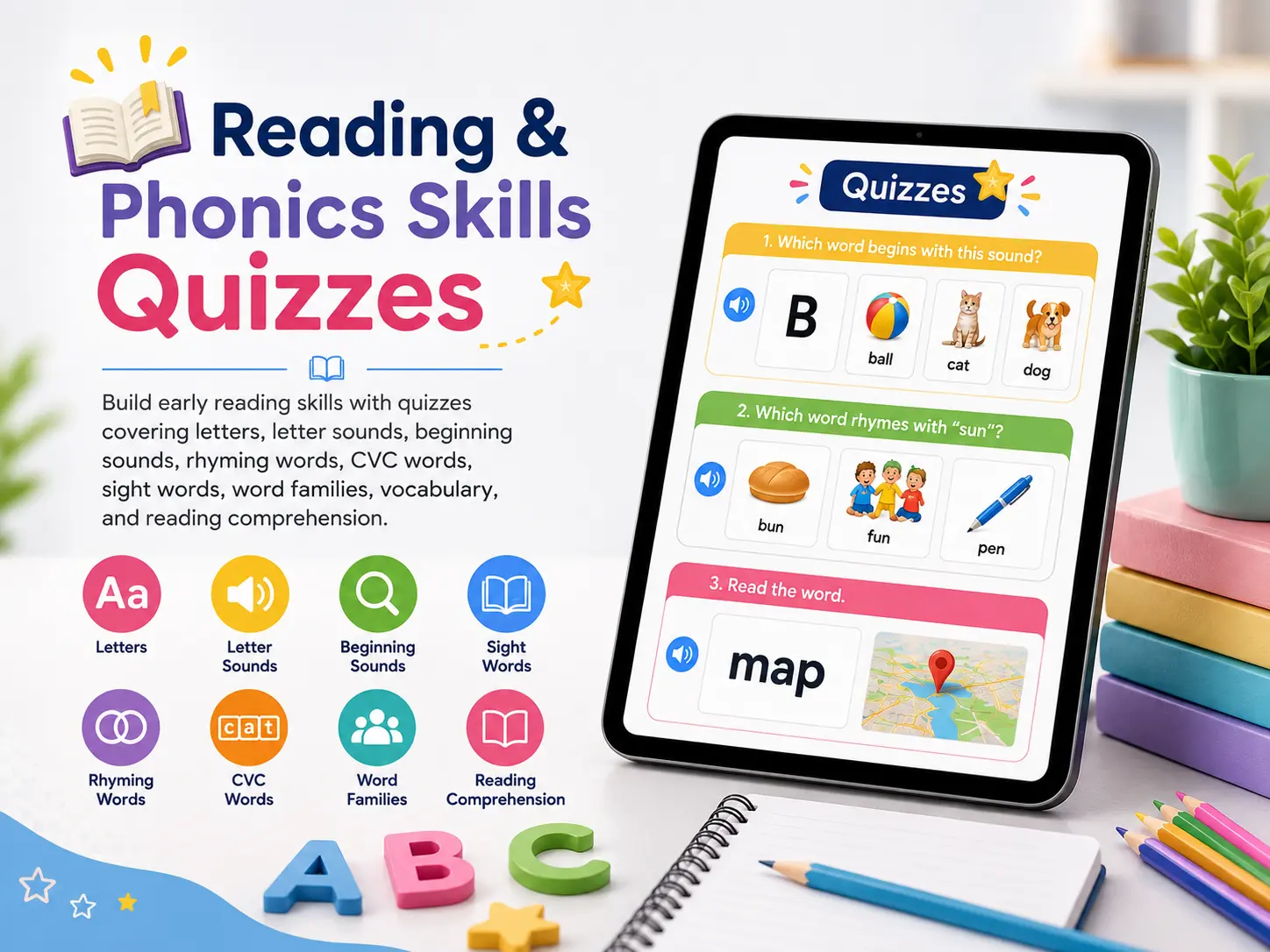
Kindergarten Reading & Phonics Skills
Build early reading skills with quizzes covering letters, letter sounds, beginning sounds, rhyming words, CVC words, sight words, word families, vocabulary, and reading comprehension.
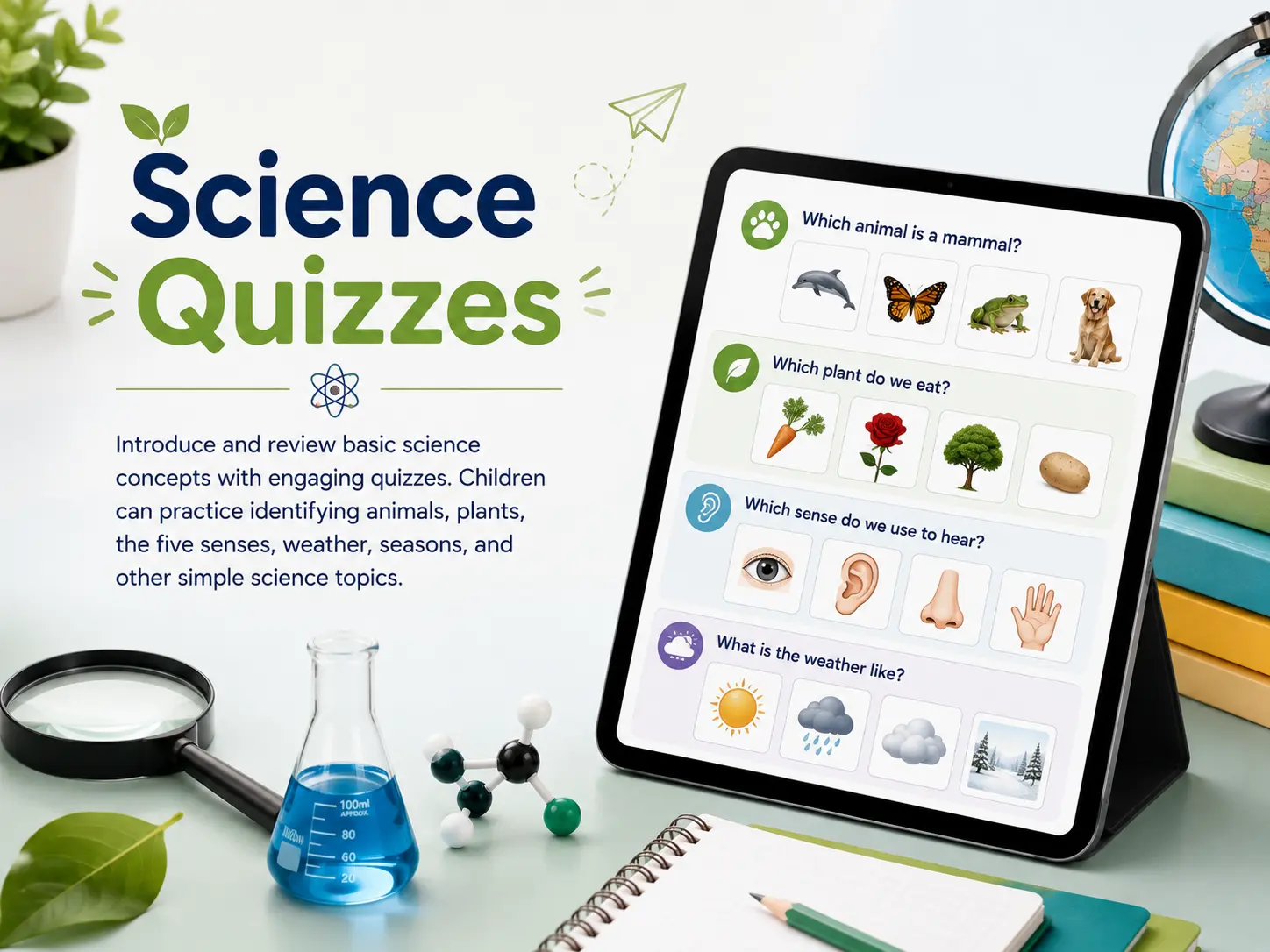
Kindergarten Science Quizzes
Introduce and review basic science concepts with kindergarten science quizzes. Children can practice identifying animals, plants, the five senses, weather, seasons, and other simple science topics through age-appropriate questions.
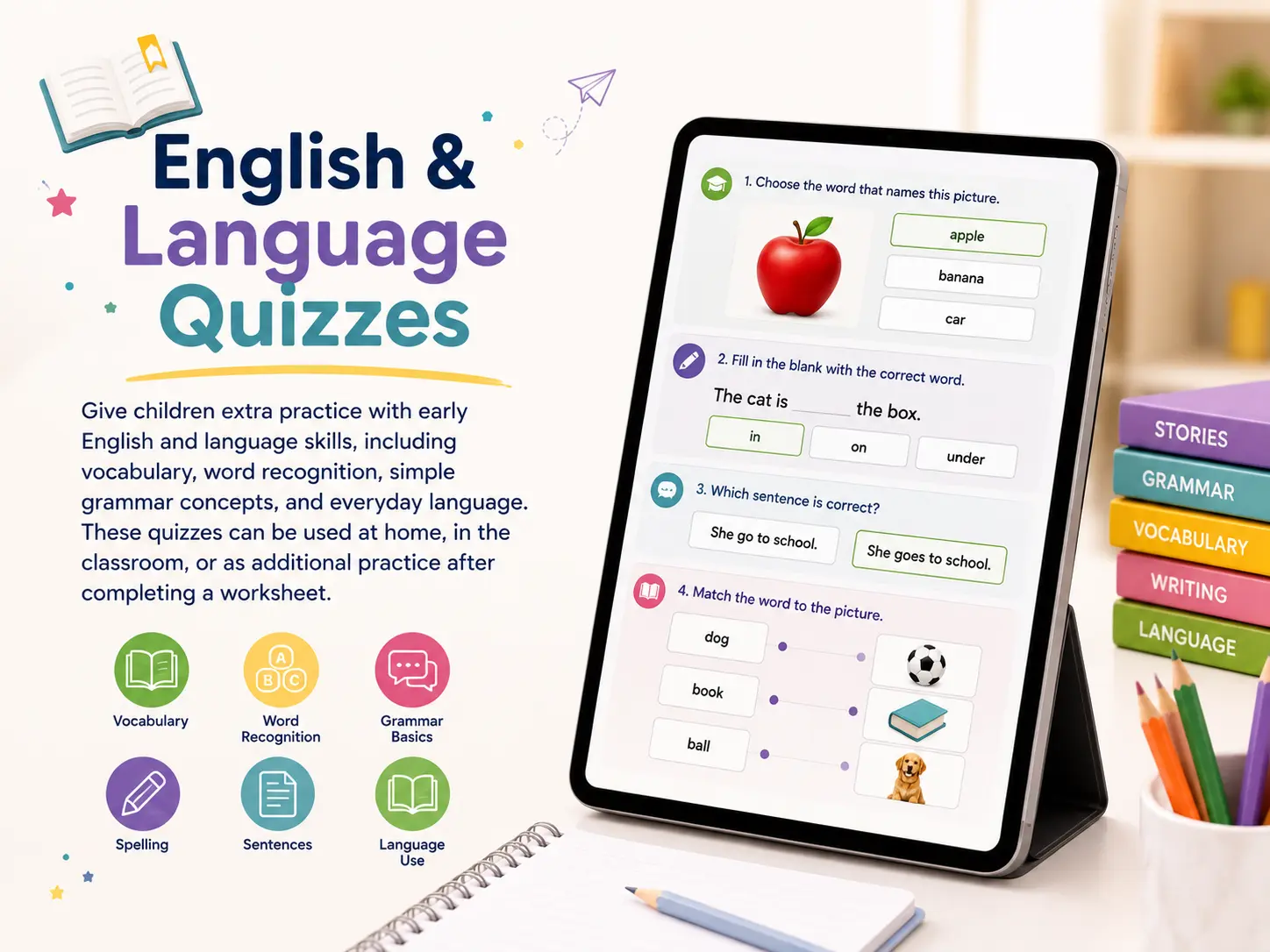
Kindergarten English & Language Quizzes
Give children extra practice with early English and language skills, including vocabulary, word recognition, simple grammar concepts, and everyday language. These quizzes can be used at home, in the classroom, or as additional practice after completing a worksheet.
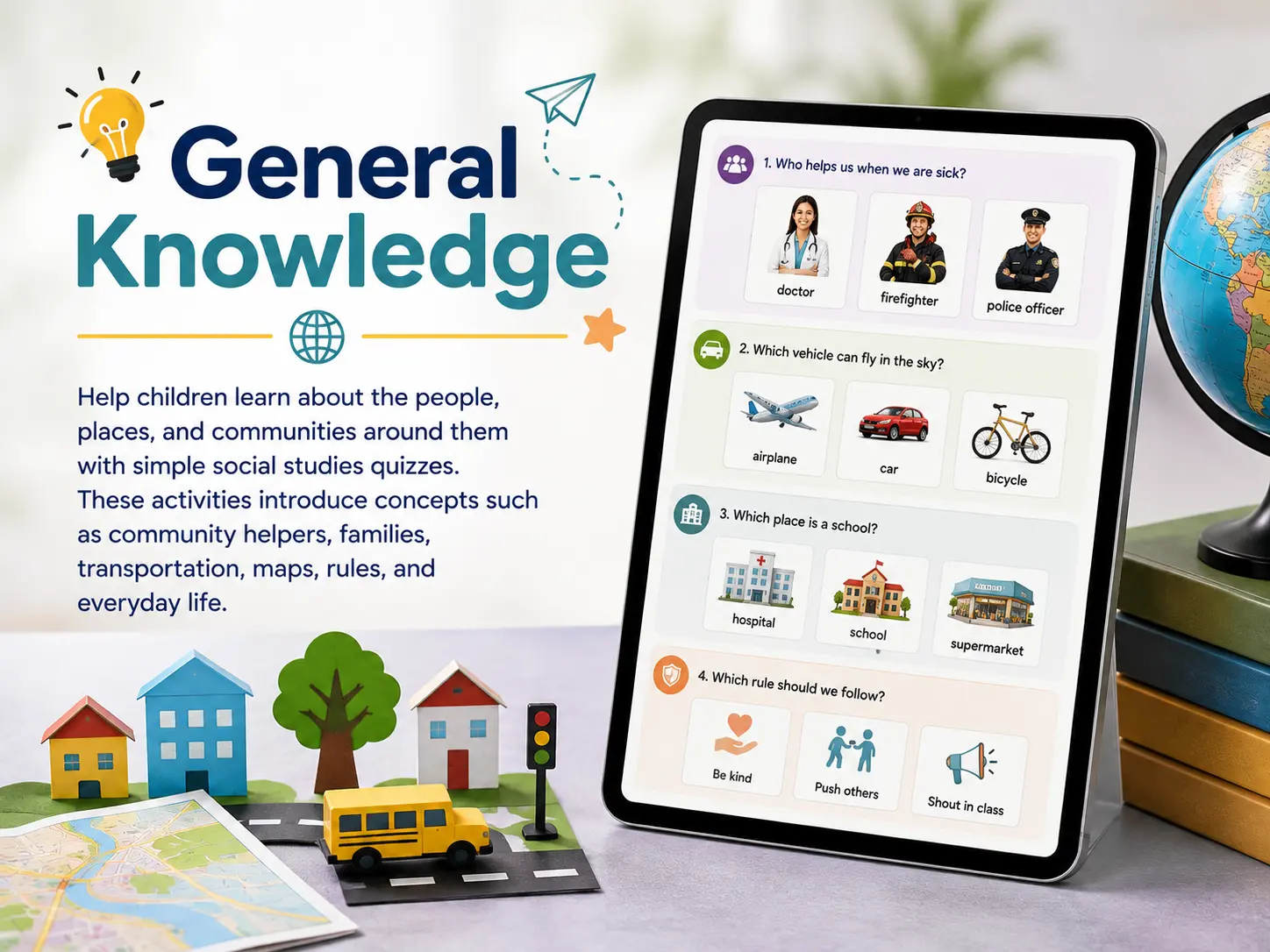
Kindergarten General Knowledge
Help children learn about the people, places, and communities around them with simple kindergarten social studies quizzes. These activities introduce concepts such as community helpers, families, transportation, maps, rules, and everyday life.
What this Dolch sight words quiz covers
If you typed dolch sight words quiz kindergarten into Google, you want more than a printable word list — you want practice that sticks. This quiz teaches the Dolch lists the way children actually meet them: hear a word and find it, spot the fake spelling, finish the sentence, and finally sort every word into the right list — pre-primer or primer. Every question uses a short story or a playful format, so even children who cannot read yet can play while a grown-up reads aloud.
The quiz grows with your child. Easy introduces the friendliest pre-primer Dolch words — the, and, I, you, see, play — with hear-and-find games and big-letter pointing. Medium hides those same words inside sentences, with capital-letter twins, ABC order, missing letters and trickier fakes. Hard opens the primer list: spelling traps like thay and waz, building sentences with went, saw and ate, sound-alike traps like no, now and not, and the famous two-box sort. Unlike the bare word lists that rank for dolch sight words quiz searches today, this page gives instant feedback, three difficulty levels and teaching notes on every hard question. Pair it with our sight words for kindergarten tool for printable practice pages.
How the quiz works
Playing takes less than a minute to start, and there is nothing to install or sign up for. Press start, pick Easy, Medium or Hard, and answer each question by tapping a choice. Every answer gets instant feedback, so your child knows right away whether their thinking about the word was right.
A full run is 60 questions, but nobody has to finish in one sitting. Ten minutes a day on one level beats one long session — short, repeated practice is how sight words move into long-term memory, and that is why a dolch sight words quiz kindergarten children can replay daily works so well. When a level feels easy, move up; when it feels hard, stay and replay. One rule runs through the whole quiz: pre-primer words come before primer words, always — master the first 40 before opening the next box. If you want a change of pace, try our missing number quiz for kindergarten between reading sessions.
Skills your child practices
A Dolch sight words quiz looks simple, but it trains several skills at once. For extra handwriting practice with these same words, try our name tracing generator to build custom tracing pages:
- Instant word recognition: the pre-primer 40 — the, and, a, I, you, see, play, said and friends — read in a flash, not sounded out.
- List awareness: knowing which words belong to pre-primer and which belong to primer, the Expert level’s signature skill.
- Spelling accuracy: telling they from thay, was from waz, with from wiht — the traps that catch early readers.
- Words in sentences: finding, finishing and fixing words inside real sentences, not just on flash cards.
- Sound-alike sorting: no, now and not; went and want — look-alikes that only careful eyes can separate.
Work through those five skills and this dolch sight words quiz kindergarten page turns into a warm-up instead of a challenge.
Age and grade guide
| Age | Grade | What to expect |
|---|---|---|
| 4–5 | Pre-K | pre-primer first words (the, and, I, you); read everything aloud together |
| 5–6 | Kindergarten | full pre-primer 40, words hiding in sentences, first primer words |
| 6–7 | Grade 1 | primer list, spelling traps, pre-primer vs primer sorting |
Every child is different. If the Easy level feels too simple after a day or two, jump straight to Medium — the jump from single words to words-inside-sentences is where most children start thinking hard. And if Hard feels impossible, that is fine too: the list-sorting questions in Level 3 challenge many first graders. Let your child set the pace and replay favourite questions on this dolch sight words quiz kindergarten page. For printable follow-up, our free sight words for kindergarten tool turns any word list into practice pages.
How to use the quiz at home or in the classroom
At home
Ten minutes a day with a dolch sight words quiz works better than one long weekend session. Sit with your child for the first few rounds and read the stories aloud — sight word questions are listening questions first. When they miss one, do not just give the answer: ask “what do you notice about the letters?” Most mistakes are look-alike mistakes, not reading mistakes. Save this dolch sight words quiz kindergarten link where your child can tap it daily.
In the classroom
Use the quiz as a five-minute warm-up before guided reading, or as a station in literacy centers where pairs take turns reading questions aloud. The Easy level suits the start of kindergarten; bring out Medium when children start reading simple sentences, and Hard when you introduce the primer list. Pair it with our missing number quiz for kindergarten for a balanced literacy-and-math rotation.
Tips to help your child do their best
These five habits make any Dolch sight words practice more productive:
- Pre-primer before primer, always. Do not open Level 3 until the first 40 words are instant — mixing the lists early confuses new readers.
- Say the letters together. When a child picks “thay”, chant T-H-E-Y and clap each letter — the wrong spellings are logical, so honour the thinking, then fix the letters.
- Hunt the time word. “Yesterday” means went, saw, ate — teach children to find the time clue first, then pick the verb.
- Write the hard ones. After the quiz, have your child write said, was, they and with with crayons or finger paint — hands remember what eyes forget. Our personalized name tracing workbook builder works for sight words too.
- Play the two-box game offline. Label two boxes pre-primer and primer, write words on cards, and let your child sort them — the same skill as the Expert level, with real cards.
Answer key for parents and teachers
Level 1 — Easy (questions 1–10)
- The — hear the word “the” and find it: the very first Dolch word.
- AND — big letters do not change the word; AND is “and” in a different hat.
- I — “I am Lily” — the word “I” always goes with “am”.
- Make — M is for make; the other words start with different letters.
- it / it — the only pair with the same word written twice.
- 3 — y-o-u has three letters; count them together.
- You — point at the child: “you” means the person being pointed at.
- Red — Ben’s ball is red; “bed” and “read” are the look-alike traps.
- Zebra — play, see and go are real Dolch words; zebra is the fake.
- Jump — junp, jummp and jomp are make-believe; jump is the real word.
Level 2 — Medium (questions 11–30)
- Here — “Come here!” — the word that finishes Mum’s call.
- See — in “I see the red ball”, the word “see” sits in second place.
- Because — funny, play and where are pre-primer words; because is not.
- Jump — Lily likes to jump in the pond, not to “blue” in it.
- THE / the — capital letters do not make a new word.
- Yellow — six letters beats and, big and red.
- Up — Mia points up to show where to look.
- We — the only W word in the set; see, the and me start differently.
- My — “My name is Ben” and “What is my name?” both need “my”.
- Jump — the only word that tells something a body can do.
- Funny — the only word that tells what something is like.
- A — C-A-N: the missing letter in “can” is A.
- Jump — J comes before L, M and P in the ABC book.
- Funny — the tail-chasing dog is funny, not “run” or “said”.
- Three — thee, free and tree are tricks; three is the real number word.
- Not — in “I do not like peas”, “not” is the word that means no.
- Away — “go away” travel together like best friends.
- Help — “I will help you!” — what Lily says to fallen Ben.
- Come — the only word that ends with the letter E.
- See — “I see you” and “I see you too” both need “see”.
Level 3 — Hard (questions 31–60)
- Primer — “they” is on the primer list, not pre-primer.
- They — thhey, thay and thei are traps; they is correct.
- Saw — yesterday calls for “saw”, the past of “see”.
- Pre-primer — “and” is one of the very first pre-primer words.
- Went — “She went to school” — yesterday’s word again.
- Was — waz, wus and woz are traps; was is correct.
- New — “not old at all” means new; now, no and not sound close but miss.
- He, she, they — all three are primer; and, said and the are pre-primer.
- Who — “who” asks about a person; where, when and what do not.
- Are — “They are happy” — are is the word that fits.
- Pre-primer — tricky one: “said” is pre-primer, even though it looks hard.
- With — wiht, whith and withh are traps; with is correct.
- Must — “We must stay under the leaf!” — the rain makes it a must.
- Also — in “I want cake too!”, “too” means also here.
- Primer — “like” sits on the primer list.
- Soon — “in a little while” is what “soon” means.
- Did — “She did not want to go” — did teams up with not for the past.
- What — wath, whot and whaat are traps; what is correct.
- Ate — “Yesterday we ate our lunch” — eat becomes ate in the past.
- No — say it like “NO cookies!”: no, now and not sound close but only no fits.
- Primer — one, two, three are pre-primer, but “four” is primer.
- Say — day and say rhyme; so, saw and she do not.
- Under — pirates hid the treasure under the ground.
- There — t-h-e-r-e has five letters; they has four.
- Primer — “pretty” is on the primer list.
- She — shee, shhe and seh are traps; she is correct.
- Please — the word that makes a request polite.
- No — “I have no cookies left” means zero, none at all.
- Went — “They went to the zoo yesterday” — hunt the time word first.
- Primer — “good” goes in the PRIMER box: the graduation sort.
What to practice next
The Dolch lists are one piece of kindergarten reading. Once the pre-primer 40 feel instant, the natural next step is daily sight word review — our free sight word generator builds custom practice pages from any word list. Then try a change of pace with our missing number quiz for kindergarten, which trains ordering brain muscles in a completely different subject. When your child can write the words too, our name tracing generator makes personalized tracing pages for extra handwriting practice.
Keep this dolch sight words quiz kindergarten page in the daily rotation — ten minutes a day on the lists beats a long weekend session every time.
Frequently asked questions
What is the Dolch word list?
The Dolch word list is a set of 220 common English words published by Dr. Edward William Dolch in 1948. He studied children’s books and picked the words that appear most often — the words a child must recognize instantly to read simple sentences. They are also called sight words because children learn them by sight, not by sounding out.
What is the difference between Dolch pre-primer and primer words?
The pre-primer list is the first 40 words, made for preschool and kindergarten — simple words like the, and, I, you, see and play. The primer list is the next 52 words, made for kindergarten and Grade 1 — slightly harder words like he, she, they, was, with and what. This quiz keeps the first two levels on pre-primer words and opens the primer list in the Expert level.
How many words are on the Dolch lists?
The full Dolch list has 220 service words split into five levels: pre-primer (40), primer (52), grade 1 (41), grade 2 (46) and grade 3 (41). There is also a separate list of 95 nouns. This quiz covers the pre-primer 40 and the primer words a kindergartner meets first.
Who was Edward Dolch?
Dr. Edward William Dolch was an American educator who studied how children learn to read. In 1948 he published his famous word list after counting which words show up most often in children’s books. Teachers have used his lists for more than 75 years.
What age is this Dolch sight words quiz for?
This dolch sight words quiz for kindergarten is made for ages 4 to 6. Younger children can start with the Easy level while a parent reads the questions aloud, and confident learners can move up to Medium and Hard.
How many questions are in the quiz?
There are 60 questions in three levels: Easy has 10, Medium has 20 and Hard has 30. A child can play one level at a time, and each level feels different so practice never gets boring.
Does the quiz save my child’s answers?
No. The quiz never asks for a name, email, age or any personal detail. It does not use cookies or tracking, it stores nothing, and nothing is sent anywhere. Everything happens in the browser and disappears when the page is closed.
How can I teach Dolch sight words at home?
Ten minutes a day works best: read the questions aloud, let your child point to the answers, and celebrate the tricky ones like said and was. Hunt for the same words in picture books afterwards — when a child spots ‘the’ or ‘and’ on a real page, the word sticks.
What should my child practice after this quiz?
After the Dolch lists, keep practicing sight words daily and start blending simple CVC words. Our free sight word generator tool builds custom practice pages, and the What to practice next section below has more quizzes to try.
Is the quiz free?
Yes. The full 60-question quiz is free, with no signup and no account needed. Just press start and play.
Made for parents and teachers by Book and Pencil. Last updated October 2026.