
Vocabulary Quiz for Kindergarten
A free online quiz with 60 vocabulary questions in 3 levels — naming, opposites, categories and word meanings, for ages 4 to 6.
If you are looking for a kindergarten vocabulary quiz online that children actually enjoy, you are in the right place. This free quiz practices the words 5- and 6-year-olds need most: naming words, opposites, categories and word meanings. It works on phones, tablets and computers, and there is no signup. Sixty questions in three levels turn words into games — riddles, silly stories and odd-one-out puzzles that make kids think.
Sight Words / Vocabulary: Kindergarten Vocabulary
Great Work!
You completed the quiz!
Free Kindergarten Quizzes by Subject
Choose a subject below to find free kindergarten quizzes and practice activities. Each section focuses on age-appropriate skills commonly introduced during kindergarten.
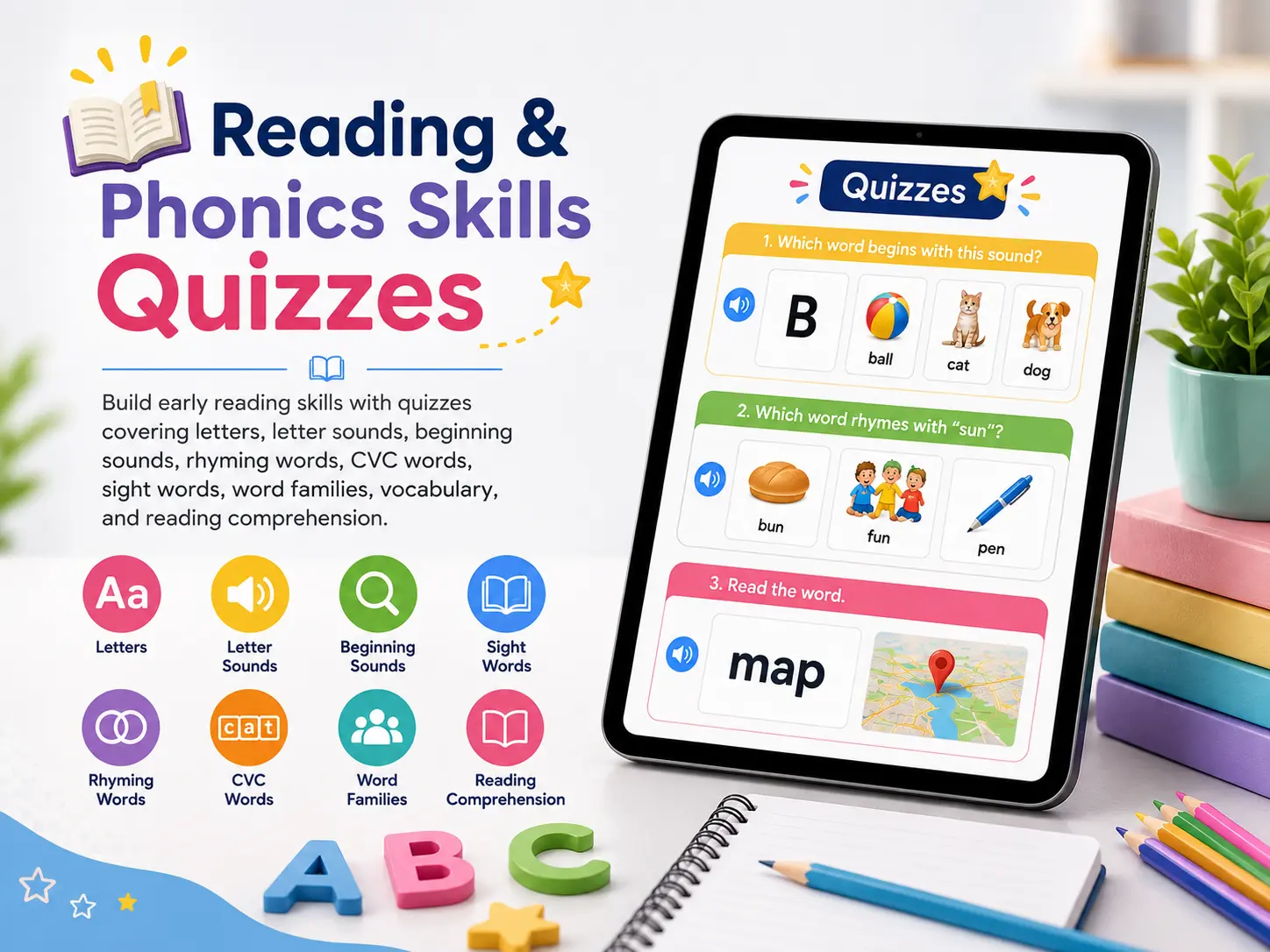
Kindergarten Reading & Phonics Skills
Build early reading skills with quizzes covering letters, letter sounds, beginning sounds, rhyming words, CVC words, sight words, word families, vocabulary, and reading comprehension.
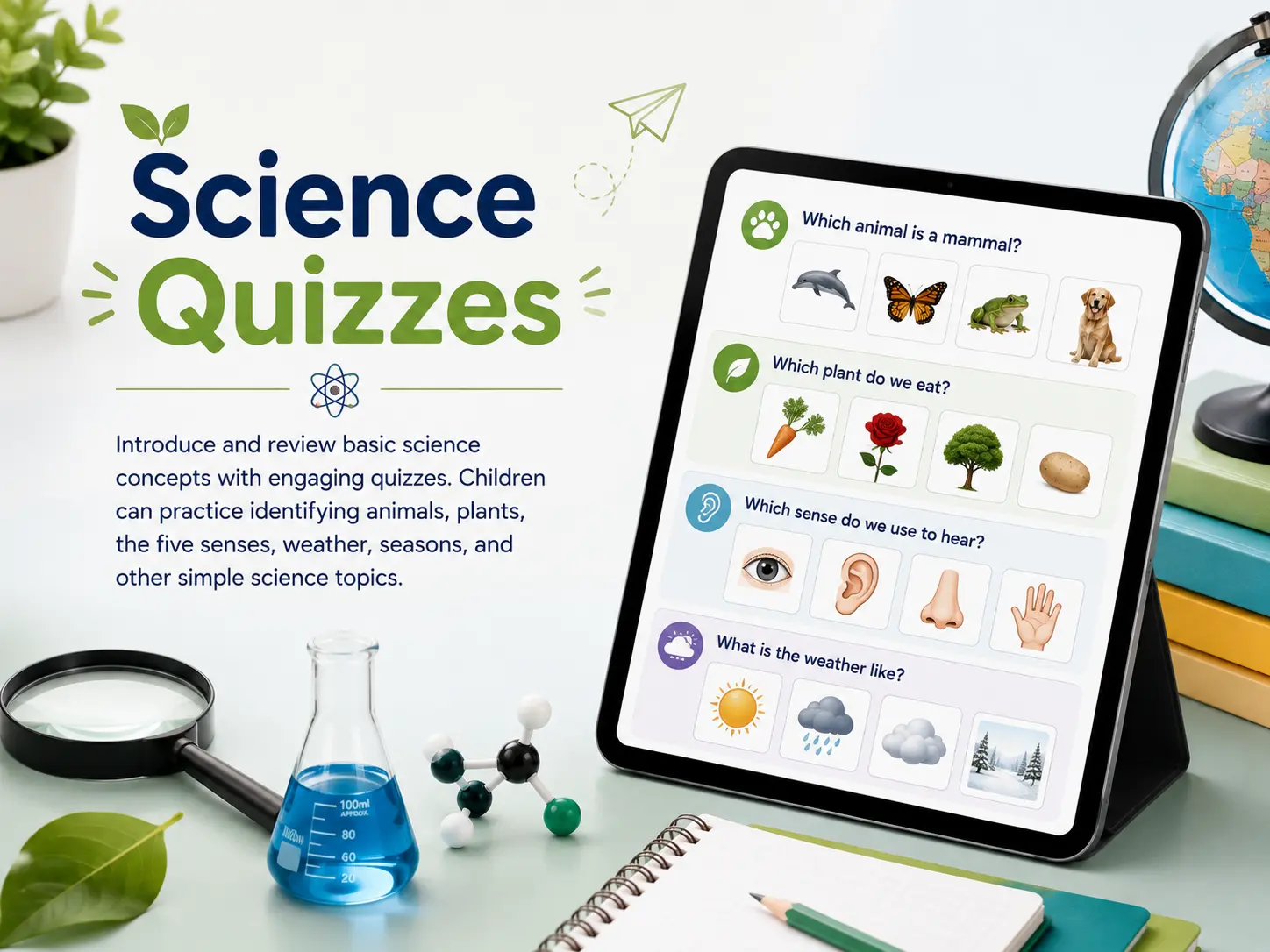
Kindergarten Science Quizzes
Introduce and review basic science concepts with kindergarten science quizzes. Children can practice identifying animals, plants, the five senses, weather, seasons, and other simple science topics through age-appropriate questions.
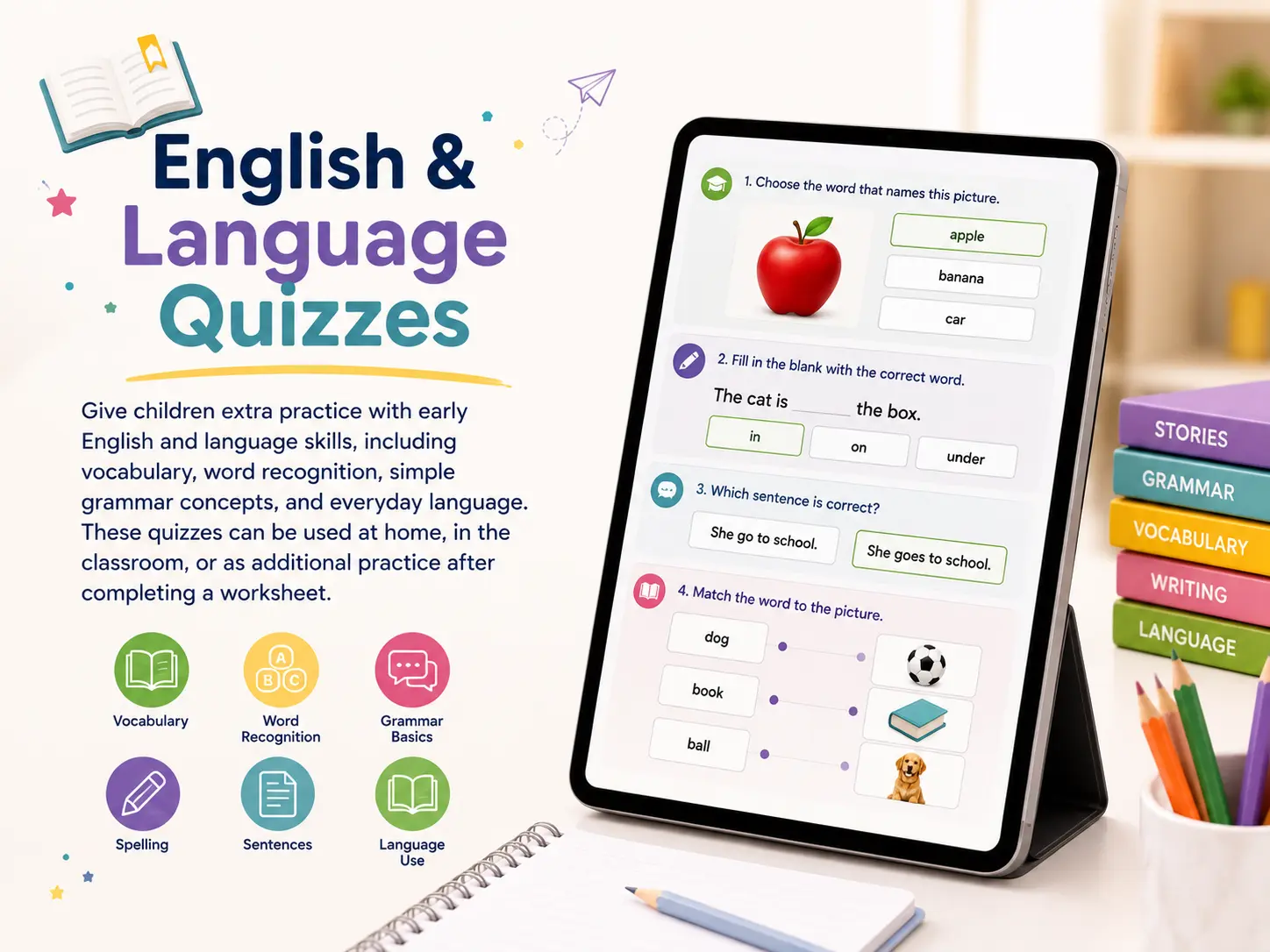
Kindergarten English & Language Quizzes
Give children extra practice with early English and language skills, including vocabulary, word recognition, simple grammar concepts, and everyday language. These quizzes can be used at home, in the classroom, or as additional practice after completing a worksheet.
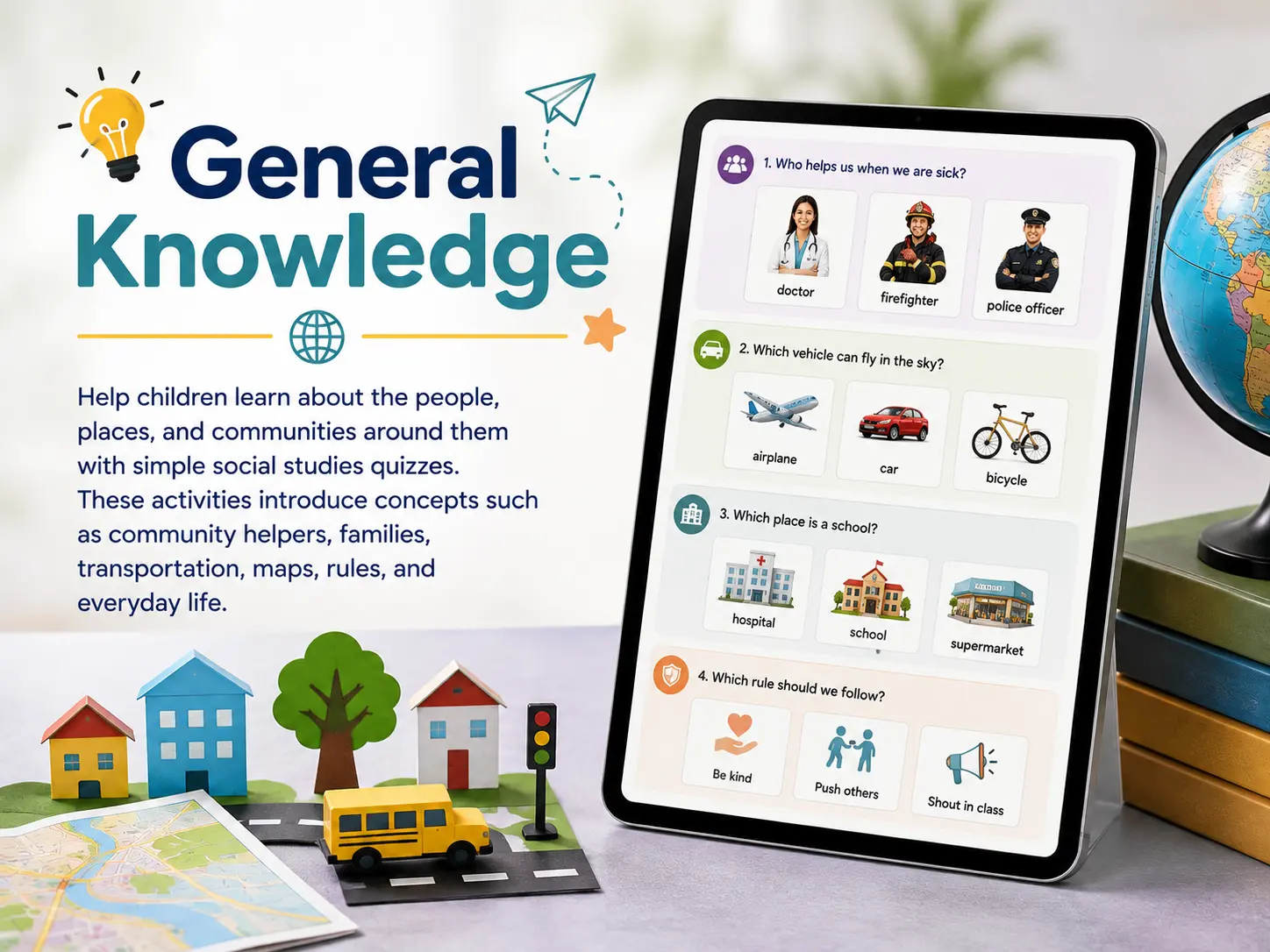
Kindergarten General Knowledge
Help children learn about the people, places, and communities around them with simple kindergarten social studies quizzes. These activities introduce concepts such as community helpers, families, transportation, maps, rules, and everyday life.
What this vocabulary quiz covers
If you typed kindergarten vocabulary quiz online into Google, you want more than a word list — you want vocabulary practice that sticks. This quiz teaches words the way children actually meet them: naming the things in their world, sorting them into groups, flipping them into opposites, and figuring out what new words mean from story clues. Every question is written to be read aloud, so even children who cannot read yet can play along with a grown-up.
The quiz grows with your child. Easy names the world — ball, dog, morning — with clue riddles a parent reads out. Medium sorts it: opposites like hot and cold, categories like animals and tools, and “what do you use to…?” questions. Hard asks children to think with words: riddles, word pairs like bread and butter, and story words like packed, brave and exhausted. For extra word practice alongside this page, try our free sight words tool — recognizing common words in a flash is the other half of early reading.
How the quiz works
Playing takes less than a minute to start, and there is nothing to install or sign up for. Press start, pick Easy, Medium or Hard, and answer each question by tapping a choice. Every answer gets instant feedback, so your child knows right away whether their word thinking was right.
A full run is 60 questions, but nobody has to finish in one sitting. Ten minutes a day on one level beats one long session — short, repeated practice is how new vocabulary words move into long-term memory. When a level feels easy, move up; when it feels hard, stay and replay. Grown-ups: read every question aloud. At this age a vocabulary quiz is a listening quiz first, and your voice is the bridge. Replay favourite rounds any time — this kindergarten vocabulary quiz online is free to use as often as you like.
Skills your child practices
A vocabulary quiz looks simple, but it trains several skills at once. For more practice across subjects, browse our free kindergarten quizzes collection:
- Naming words: ball, doctor, rain — the labels for the world around them.
- Describing words: soft, gigantic, sweet — words that tell what things are like.
- Action words: run, hop, tumbled — the verbs inside every sentence.
- Opposites: hot and cold, whisper and shout — two words learned as a team.
- Categories: animals, tools, foods — sorting the world into groups.
- Reasoning with words: riddles, odd-one-out puzzles and story clues that make kids think.
Work through those six skills and new vocabulary words stop being decorations and start being tools your child can actually use.
Age and grade guide
| Age | Grade | What to expect |
|---|---|---|
| 4–5 | Pre-K | Naming everyday things; grown-up reads every question aloud |
| 5–6 | Kindergarten | Opposites, categories, “what do you use to…?”, simple riddles |
| 6–7 | Grade 1 | Story word meanings, synonyms, two-step riddle reasoning |
Every child is different. If the Easy level feels too simple after a day or two, jump straight to Medium — the step from naming to sorting is where most children start thinking hard. And if Hard feels impossible, that is fine too: the riddles in Level 3 challenge many first graders. Let your child set the pace and replay favourite questions. If your child loves number games too, our missing number quiz for kindergarten makes a great companion to this page.
How to use the quiz at home or in the classroom
At home
Ten minutes a day with a vocabulary quiz works better than one long weekend session. Sit with your child for the first few rounds and read everything aloud — vocabulary questions are listening questions first. When they miss one, do not just give the answer: ask “how did you know?” The thinking matters more than the pick. After the quiz, use one new word all day — brave at the playground, gentle with the cat. Words learned by doing stay forever. You can even turn favourite new words into handwriting practice with our name tracing generator.
In the classroom
Use the quiz as a five-minute circle-time warm-up, a literacy-center station, or a follow-up to a read-aloud: after the story, play the matching level and let children defend their answers. The Easy level suits the start of kindergarten; bring out Medium when you teach sorting and opposites, and Hard for riddle day. Pair it with our sight words practice tool for a full word-work rotation.
Tips to help your child do their best
These five habits make any vocabulary practice more productive:
- Narrate your day. “I am slicing the soft bread with the sharp knife.” Ordinary talk is the best vocabulary lesson ever made.
- Teach opposites as pairs. Hot and cold, whisper and shout — one word always teaches two.
- Ask “how did you know?” Explaining an answer builds deeper word sense than picking it.
- Use one new word all day. Brave, gentle, exhausted — pick one from the Hard level and live it.
- Read aloud every day. Books put rare words in children’s ears; this quiz puts them into play.
Answer key for parents and teachers
Level 1 — Easy (questions 1–10)
- A (Ball) — round, bounces; you can kick it or throw it.
- B (Apple) — the red fruit.
- A (Elephant) — bigger than a mouse.
- C (Dog) — the animal that says “woof woof”.
- B (Bed) — where you sleep at night.
- C (Milk) — what you drink when you are thirsty.
- A (Nose) — the body part you smell flowers with.
- B (Bird) — the one that can fly.
- C (Banana) — the yellow fruit.
- A (Morning) — sun is up, birds are singing.
Level 2 — Medium (questions 11–30)
- B (Hot) — the opposite of cold.
- C (Down) — the opposite of up.
- A (Dark) — lamp off means a dark room.
- B (Dog) — the animal, not the car or the ball.
- C (Apple) — the fruit in Lily’s lunch.
- A (Scissors) — what you use to cut paper.
- B (Crayon) — what you use to draw a picture.
- C (Run) — moving your legs very fast.
- A (Hop) — how frogs move.
- B (Hammer) — the tool that helps you fix things.
- C (Quack) — what a duck says.
- A (Nest) — where a bird keeps its eggs safe.
- B (Puppy) — what you call a baby dog.
- C (Teacher) — the person who teaches you at school.
- A (Whale) — the biggest of the three.
- B (Carrot) — the vegetable, not the fruit or the cookie.
- C (Shoes) — what you wear on your feet outside.
- A (Close) — the opposite of open.
- B (How it feels) — “soft” tells you how the blanket feels.
- C (Apple) — the sensible thing for a hungry tummy.
Level 3 — Hard (questions 31–60)
- A (Bread and butter) — two words that go together.
- B (Nail) — what goes with a hammer.
- C (How it tastes) — “sweet” tells you how the cake tastes.
- A (How it feels) — “hard” tells you how the rock feels.
- B (Put things into) — what “packed” means.
- C (Not afraid) — what “brave” means.
- A (Soft and careful) — what “gentle” means.
- B (A shout) — the opposite of a whisper.
- C (Tiny) — the opposite of gigantic.
- A (Car) — the one that is not a fruit.
- B (Blue) — the describing word among action words.
- C (Pizza) — the one that is not a hospital helper.
- A (Frozen) — the opposite of melted.
- B (Clock) — hands and a face, but it cannot clap or smile.
- C (Banana) — yellow, curved, and you peel it.
- A (Owl) — wings and “hoot” footprints in the snow.
- B (Duck) — swims, says quack, has soft feathers.
- C (Happy) — a describing word, not a naming or doing word.
- A (Jump) — the word that tells you something you can do.
- B (Fell down) — what “tumbled” means.
- C (Day and night) — true opposites.
- A (Breakfast) — the word that tells about morning time.
- B (Surprised) — how Ben feels with eyes wide at his gift.
- C (Rain) — water that falls from the clouds.
- A (Very tired) — what “exhausted” means.
- B (Glad) — means almost the same as happy.
- C (Huge) — means almost the same as big.
- A (Shoes go on feet, not hands) — the silly part of the story.
- B (Breakfast) — the meal you eat in the morning.
- C (Because it was going to rain) — dark clouds and thunder mean grab the umbrella.
What to practice next
Vocabulary is one piece of kindergarten language. Once naming, opposites and categories feel solid, the natural next step is sight words — the common words children must recognize in a flash to start reading. Practice them with our free sight words tool. Then keep learning balanced: our missing number quiz for kindergarten exercises ordering and thinking muscles, and our name tracing generator turns favourite new words into handwriting practice.
Mix word days and number days through the week — our free kindergarten quizzes collection covers both. This kindergarten vocabulary quiz online stays free, so come back whenever new words need practice.
Frequently asked questions
What is kindergarten vocabulary?
Kindergarten vocabulary is the set of words a 5- or 6-year-old understands and uses: naming words like ball and doctor, describing words like soft and gigantic, and action words like run and tumbled. Children build it fastest through talking, being read to, and playing with words — not by memorizing lists.
How many words should a kindergartener know?
There is no official number of words a kindergartener should know, and every child grows at a different pace. What matters more than a count is range: can your child name everyday things, use opposites like hot and cold, and describe how something feels, tastes or looks? If those pieces are growing, their vocabulary is growing.
How can I build my child’s vocabulary at home?
Talk about what you are doing as you do it — I am slicing the soft bread with the sharp knife. Read aloud every day and pause to wonder about new words together. Play opposite games, sorting games and riddle games — the same kinds of questions in this quiz. Short daily word play beats occasional long sessions.
Why does this quiz ask about opposites?
Opposites teach two words for the price of one: hot teaches cold, up teaches down, whisper teaches shout. They also train comparing, which is early thinking practice. And children love opposite games, so the learning feels like play.
My child speaks another language at home. Will this quiz help?
Yes. The questions are about meaning, not spelling, so a grown-up can read them aloud in whatever language mix works for your family. Act out the action words, point at the naming words, and let your child answer in whichever language comes first — the word knowledge transfers.
How many questions are in the quiz?
There are 60 questions in three levels: Easy has 10, Medium has 20 and Hard has 30. A child can play one level at a time, and each level practices words in a different way so it never feels like the same drill.
Does the quiz save my child’s answers?
No. The quiz never asks for a name, email, age or any personal detail. It does not use cookies or tracking, it stores nothing, and nothing is sent anywhere. Everything happens in the browser and disappears when the page is closed.
How can teachers use this vocabulary quiz in the classroom?
It works as a five-minute circle-time warm-up, a literacy-center station, or a follow-up to a read-aloud. Use Easy for naming practice, Medium for opposites and sorting, and Hard for riddles and story words. The questions double as discussion starters — after each answer, ask your class how they figured it out.
What should my child practice after this vocabulary quiz?
After vocabulary, the natural next step is sight words — the common words children must recognize in a flash to start reading. Our free sight words tool is linked in the What to practice next section below, and it pairs perfectly with this quiz.
Is the quiz free?
Yes. The full 60-question quiz is free, with no signup and no account needed. Just press start and play.
Made for parents and teachers by Book and Pencil. Last updated October 2026.