
A landmark Australian report has found that one in ten childcare centres provide no food to the children in their care — and that food provision is not required by national law, nor monitored in the country’s quality assessments of early learning services.
The report, titled “Food where it matters most”, is the first national mapping of food provision in full-day childcare services for children from birth to age six. Produced by researchers from the University of Queensland with the non-profit Social Ventures Australia, it was launched at the 2nd National Early Childhood Education Summit in Sydney on 11 November 2026. Its message is blunt: hungry children cannot learn.
What the report found
The headline figure is stark. One in ten Australian childcare centres provide no food at all. Families using those services must send food from home, or children go without a meal during the day.
The gaps are worst where help is hardest to reach. In small rural towns, only 58 per cent of services provided food. Tasmania had the lowest rate in the country: 66 per cent of full-day childcare centres there provided food, compared with 87 to 94 per cent in other states and territories.
Even where food was provided, families and educators report it is not always enough — and the study did not measure nutritional quality, which remains an open question. The barriers were practical: cost, limited space and a lack of staff training.
Lead researcher Professor Karen Thorpe of the University of Queensland said the findings exposed a significant gap in Australia’s early childhood system. “Food provision is not required by national law, nor monitored in the quality assessment of child care services,” she said.
Why food matters for learning
The report’s argument is not really about lunch, but about what happens in a child’s brain when lunch is missing. Around 90 per cent of brain growth happens in the first five years of life, and attendance at childcare coincides with that critical window. Hunger and poor nutrition at this age can have lasting effects on health, behaviour and learning.
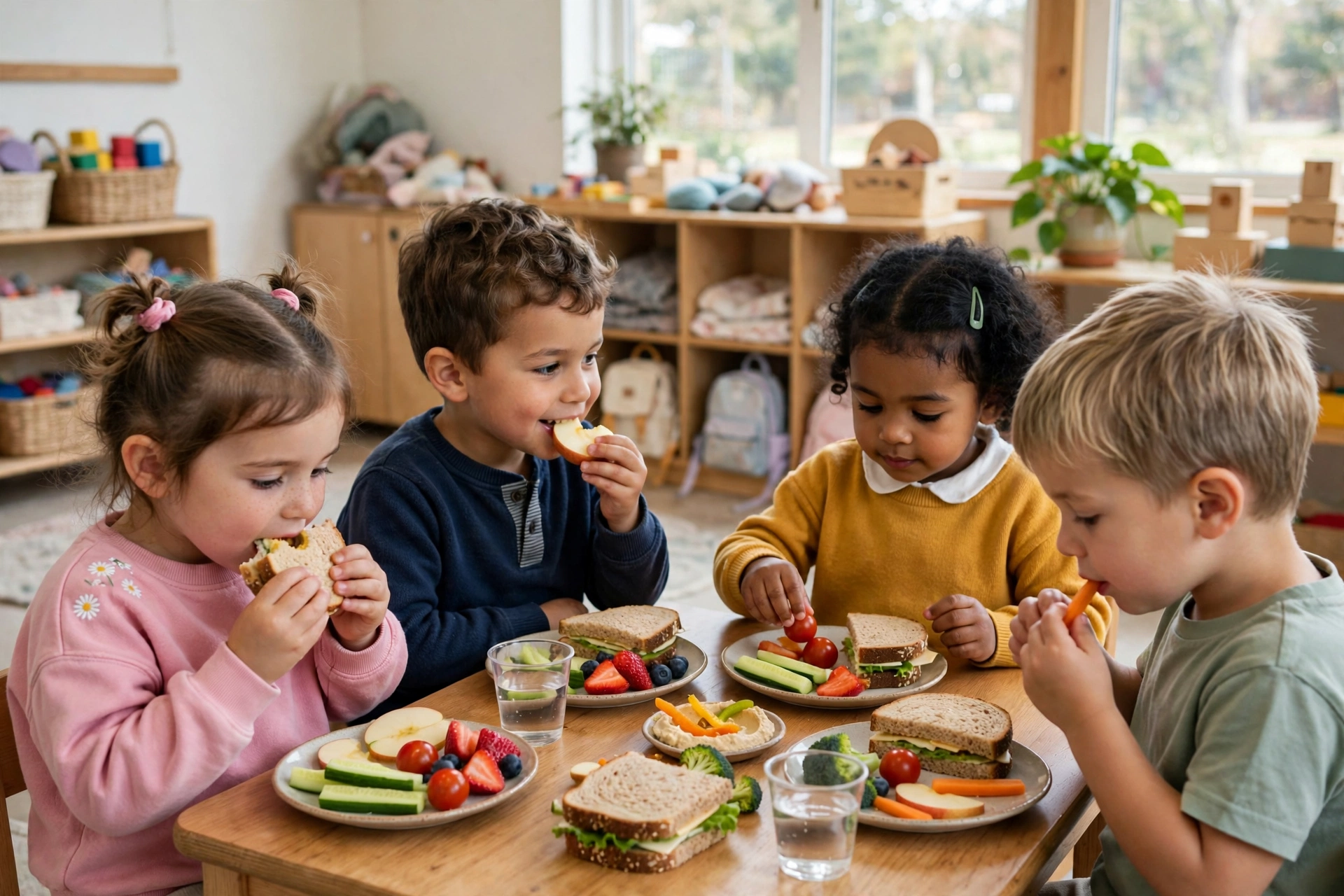
“Hungry children cannot regulate their behavior or learn,” Professor Thorpe said. The report recommends that governments recognise access to adequate, nutritious and culturally appropriate food as a fundamental condition for children’s learning, development and wellbeing.
Behind the childcare figures sits a wider problem. Between 16 and 43 per cent of Australian households with children experience food insecurity, with the highest rates among low-income and single-parent families, according to Dr Bonnie Searle of the Queensland Brain Institute. More than one in six Australian children live in poverty.
What the report recommends
The report makes three main calls on governments. First, access to nutritionally adequate food should be written into national quality standards, so food provision is no longer optional and no longer invisible to quality assessors.
Second, the government should establish a targeted Food Provision in ECEC program, initially focused on 50 communities where children are at greatest risk of food insecurity, to test what good provision takes across different settings.
Third, the report calls for an early childhood education and care commission with a mandate to recognise food as essential educational infrastructure and a core component of quality childcare.
Emma Sydenham of Social Ventures Australia said the findings pointed to an opportunity for governments to act now. “Ensuring children can access nutritious food in early learning is a practical step governments can take now to give more children the foundations for a good life,” she said.
Why it matters
The report lands as Australia’s early childhood sector is already under the microscope: days earlier, education ministers agreed the next steps in a national safety overhaul, including $11.5 million in CCTV grants for not-for-profit services.
Food now joins safety and quality as a third front in that reform conversation — and it may be the one that touches children’s daily lives most directly. A camera watches a room; a meal fuels a brain. The report’s framing is deliberate: food is not a catering question, it is educational infrastructure, as fundamental as trained educators and safe premises.
It also exposes a quiet inequity: the children most likely to arrive hungry are in the communities where services are least likely to provide food. The system is thinnest exactly where the need is greatest.
What this means for parents and teachers
For parents, the report is a reminder to ask a question that rarely makes the enrolment checklist: what food does this service actually provide? Ask whether meals and snacks are included, what they typically consist of, and how the service handles children who arrive without food.
For teachers, the report underlines a classroom truth: behaviour and learning in the morning often track what a child has eaten, or has not eaten. The call for staff training recognises that educators are being asked to spot hunger and manage it sensitively, without formal guidance or funding.
And the learning itself can continue at home, whatever is on the lunch menu. Our free kindergarten quizzes turn practice into a game, our sight words generator builds personalised reading practice, and our name tracing generator creates a printable workbook with your child’s own name. For classroom-ready printables, the Superstar Worksheets collection covers maths, English and more.

What happens next
Three things to watch: whether the government funds the targeted program in 50 high-risk communities; whether food provision enters the national quality standards; and whether the proposed early childhood commission gets a mandate over food as educational infrastructure.
For families, the message is simpler: food is learning. A system that feeds children well is a system that teaches them well — and this report has put the numbers on the table for the first time.
Frequently asked questions
How many Australian childcare centres provide no food?
One in ten, according to “Food where it matters most”, the first national mapping of food provision in full-day childcare.
Which areas have the worst food provision in childcare?
Small rural towns, where only 58 per cent of services provided food, and Tasmania, where 66 per cent of full-day centres provided food, compared with 87 to 94 per cent elsewhere.
Is food provision required by law in Australian childcare?
No. Food provision is not required by national law, and it is not monitored in the quality assessment of childcare services — one of the gaps the report calls on governments to close.
Why does food matter so much in early childhood?
Around 90 per cent of brain growth happens in the first five years of life. Hunger and poor nutrition at this age can affect behaviour, learning and development, with effects that can last into later life.
What is the report asking the government to do?
It recommends writing access to nutritionally adequate food into national quality standards, establishing a targeted food program in 50 communities at greatest risk of food insecurity, and creating an early childhood commission with a mandate to treat food as essential educational infrastructure.
How common is food insecurity among Australian families with children?
Between 16 and 43 per cent of households with children experience food insecurity, highest among low-income and single-parent families. More than one in six Australian children live in poverty.
Source: Medical Xpress, “Feed the children: Food provision in early child care falls short” (11 November 2026), reporting on “Food where it matters most” by the University of Queensland and Social Ventures Australia.