Free Cursive Letter C Worksheet — Printable PDF Practice Sheets
Learn how to write cursive letter C with our free printable cursive letter C worksheets. This set of five practice sheets covers uppercase and lowercase letter C tracing, grid-based letter practice, combined uppercase and lowercase recognition, and a full cursive passage built around the letter C. Every worksheet is a free PDF download that opens instantly in your browser. No account needed and no membership required.
Cursive letter C is one of the most naturally flowing letters in the entire alphabet because both its uppercase and lowercase forms share the same open curved stroke that defines the letter. Whether you are just beginning your cursive journey in Grade 1 or returning to handwriting practice as an adult, these five worksheets give you everything needed to develop clean and confident cursive C from first tracing through independent writing.
Letter Tracing and Word Practice
Uppercase Grid Practice
Lowercase Grid Practice
Upper and Lowercase
Passage Writing Practice
What These Cursive Letter C Worksheets Include
This collection of five worksheets takes learners through every stage of writing cursive C, from first guided tracing through to writing the letter fluently within connected passage sentences.
Worksheet 1 — Letter Tracing and Word Practice
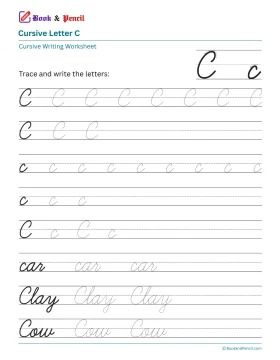
Trace the uppercase cursive C and lowercase cursive c across full rows using dotted letter guides. A combined row alternates between uppercase C and lowercase c to build natural recognition of both forms together. Three real words are included for word-level tracing practice: car, Clay, and Cow.
Worksheet 2 — Uppercase Grid Practice
A grid-format sheet with individual boxes for tracing the uppercase cursive C. Three rows of traced uppercase letters are followed by four rows of blank grid boxes for independent writing practice without any tracing guide.
Worksheet 3 — Lowercase Grid Practice
A grid-format sheet focused entirely on the lowercase cursive c. Three rows of dotted lowercase letter tracing followed by four rows of blank independent practice boxes.
Worksheet 4 — Uppercase and Lowercase Practice
A grid-format sheet that alternates between uppercase C and lowercase c in each box. Three rows of traced alternating letters followed by four rows of blank grid boxes build the learner’s ability to switch between both forms naturally in a single writing session.
Worksheet 5 — Passage Writing Practice
A short cursive passage packed with the letter C for tracing and independent rewriting: “Clara cut a cake for her cat. Carl came to carry the cups and cookies. The cold cream cone was fresh.” This passage places the letter C naturally in both uppercase and lowercase positions across connected sentences, building stroke fluency and reading recognition of cursive C in real written text.
How to Write Cursive Letter C
Cursive lowercase c is formed with a single open curved stroke. The stroke begins just below the midline, swings upward and to the left in a smooth arc that curves around to the left and downward, then continues along the bottom and finishes with a short upward flick at the right side.
Cursive uppercase C follows the same fundamental arc as lowercase c but is scaled up to span the full height from baseline to headline. The stroke begins near the top of the headline zone, curves broadly to the left and downward in a wide smooth arc, sweeps along the baseline, and finishes with a short upward curl at the right.
The scale of the curve is the primary difference between uppercase and lowercase C. Uppercase C requires the learner to maintain the smooth arc across a much larger distance, which demands more deliberate wrist and arm movement than the compact lowercase version.
Tips for Better Cursive Writing Practice
Keep the opening of cursive c consistent. The open gap on the right side of lowercase c is one of the most frequently inconsistent elements when learners are first practicing this letter. Some sessions the gap is too wide, making the letter look incomplete. Other sessions it closes too much, making c look like o. Aiming for a gap roughly the width of the letter stroke itself produces the most readable and proportionate result.
Use a smooth continuous arc with no corners or flat sections. Cursive c is entirely curved with no straight sections, angles, or stopping points. A common issue is allowing the curve to flatten slightly at the top or bottom of the stroke, which gives the letter a slightly squared appearance. Practicing the stroke as one uninterrupted flowing motion produces a cleaner result than trying to control each part of the arc separately.
Notice how the C entry stroke appears in words like car and cow. The opening arc of lowercase cursive c is the same motion used to begin several other letters. In words like car and cow on Worksheet 1, the c connects into the following letter immediately after the opening arc. Paying attention to how this connection works during word tracing practice gives learners early experience with one of the most commonly occurring entry strokes in the entire cursive alphabet.
Scale uppercase C carefully from the headline to the baseline. Uppercase cursive C must span the full height of the writing zone without losing the smooth arc quality of the stroke. A common problem is that the curve becomes angular or compressed at the baseline when learners are trying to control the larger stroke. Practicing the uppercase arc in slow deliberate movements before attempting full-speed writing helps maintain the curve quality at both the top and bottom of the letter.
Frequently Asked Questions (FAQs)
How do you write lowercase cursive c?
Lowercase cursive c begins just below the midline with a smooth arc that curves upward and to the left, sweeps around and downward, continues along the baseline, and finishes with a short upward flick at the right side.
How is cursive uppercase C different from cursive lowercase c?
Both uppercase and lowercase cursive C share the same open arc shape, but uppercase C spans the full height from baseline to headline while lowercase c fits entirely within the midline zone.
Does cursive lowercase c connect to the next letter?
Cursive lowercase c is one of the letters that does not connect directly to the letter that follows it through a standard exit stroke. The open ending of the c stroke means the pen lifts briefly before beginning the next letter.