Free Cursive Letter I Worksheet — Printable PDF Practice Sheets
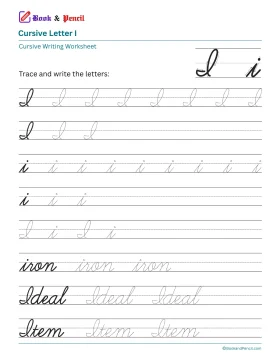
Learning to write the letter I helps children build control over straight vertical strokes, consistent letter height, and careful pencil placement. This Tracing Letter I Worksheet gives preschool, pre-K, and kindergarten learners structured practice with both uppercase I and lowercase i while strengthening handwriting habits, fine motor skills, and early reading readiness. The tracing lines, guided examples, and writing exercises encourage children to develop smooth, controlled movements before writing independently.
Letter Tracing and Word Practice
Uppercase Grid Practice
Lowercase Grid Practice
Upper and Lowercase
Passage Writing Practice
Build Strong Vertical Strokes with Uppercase I and Lowercase i
The letter I introduces an important handwriting skill: writing clean, straight vertical lines with steady pencil control. While many letters rely on curves or diagonal movements, uppercase I focuses on maintaining a consistent top-to-bottom stroke and correct letter height. Lowercase i adds an extra level of precision by requiring children to place a small dot directly above the stem after completing the letter.
During preschool handwriting practice, encourage children to finish the vertical stroke first before lifting the pencil to add the dot. This sequence helps develop good writing habits and improves accuracy as children begin writing more complex letters.
Why the Worksheet Separates Uppercase and Lowercase Practice
Instead of introducing every skill at once, the worksheet divides practice into dedicated sections.
The uppercase practice page allows children to focus only on controlling tall vertical strokes without switching between letter sizes. This helps establish consistent height across the writing line.
The lowercase practice page introduces a different challenge. After forming the stem, children must stop, lift the pencil, and place the dot directly above it. This extra step develops visual accuracy and hand-eye coordination that are difficult to practice when multiple letters are introduced together.
Once both forms become familiar, the combined uppercase and lowercase letters worksheet asks learners to alternate between I and i. Changing between tall and short letters improves letter-size awareness and helps children recognize the differences between the two forms while maintaining smooth handwriting.
Building Vertical Stroke Control Before Connected Writing
Unlike rounded letters such as O or looping letters such as G, the cursive letter I emphasizes straight-line consistency.
Repeated tracing helps children practice:
- controlled top-to-bottom pencil movement
- steady vertical alignment
- consistent letter height
- smooth wrist movement
- balanced spacing between letters
Because the worksheet gradually replaces dotted models with blank practice rows, children transition from guided tracing to independent handwriting instead of relying on visual copying alone. This gradual reduction of support helps strengthen muscle memory and writing confidence.
Common Difficulties Children Experience With Letter I
The practice sequence has been designed to address mistakes that frequently appear during early handwriting instruction.
Children often:
- tilt the vertical stroke instead of writing straight downward
- forget to add the lowercase dot after finishing the stem
- place the dot too close, too high, or too far from the letter
- make uppercase I and lowercase i nearly the same height
- lose consistent spacing while alternating between uppercase and lowercase practice
Encouraging slow, deliberate writing usually produces better results than asking children to write quickly. Accuracy should be established before speed.
From Individual Letters to Complete Cursive Words
Once children become comfortable writing single letters, the worksheet introduces connected cursive words including iron, ideal, and item.
These words have been selected because each begins with the target letter, allowing children to repeat the same opening stroke before connecting naturally into the remaining letters.
Instead of restarting after every character, learners practice maintaining continuous pencil movement throughout an entire word. This strengthens:
- letter connections
- spacing consistency
- rhythm in cursive writing
- visual alignment across the baseline
Writing complete words also prepares children for longer handwriting tasks later in the curriculum.
Why the Cursive Passage Comes Last
The final handwriting activity asks children to trace and rewrite a short passage containing several I words, including Ian, invited, inside, ice cream, itchy, insect, and iron.
This passage is more than a copying exercise.
It encourages learners to maintain consistent vertical strokes over multiple connected words while practicing correct spacing, letter height, and sentence flow. Repeated exposure to the target letter in meaningful text also reinforces reading fluency alongside handwriting development.
By progressing from letters to words and finally to complete sentences, children practice handwriting in the same sequence they encounter during everyday classroom writing.
Strengthening Pencil Control Through Letter I Practice
The letter I requires careful control rather than complex movement.
Each section of this letter tracing worksheet helps children improve:
- fine motor coordination
- finger and wrist stability
- visual tracking
- pressure control
- consistent writing size
- attention to small finishing details such as dot placement
These foundational skills transfer naturally to other cursive letters that rely on accurate vertical strokes and careful alignment.
Reinforce Letter I Sounds During Handwriting
This letter I tracing printable also supports early phonics.
As children trace each row, encourage them to say the letter name and identify words that begin with I.
Examples include:
- igloo
- insect
- ink
- ice cream
- iguana
Parents and teachers can also discuss both the short /i/ sound found in insect and the long /ī/ sound heard in words such as ice. Combining handwriting with sound recognition strengthens alphabet knowledge and early reading skills.
Letter I Learning Activities
Igloo Picture Match
Show several pictures and ask children to identify which ones begin with the letter I. Trace the letter before naming each object aloud.
Insect Sorting
Provide picture cards of insects and non-insects. Children sort the cards while saying the beginning /i/ sound whenever appropriate.
Ice Cream Letter Hunt
Hide uppercase I and lowercase i cards around the room. Each time a child finds one, they write the matching letter on a handwriting line before searching for another.
Indoor I Word Challenge
Ask children to find or name objects beginning with I, such as ink or ice, then practice writing the words after completing the tracing worksheet.
Frequently Asked Questions (FAQs)
How do children write an uppercase I correctly?
Uppercase I is formed with one controlled vertical stroke from top to bottom. Encourage children to keep the line straight and maintain a consistent height while tracing. Practicing the uppercase form first helps build pencil control before moving to the lowercase letter.
What is the correct way to write a lowercase i?
Start by drawing a short vertical stroke from top to bottom. After completing the stroke, lift the pencil and place a small dot directly above the center of the stem. Keeping the dot properly aligned helps children recognize and write lowercase i correctly.
Why is the dot important when writing lowercase i?
The dot is a key part of lowercase i. Without it, the letter is incomplete and may be confused with other handwriting marks. Learning to place the dot after finishing the vertical stroke also strengthens attention to detail and pencil control.
How does this Tracing Letter I Worksheet help improve handwriting?
Young learners often tilt the vertical stroke, forget the lowercase dot, place the dot too high or too low, or make uppercase I and lowercase i the same height. Regular tracing practice helps improve letter size, spacing, and alignment.
How does this Tracing Letter I Worksheet help improve handwriting?
This Tracing Letter I Worksheet provides guided practice with both uppercase I and lowercase i, helping children develop straight-line control, accurate dot placement, consistent letter height, and better fine motor skills.