
Kindergarten Comparing Numbers Quiz – Greater, Less & Equal
Learning to compare numbers helps children understand how numbers relate to one another. This Kindergarten Comparing Numbers Quiz gives children interactive practice with identifying numbers that are greater than, less than, or equal to another number.
Instead of simply recognizing individual numbers, children have to look at two or more numbers and decide how they are related. The questions gradually introduce different comparison situations so learners can develop stronger number sense and become more confident with early kindergarten math.
This free quiz can be used at home, in the classroom, during homeschool lessons, or as extra practice after completing a kindergarten math worksheet.
Ready to Practice Comparing Numbers? Enter your name and start the quiz!
Math: Kindergarten Comparing Numbers
Great Work!
You completed the quiz!
Explore More Free Kindergarten Quizzes by Subject
Choose a subject below to find free kindergarten quizzes and practice activities. Each section focuses on age-appropriate skills commonly introduced during kindergarten.
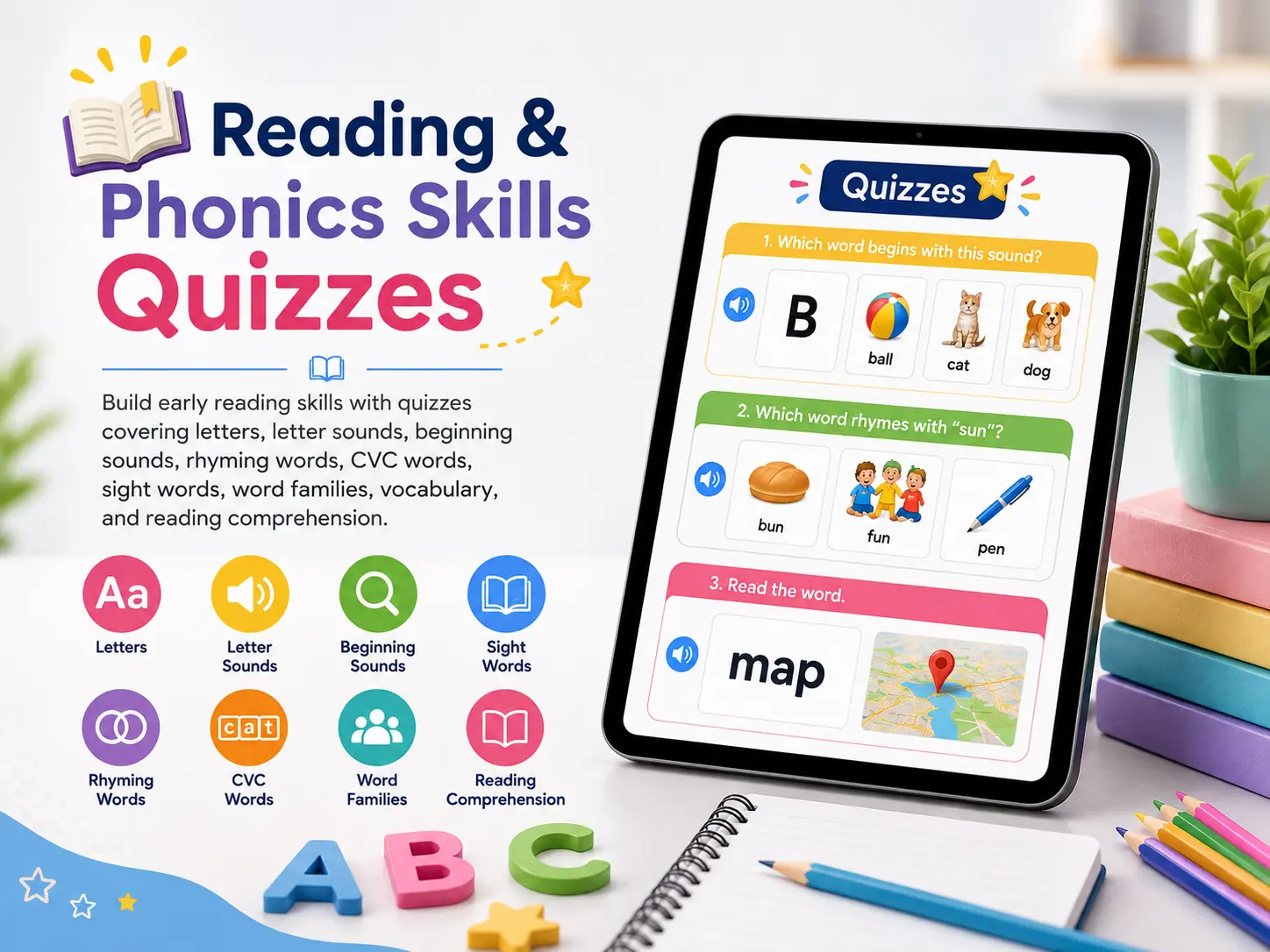
Kindergarten Reading & Phonics Skills
Build early reading skills with quizzes covering letters, letter sounds, beginning sounds, rhyming words, CVC words, sight words, word families, vocabulary, and reading comprehension.
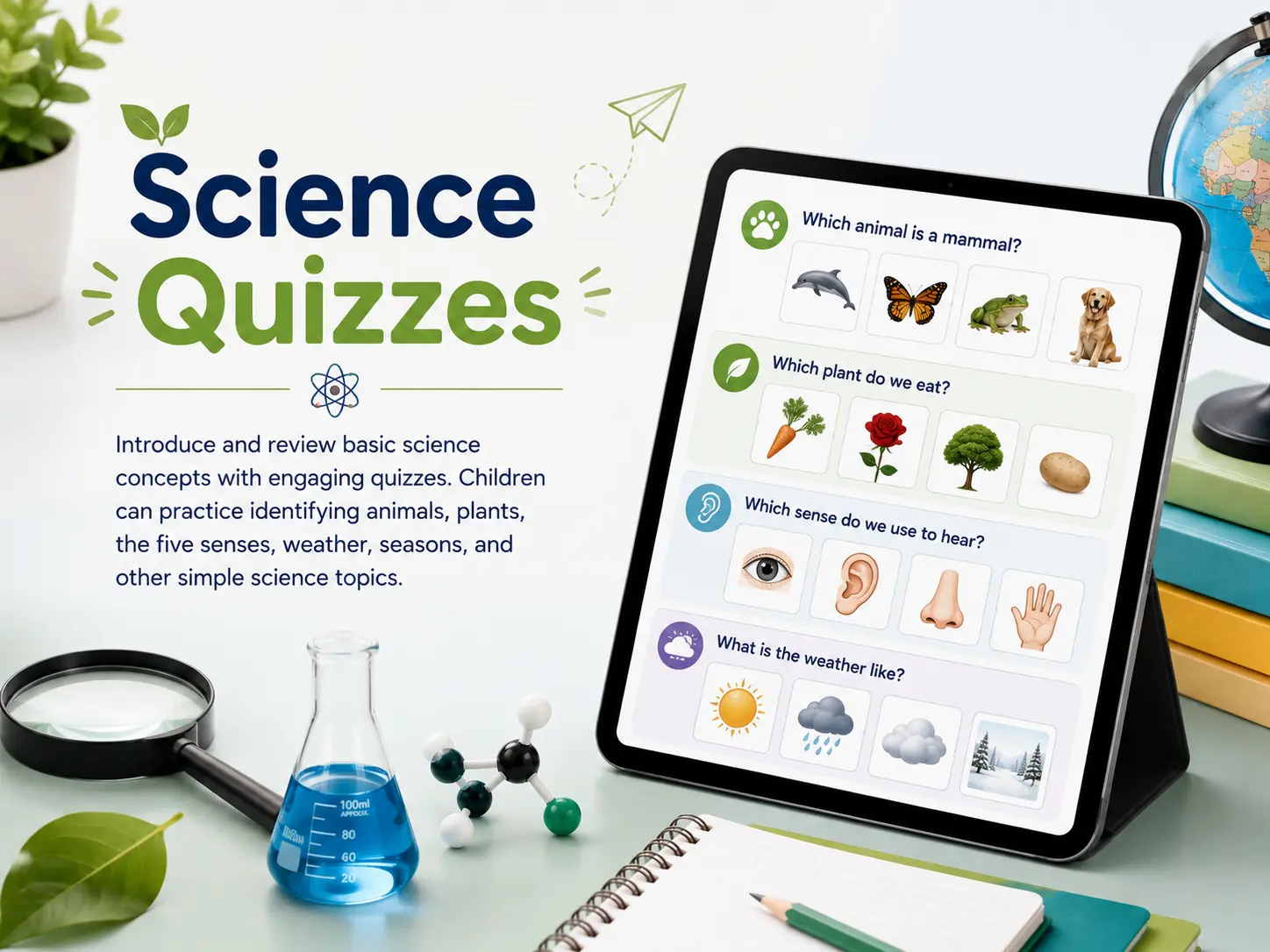
Kindergarten Science Quizzes
Introduce and review basic science concepts with kindergarten science quizzes. Children can practice identifying animals, plants, the five senses, weather, seasons, and other simple science topics through age-appropriate questions.
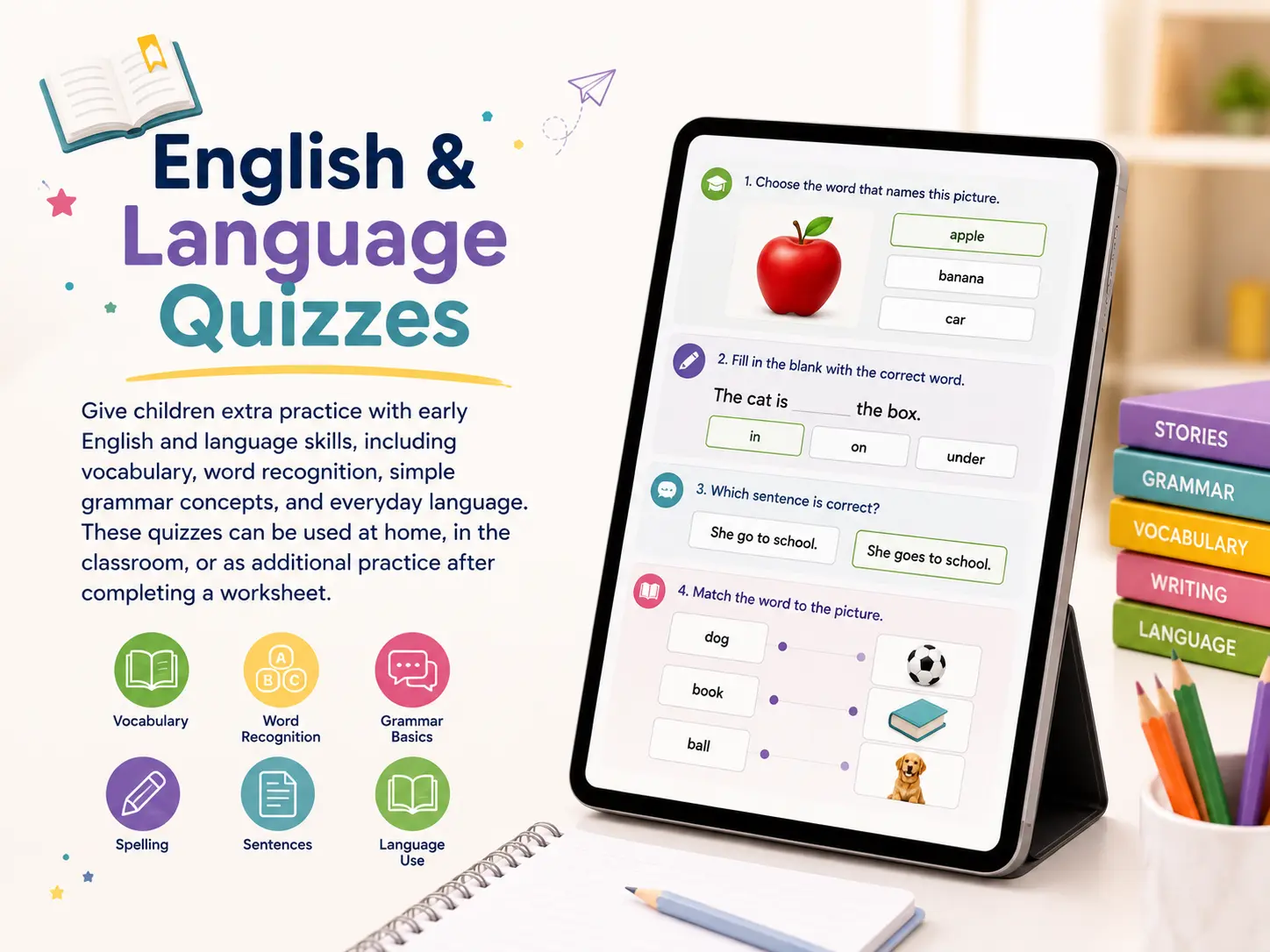
Kindergarten English & Language Quizzes
Give children extra practice with early English and language skills, including vocabulary, word recognition, simple grammar concepts, and everyday language. These quizzes can be used at home, in the classroom, or as additional practice after completing a worksheet.
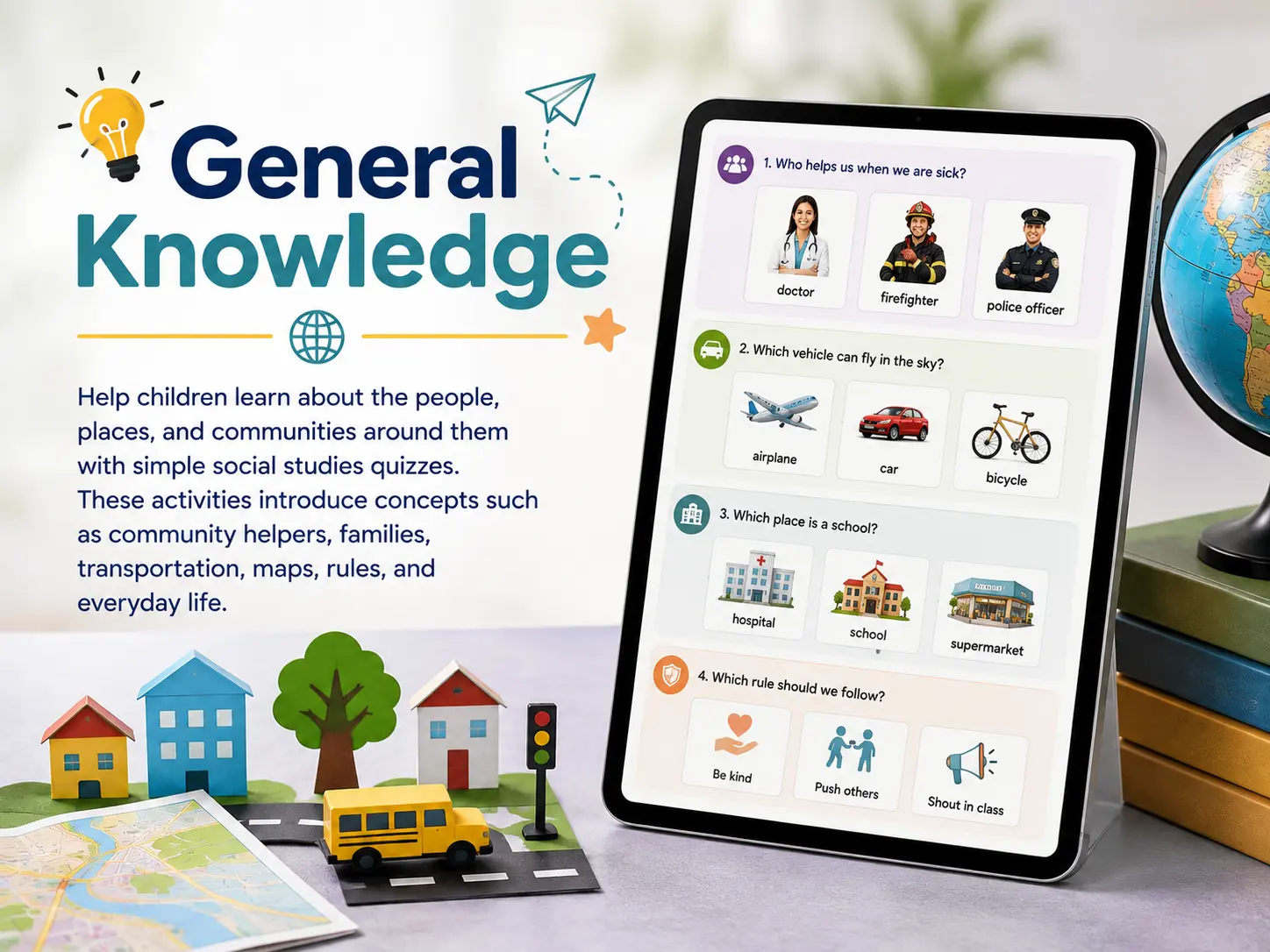
Kindergarten General Knowledge
Help children learn about the people, places, and communities around them with simple kindergarten social studies quizzes. These activities introduce concepts such as community helpers, families, transportation, maps, rules, and everyday life.
What Does This Kindergarten Comparing Numbers Quiz Practice?
Comparing numbers is an important early math skill because it helps children understand that numbers have different values and positions in a number sequence.
This quiz gives children practice with:
- Identifying the greater number
- Identifying the smaller number
- Recognizing when two numbers are equal
- Comparing numbers using greater than (>)
- Comparing numbers using less than (<)
- Comparing numbers using equal to (=)
- Looking at numbers and deciding which has greater value
- Comparing numbers in different positions
- Using number sequences to make comparisons
- Developing early number sense
The questions are designed to move beyond simple number recognition. Children are encouraged to look at the relationship between numbers and choose the comparison that makes sense.
Understanding Greater Than, Less Than, and Equal To
When children compare numbers, they are learning three important relationships.
Greater Than
A number is greater than another number when it has a larger value.
For example:
8 > 5
Eight is greater than five.
Less Than
A number is less than another number when it has a smaller value.
For example:
3 < 7
Three is less than seven.
Equal To
Two numbers are equal when they have the same value.
For example:
6 = 6
Both numbers represent the same amount.
Learning these three relationships gives children a foundation for later math skills such as ordering numbers, addition, subtraction, and place value.
How Children Can Compare Numbers
Young learners can use several strategies when deciding which number is greater or smaller.
1. Look at the Number Sequence
Children can think about where each number appears when counting.
For example:
4, 5, 6, 7, 8
Since 8 comes later than 4, 8 is greater than 4.
2. Count the Objects
When numbers are represented by objects, children can count each group and compare the amounts.
For example:
● ● ● ● ●
and
● ● ●
The first group has more objects, so its number is greater.
3. Think About What Comes First
When two numbers are close together, children can use their knowledge of counting to determine which one is smaller or larger.
For example:
12 comes before 15, so 12 is less than 15.
4. Look for Equal Numbers
If both numbers are exactly the same, they are equal.
9 = 9
This helps children understand that equal numbers represent the same quantity.
How to Use the Kindergarten Numbers 50–100 Quiz
This interactive quiz can be used in several learning situations.
For Parents
Use the quiz after your child has practiced counting and recognizing numbers through 100. If your child has difficulty with a question, pause and talk through the number sequence rather than focusing only on the final score.
A number chart from 1–100 can also be helpful when reviewing questions about missing, before, and after numbers.
For Teachers
Teachers can use the quiz as a short classroom activity, review exercise, or informal check of number understanding.
It can be especially useful after lessons involving counting, number sequences, or tens and ones.
For Homeschoolers
Add the quiz to a kindergarten math routine alongside number tracing, counting activities, place-value practice, and printable math worksheets.
The different difficulty levels allow children to continue practicing as their confidence develops.
QUIZ LEVELS
Kindergarten Comparing Numbers Quiz Levels
The quiz uses three difficulty levels so children can gradually develop their comparison skills.
Easy Level
The Easy level introduces straightforward number comparisons using familiar numbers.
Children may practice:
- Identifying which of two numbers is greater
- Identifying which number is smaller
- Recognizing equal numbers
- Comparing numbers in simple pairs
- Using basic number-order knowledge
These questions help children become comfortable with the idea that numbers can be compared.
Moderate Level
The Moderate level introduces more varied comparison situations.
Children may encounter:
- Numbers that are closer together
- Greater-than and less-than relationships
- Missing comparison symbols
- Equal-number questions
- Comparing numbers in different arrangements
- Simple number sequences
This level encourages children to think about why one number is greater or smaller, rather than relying only on memorization.
Advanced Level
The Advanced level provides more challenging number-reasoning tasks appropriate for kindergarten learners who are ready for additional practice.
Questions may involve:
- Comparing several numbers
- Identifying the greatest or smallest number
- Completing comparison statements
- Choosing the correct symbol
- Comparing numbers within a sequence
- Short descriptive math situations
- Determining which group or number represents more
- Reasoning about numbers that are close together
The Advanced questions are designed to encourage children to apply their number knowledge, not simply recognize a familiar answer.
Comparing Numbers With Number Symbols
Children often begin comparing numbers using words such as greater, less, and equal before becoming comfortable with mathematical symbols.
The three symbols used in this quiz are:
> Greater than
< Less than
= Equal to
For example:
7 > 4
2 < 9
5 = 5
A useful way to think about these comparisons is to read the entire statement from left to right.
7 > 4 means:
Seven is greater than four.
2 < 9 means:
Two is less than nine.
This helps children connect mathematical symbols with the language they already use.
Comparing Numbers With Pictures
Visual comparisons can make number relationships easier for young learners to understand.
For example:
● ● ● ● ● ●
compared with
● ● ●
The first group contains more objects.
This means:
6 > 3
Picture-based questions are especially useful for kindergarten because children can connect an abstract numeral with a quantity they can actually see and count.
Why Is Comparing Numbers Important in Kindergarten?
Comparing numbers is more than learning which number is bigger.
It helps children develop number sense—the ability to understand how numbers work and relate to each other.
These skills become useful when children begin learning:
- Addition
- Subtraction
- Number ordering
- Number sequences
- Place value
- Counting
- Measurement
- More and fewer
- Greater and smaller quantities
A child who understands that 9 is greater than 6 is beginning to understand the relationship between numerical values rather than simply memorizing the names of numbers.
How to Use This Comparing Numbers Quiz
This quiz works well as a short practice activity after children have been introduced to greater than, less than, and equal to.
For Parents
Let your child complete the quiz independently when possible. If a question is difficult, use physical objects such as blocks, pencils, or counters to demonstrate which group has more or fewer items.
For Teachers
Use the quiz as additional classroom practice or an informal way to see whether students understand basic number comparisons.
If a student struggles with symbols, first return to the words greater than, less than, and equal to before introducing more comparison problems.
For Homeschoolers
Use the quiz alongside counting activities, number cards, manipulatives, and printable kindergarten math worksheets. It can work particularly well as a short review activity after a lesson on number comparison.
Tips for Helping Children Learn Number Comparison
Children don’t have to memorize comparison symbols immediately. Understanding the numbers should come first.
Try these simple activities:
Compare Two Groups
Give your child two groups of small objects and ask:
Which group has more?
Then ask:
Which group has fewer?
Compare Number Cards
Write two numbers on separate cards and ask your child to identify the greater number.
Use a Number Line
A number line can help children visualize number relationships. Numbers farther to the right have greater values than numbers farther to the left.
Practice Equal Numbers
Don’t focus only on greater and less. Give children examples where both numbers are the same.
For example:
7 and 7
Ask:
Are these numbers greater, less, or equal?
This gives children practice with all three comparison relationships.
