
Kindergarten Measurement Online Quiz
Learning about measurement helps children describe and compare the world around them. A child may notice that one pencil is longer than another, one tower is taller, or one book is wider than a notebook. These everyday observations are the beginning of mathematical measurement.
This free Kindergarten Measurement Online Quiz gives children an opportunity to practice these early measurement ideas through simple questions. The quiz focuses on concepts that young learners can understand visually, including length, height, size, and comparisons such as longer and shorter or taller and shorter.
Instead of beginning with complicated measuring tools or difficult units, children first learn to notice measurable attributes and compare objects. This is an important part of early mathematics because children need to understand what they are measuring before they can use a ruler or another measurement tool effectively. Early-childhood mathematics resources similarly emphasize comparing objects directly and describing measurable attributes before moving toward more formal measurement.
The questions in this quiz are designed to give Kindergarten children practice looking carefully at objects, comparing their dimensions, and choosing the answer that matches what they see.
Ready to practice measurement? Enter your name and start the quiz!
Math: Kindergarten Measurement
Great Work!
You completed the quiz!
Explore More Free Kindergarten Quizzes by Subject
Choose a subject below to find free kindergarten quizzes and practice activities. Each section focuses on age-appropriate skills commonly introduced during kindergarten.
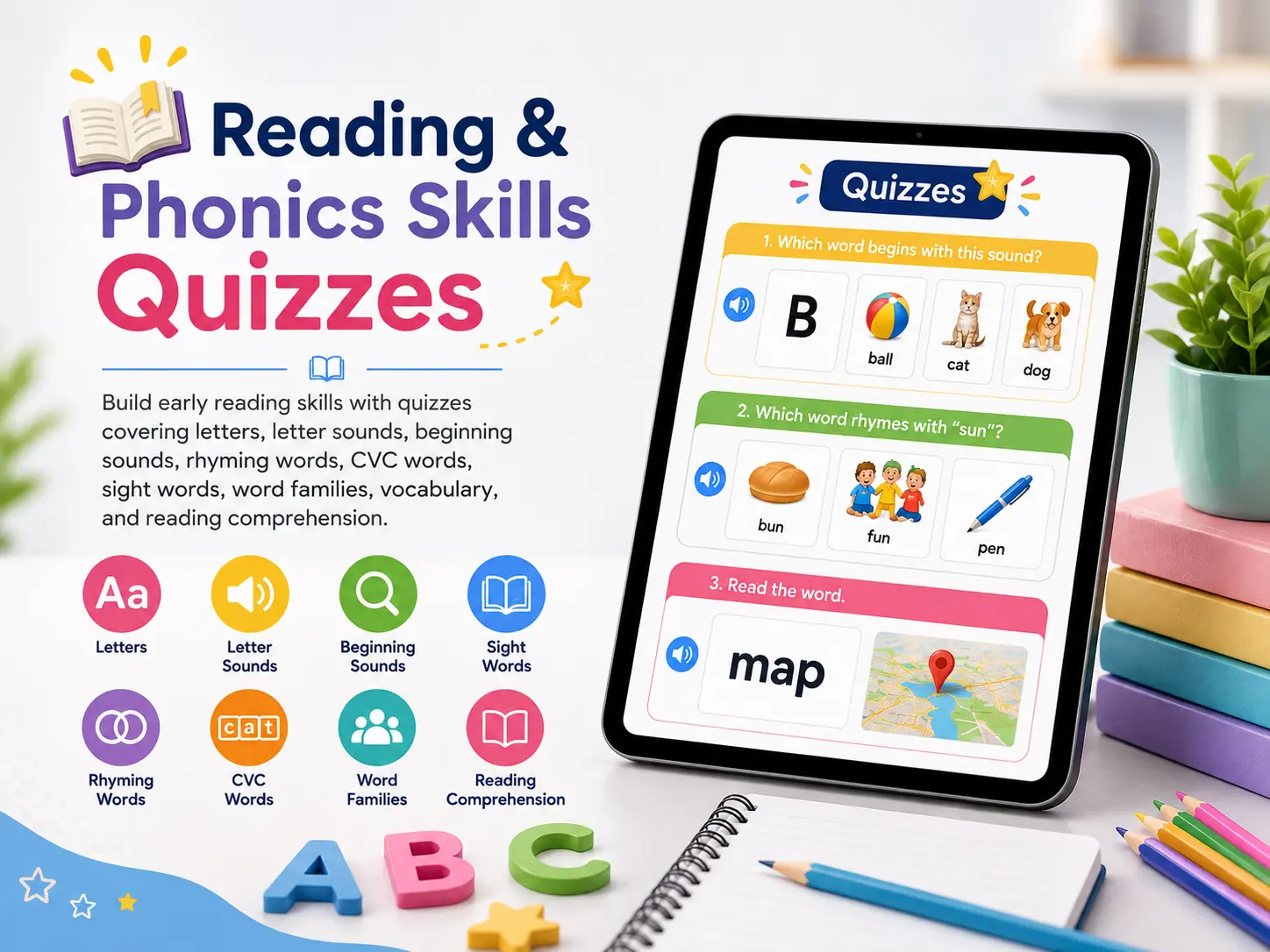
Kindergarten Reading & Phonics Skills
Build early reading skills with quizzes covering letters, letter sounds, beginning sounds, rhyming words, CVC words, sight words, word families, vocabulary, and reading comprehension.
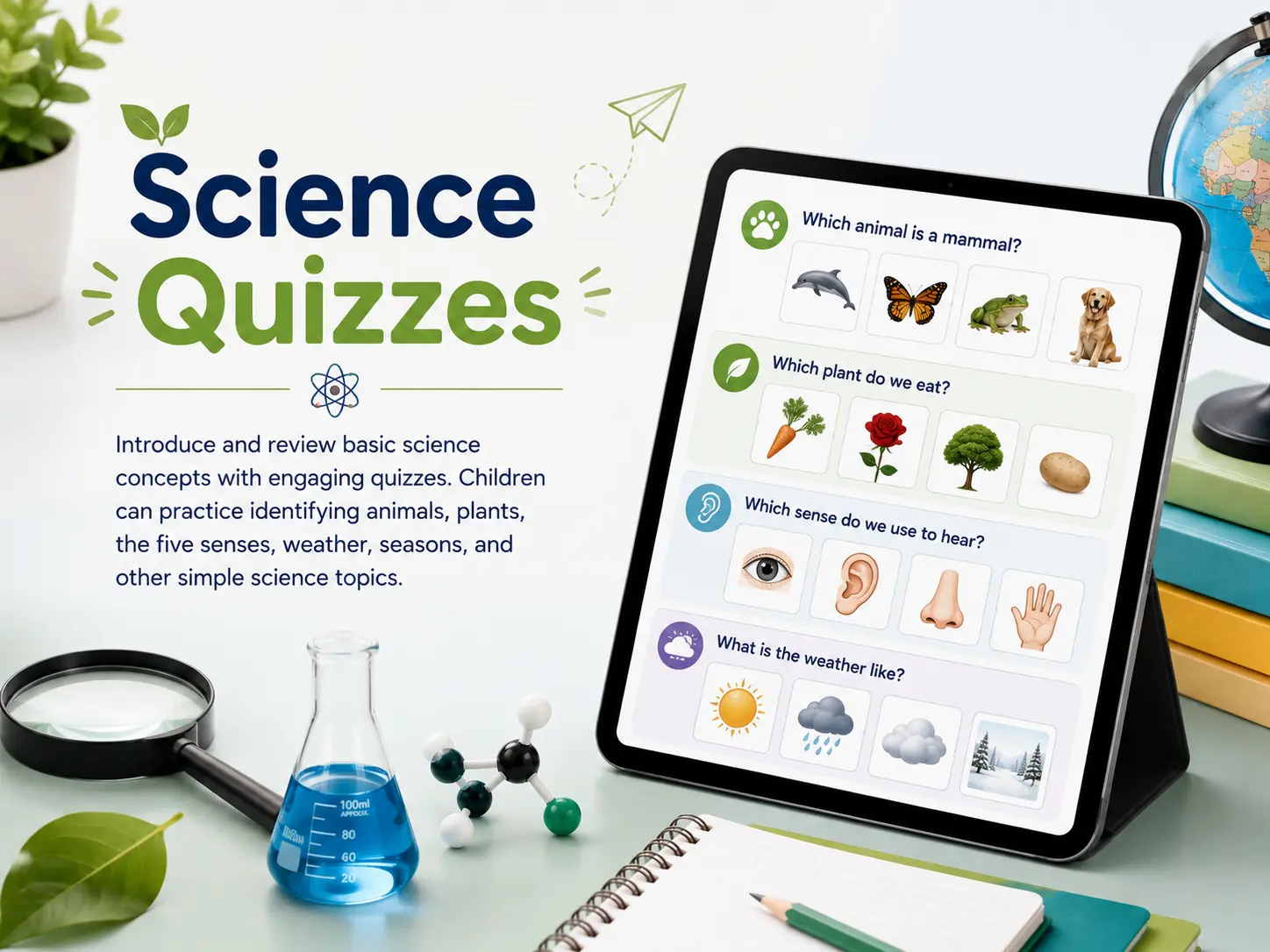
Kindergarten Science Quizzes
Introduce and review basic science concepts with kindergarten science quizzes. Children can practice identifying animals, plants, the five senses, weather, seasons, and other simple science topics through age-appropriate questions.
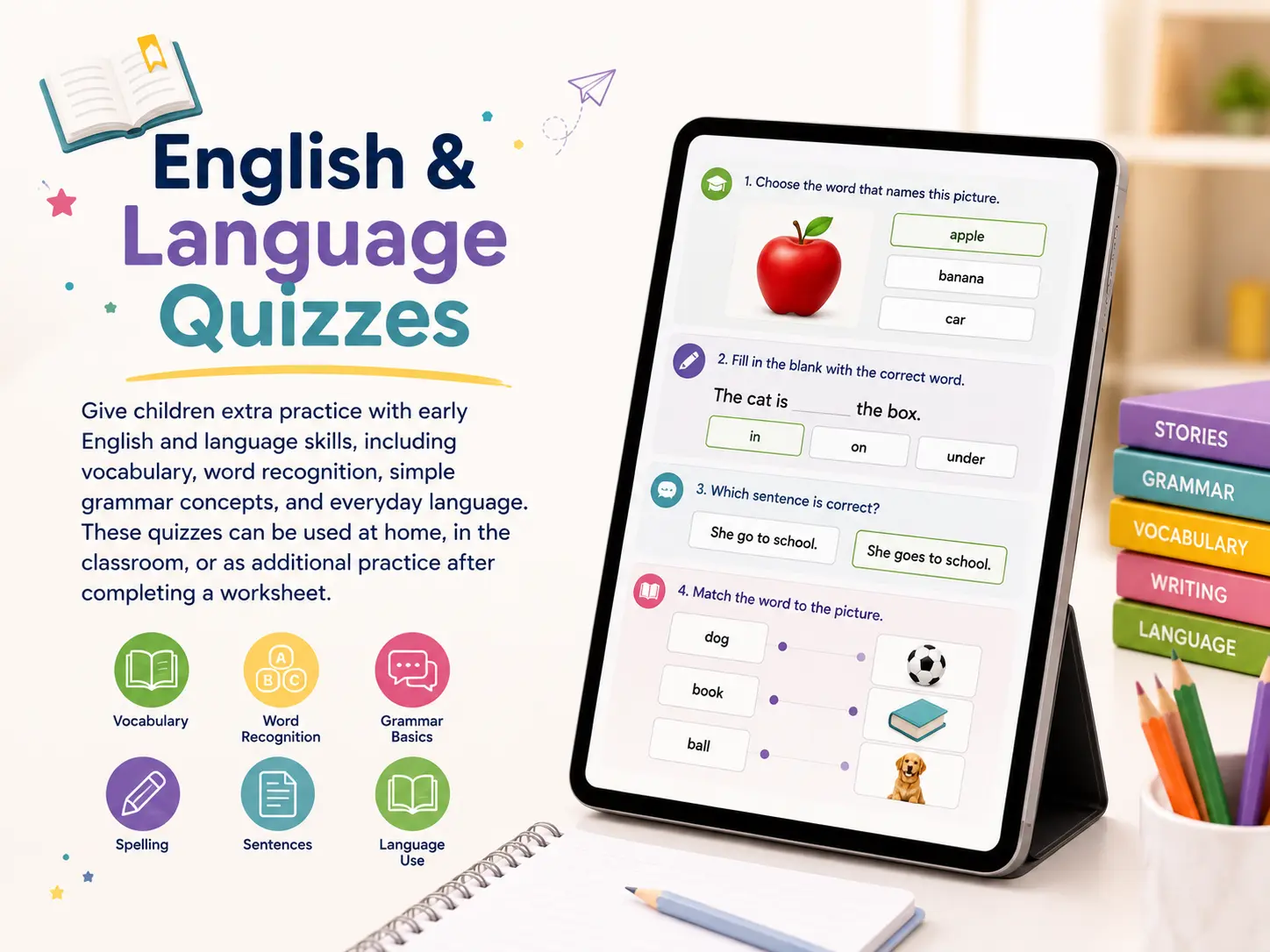
Kindergarten English & Language Quizzes
Give children extra practice with early English and language skills, including vocabulary, word recognition, simple grammar concepts, and everyday language. These quizzes can be used at home, in the classroom, or as additional practice after completing a worksheet.
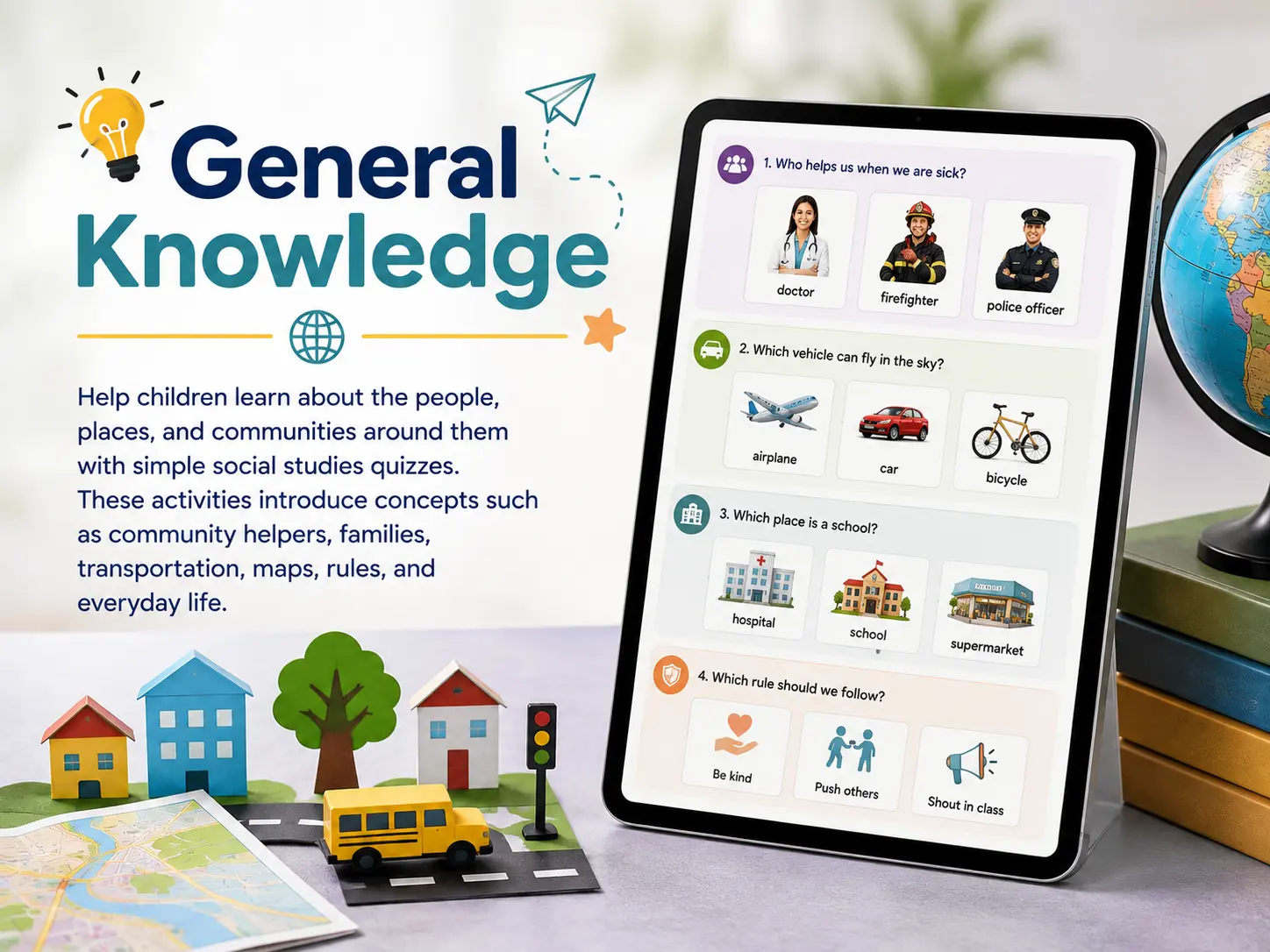
Kindergarten General Knowledge
Help children learn about the people, places, and communities around them with simple kindergarten social studies quizzes. These activities introduce concepts such as community helpers, families, transportation, maps, rules, and everyday life.
What Is Measurement for Kindergarten Children?
Measurement may sound like a complicated math topic, but young children encounter it throughout the day.
A child knows that one toy is bigger than another. They can see that one pencil is longer. They can notice that one person is taller. They may also compare a small cup with a large cup or decide which block will make the taller tower.
These are all early measurement experiences.
At the Kindergarten level, children are developing the language and reasoning needed to describe measurable attributes. They begin using words such as long, short, longer, shorter, tall, taller, small, and large to compare objects. Early measurement learning also involves ordering objects from shortest to longest or smallest to biggest.
The goal is not simply to memorize measurement words. Children should begin to understand what those words mean when they look at real objects.
Learning About Length
Length describes how long something is from one end to the other. Children can begin understanding length by comparing two objects.
For example, imagine two pencils lying next to each other. If one extends farther than the other, it is longer. The other pencil is shorter.
The same idea can be used with books, crayons, pieces of string, blocks, sticks, or many other objects children encounter every day.
A Kindergarten child does not always need a ruler to begin thinking about length. Putting two objects next to each other and comparing them directly can be a useful first step. Children can then progress toward using informal units and eventually standard measurement tools as their understanding develops.
This quiz gives children practice recognizing these relationships visually.
Longer and Shorter
The words longer and shorter are important measurement words for young learners.
Suppose there are two strips of paper. One strip reaches farther across the table than the other. The longer strip has greater length, while the other strip is shorter.
Children may also compare objects that are very similar in appearance. Two pencils might have the same color and shape but different lengths. The child needs to pay attention to the measurable attribute rather than the object’s color or design.
Questions involving longer and shorter help children develop this habit of looking carefully at the property being compared.
This kind of comparison is an important foundation for later measurement work. Kindergarten learning resources commonly encourage children to compare objects directly and use appropriate vocabulary such as longer and shorter.
Understanding Height
Height is another important measurement idea.
Children often use the word tall when talking about people or objects. A child might say that one building is taller than another or that one plant is shorter than another.
Height is related to length, but it describes how high something extends, usually from bottom to top.
For example, imagine two blocks standing upright. If one block reaches higher than the other, it is taller. The lower block is shorter.
Children can practice this concept with towers, plants, containers, furniture, and people. A simple height chart can also help children see how different heights compare.
Early Kindergarten measurement activities specifically encourage children to develop vocabulary such as tall, short, taller, and shorter when comparing height.
Taller and Shorter
The difference between taller and shorter is easier to understand when objects are placed in a fair position for comparison.
For example, if two toy towers are standing on the same table, children can compare where the tops of the towers reach. The tower that reaches higher is taller.
This is an important point because children can sometimes be distracted by how an object is positioned. When comparing height, objects should be placed so that the comparison is fair.
The same idea applies when comparing people. If two children are standing on the same floor, their heights can be compared more easily.
The Kindergarten measurement quiz gives children practice using these comparison ideas instead of simply choosing the object that looks bigger overall.
Size Is More Than Just "Big" or "Small"
Young children often use the word big to describe many different things. But an object can be bigger in one measurable attribute and not another.
For example, one box could be taller but narrower than another box. A book could be longer but thinner. A container could be shorter but wider.
As children develop their measurement vocabulary, they begin to use more precise words to describe what they see.
Instead of saying only:
“This one is big.”
They can learn to say:
“This one is longer.”
Or:
“This one is taller.”
Or:
“This one is shorter.”
Using more precise mathematical language helps children communicate what they observe. Early-childhood mathematics guidance encourages adults to use specific measurement vocabulary rather than relying only on general words such as “big.”
Comparing Objects by Their Length
One of the most useful early measurement skills is being able to compare two or more objects.
Children can look at two pencils and decide which is longer. They can compare two pieces of string and identify the shorter one. They can arrange several objects from shortest to longest.
This type of activity teaches children that length is something that can be compared.
The same principle works with many familiar classroom materials. A teacher might place several crayons on a table and ask children to find the longest one. A parent might compare two books or two pieces of paper at home.
The quiz provides a digital version of this kind of comparison practice.
Putting Objects in Order
Measurement becomes more interesting when children compare more than two objects.
Imagine three pencils:
- one short pencil
- one medium-length pencil
- one long pencil
Instead of simply asking which pencil is longer, children can arrange the pencils from shortest to longest.
This develops an important early reasoning skill. Children need to look at the relationship between several objects rather than making only one comparison.
Kindergarten measurement learning commonly includes ordering objects according to measurable attributes, such as arranging objects from smallest to biggest or shortest to longest.
Why Children Should Compare Before Measuring With a Ruler
A ruler is a useful measurement tool, but simply giving a young child a ruler does not automatically mean they understand measurement.
Children first need to understand what they are comparing and how measurement works.
For example, if two objects are placed next to each other, children can directly see which is longer. Later, they can use blocks, paper clips, string, or another repeated unit to measure an object’s length. Eventually, they can connect these ideas with standard tools such as rulers.
Early measurement learning often moves from direct comparison to informal units and then toward more formal measurement tools.
That is why simple visual comparison is valuable for Kindergarten learners.
Using Simple Objects to Practice Measurement
Measurement does not require an expensive math kit.
Parents and teachers can use objects that are already available.
A child can compare two pencils, two books, several crayons, blocks, pieces of string, or toys. They can decide which object is longer, which is shorter, which is taller, or which is smaller.
For example, place two crayons on a table and ask:
Which crayon is longer?
Then place three objects together and ask:
Which object is the shortest?
After that, try:
Can you put these objects in order from shortest to longest?
These simple activities help children connect mathematical vocabulary with real objects.
Making a Fair Comparison
Children also need to learn that objects should be positioned carefully when comparing length or height.
Imagine two pencils. If one pencil starts farther forward than the other, it may be difficult to compare their lengths accurately.
A better approach is to line up their starting points and then compare where they end.
The same principle applies when measuring with informal units. If children use blocks to measure a book, the blocks should be placed next to each other without gaps or overlaps.
Learning resources for early mathematics emphasize this idea of making a fair comparison and using units consistently when measuring.
This is a small detail, but it helps children develop a much stronger understanding of measurement.
Estimating Before Measuring
Another useful measurement skill is estimation.
Before measuring an object, a child can make a reasonable guess.
For example:
Which pencil do you think is longer?
The child makes a prediction and then checks it by placing the pencils side by side.
This turns measurement into a simple problem-solving activity. The child is not just identifying an answer; they are making a prediction and then checking whether their prediction was correct.
Early childhood measurement guidance encourages children to estimate attributes such as length and then verify their estimates using simple tools or comparison methods.
At the Kindergarten level, estimation should remain simple and visual. Children do not need complicated calculations to begin developing this skill.
Measurement in Everyday Life
Children encounter measurement everywhere.
When getting dressed, they notice whether clothes are too long or too short. When building with blocks, they notice which tower is taller. When choosing a pencil, they may compare its length with another pencil.
Cooking introduces another type of measurement. Children can see that containers hold different amounts, although capacity is a separate measurement attribute from length and height.
At school, children may compare the height of plants, the length of classroom objects, or the size of different blocks.
Measurement therefore does not have to feel like a separate math lesson. It can naturally become part of everyday conversations.
What This Kindergarten Measurement Quiz Practices
This quiz gives children focused practice with early measurement concepts rather than requiring them to work with complicated formulas or advanced measurement units.
The questions can help children think about the differences between objects and identify relationships such as longer and shorter or taller and shorter.
They also encourage children to pay attention to size and measurable attributes when looking at objects.
For parents and teachers, the quiz can work as a quick review after a lesson or hands-on activity. If a child has difficulty with a particular comparison, that can be a useful signal to return to real objects and practice the concept again.
Measurement Words Children Should Know
A strong measurement vocabulary makes it easier for children to explain what they see.
During Kindergarten, children can gradually become comfortable with words such as long, short, longer, shorter, tall, taller, small, big, bigger, and smaller.
Depending on the activity, children may also encounter words such as wide, narrow, heavy, light, heavier, and lighter.
The important thing is to connect the word to the attribute being compared.
For example, “tall” describes height, while “long” describes length. A child may need repeated experiences comparing real objects before these distinctions become natural.
Using precise measurement language during everyday activities is one way parents and teachers can support this development.
A Simple Way to Practice Measurement at Home
You can turn ordinary household objects into a quick measurement activity.
Place two books on a table and ask your child which one is longer. Then place two objects upright and ask which one is taller.
Next, choose three objects and ask your child to put them in order from shortest to longest.
Once your child is comfortable making direct comparisons, introduce a simple informal unit. For example, a book can be measured using blocks placed end to end.
The child can count how many blocks are needed to reach from one end of the book to the other.
This type of activity helps children understand that measurement can be represented using repeated units. Early mathematics resources recommend hands-on experiences with informal units such as blocks, paper clips, hands, or string before children move into more formal measurement systems.
From Visual Comparison to Real Measurement
There is a natural progression in measurement learning.
First, children notice differences.
They see that one object is longer or that one person is taller.
Next, they compare objects directly.
They place two objects together and decide which one is longer or shorter.
Then they can begin using informal units.
They may measure a book using blocks or a piece of string.
Eventually, children connect these experiences with standard tools and units.
This progression gives measurement meaning. A ruler becomes more useful when a child already understands that length is an attribute that can be compared and measured.
How to Use This Online Quiz
Before starting the quiz, it can help to remind children of the measurement words they have been learning.
Ask them to look carefully at each question rather than choosing an answer quickly. If two objects are shown, encourage them to compare the relevant attribute.
If the question is about length, think about how long the object is.
If it is about height, look from the bottom toward the top.
If it is about size, pay attention to what the question is actually asking instead of simply choosing the object that looks biggest.
Parents and teachers can also discuss the answer after a question. Asking a child “How do you know?” encourages them to explain their mathematical thinking.
The quiz can be repeated after additional practice so children can see whether their understanding has improved.
Who Can Use This Kindergarten Measurement Quiz?
This free quiz can be useful for Kindergarten children who are learning early measurement concepts at school or at home.
Parents can use it as a short activity after practicing measurement with household objects. Teachers can use it as a review activity after introducing length and height. Homeschool families can include it as part of a Kindergarten math routine.
It can also work well alongside printable practice. A child might first complete a measurement worksheet, compare real objects, and then take the online quiz to review the same ideas in a different format.
This combination gives children more than one way to interact with the concept.
Kindergarten Measurement and Other Math Skills
Measurement is connected to many other areas of Kindergarten math.
When children compare lengths, they are using observation and reasoning. When they count measurement units, they are using number skills. When they order objects from shortest to longest, they are thinking about sequences and comparisons.
This makes measurement a useful bridge between different early math concepts.
After practicing measurement, children can continue with other Kindergarten math topics such as counting, number recognition, addition, subtraction, shapes, comparing numbers, and patterns.
You can explore the Kindergarten Math Quizzes section on Book & Pencil to find more focused practice.
