
Sight Words Quiz for Kindergarten
A free online quiz that makes the, and, said and you stick — 60 questions in 3 levels, for ages 4 to 6.
If you are looking for a sight words quiz kindergarten children actually enjoy, you found it. This free quiz turns high-frequency words like the, and, said, you, she and was into games — 60 questions across three levels, with stories a grown-up can read aloud for children who cannot read yet. It works on phones, tablets and computers, and there is no signup.
Whether you searched for a sight words quiz, kindergarten sight words practice, or Dolch sight words games, this page gives your child sixty different ways to learn sight words.
Sight Words / Vocabulary: Kindergarten Sight Words
Great Work!
You completed the quiz!
Free Kindergarten Quizzes by Subject
Choose a subject below to find free kindergarten quizzes and practice activities. Each section focuses on age-appropriate skills commonly introduced during kindergarten.
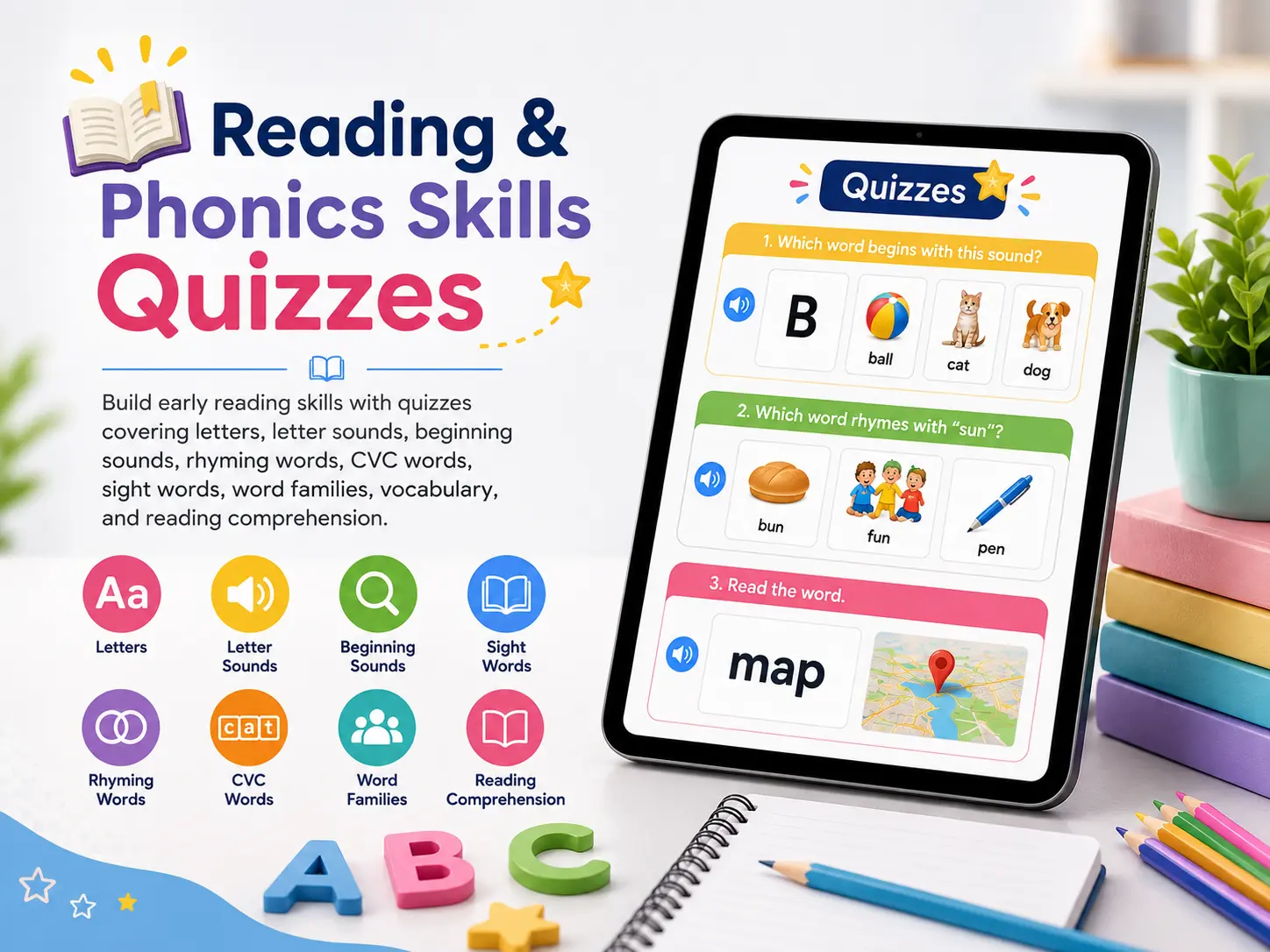
Kindergarten Reading & Phonics Skills
Build early reading skills with quizzes covering letters, letter sounds, beginning sounds, rhyming words, CVC words, sight words, word families, vocabulary, and reading comprehension.
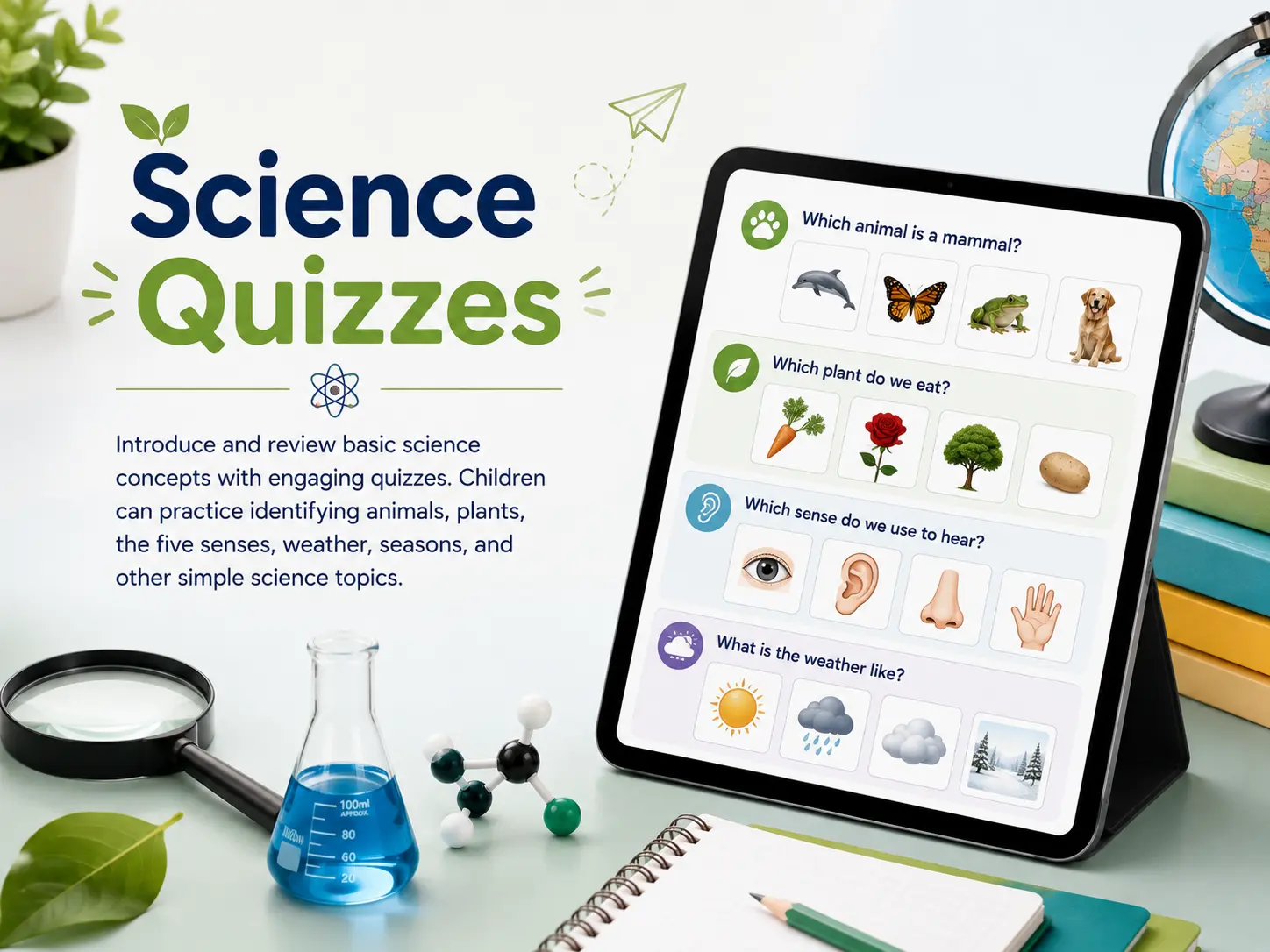
Kindergarten Science Quizzes
Introduce and review basic science concepts with kindergarten science quizzes. Children can practice identifying animals, plants, the five senses, weather, seasons, and other simple science topics through age-appropriate questions.
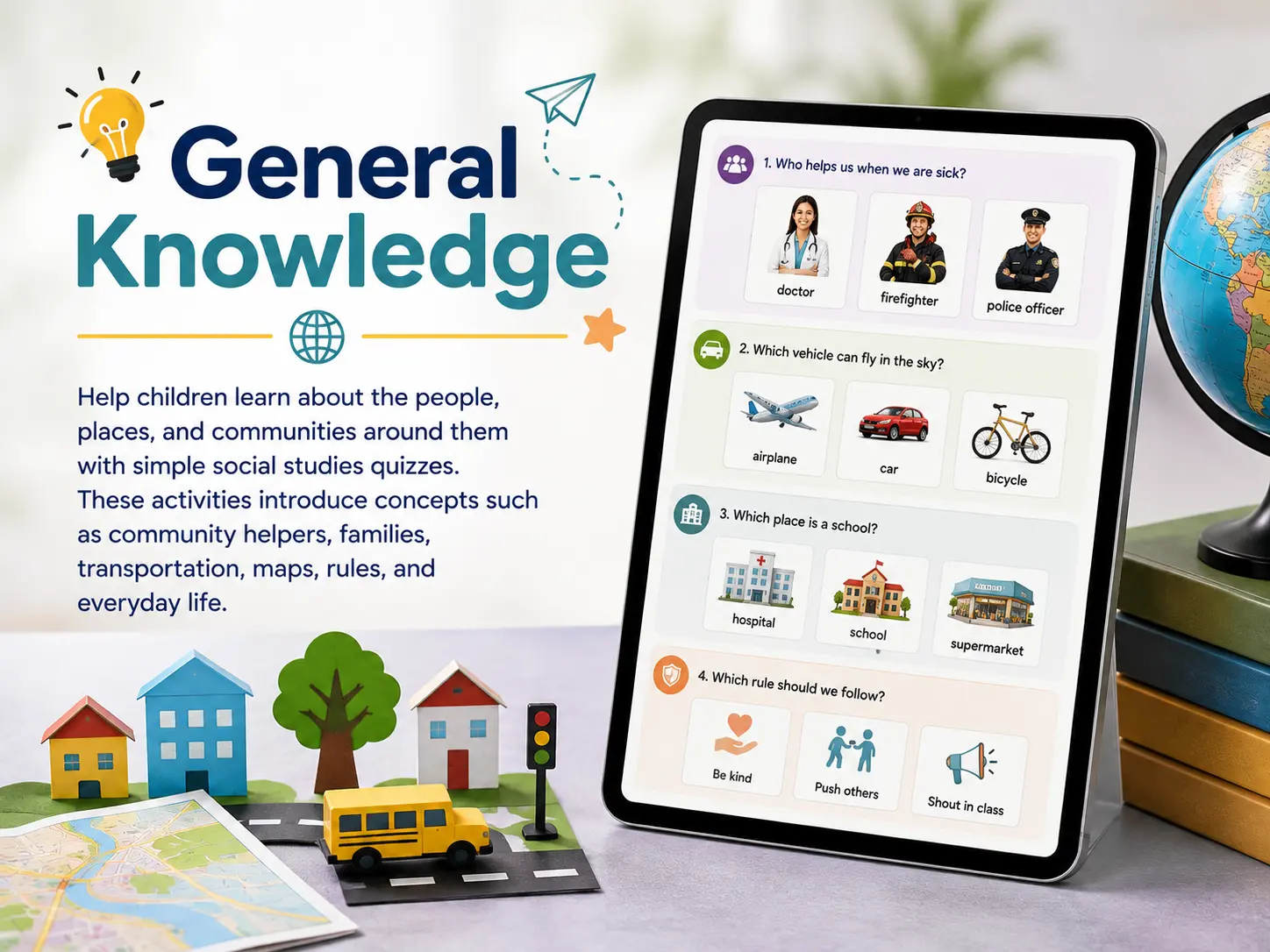
Kindergarten General Knowledge
Help children learn about the people, places, and communities around them with simple kindergarten social studies quizzes. These activities introduce concepts such as community helpers, families, transportation, maps, rules, and everyday life.
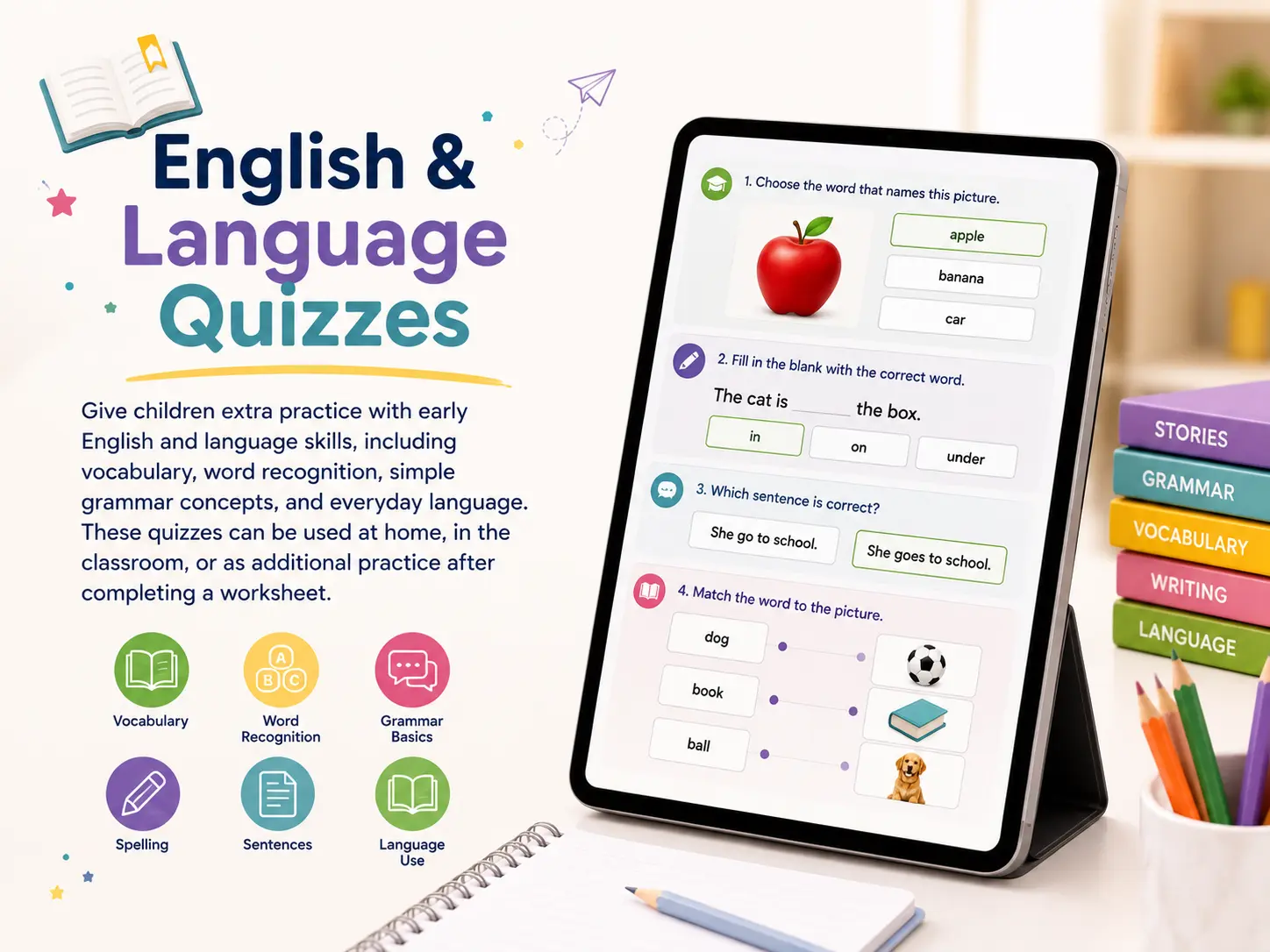
Kindergarten English & Language Quizzes
Give children extra practice with early English and language skills, including vocabulary, word recognition, simple grammar concepts, and everyday language. These quizzes can be used at home, in the classroom, or as additional practice after completing a worksheet.
What this sight words quiz covers
This sight words quiz covers the words that unlock early reading: the Dolch pre-primer list (the, and, a, I, you, said, see, look, big, little, can, go, come, here and more) plus the gentlest primer words (she, he, was, they, what, with, like). These high-frequency words fill kindergarten books — learn them by sight and whole sentences suddenly become readable.
The quiz grows with your child. Easy is pure recognition: point to the word, hear it and touch it, find the double. Medium puts words to work inside sentences: finish the sentence, spot the imposter (and or an?), count the word, rhyme it. Hard turns your child into a word detective: spelling traps like said/siad and was/saw, mixed-up letters, backward words, two-step puzzles and three-clue riddles. If your child already reads a little, try our sight words tool for kindergarten too — it builds printable practice from the same Dolch lists. And for number practice between reading sessions, our missing number quiz for kindergarten keeps math skills warm.
How the quiz works
Playing takes less than a minute to start, and there is nothing to install or sign up for. Press start, pick Easy, Medium or Hard, and answer each question by tapping a choice. Every answer gets instant feedback, so your child knows right away whether their word-spotting was right.
A full run is 60 questions, but nobody has to finish in one sitting. Ten minutes a day on one level beats one long session — short, repeated practice is how sight words move into long-term memory, and that is why a sight words quiz kindergarten children can replay daily works so well. When a level feels easy, move up; when it feels hard, stay and replay. One habit runs through the whole quiz: look at the WHOLE word, not just the first letter — was and saw start the same but end very differently.
Skills your child practices
A sight words quiz looks simple, but it trains several reading skills at once:
- Instant word recognition: the, and, said, you, she, was — read in a flash, no sounding out.
- Dolch list knowledge: the pre-primer 40 plus first primer words, the backbone of kindergarten books.
- Spelling awareness: said/siad, was/saw, the/teh — noticing that letter order is the word.
- Words in sentences: finding, finishing and fixing sight words where they actually live.
- Thinking with words: riddles, patterns and two-step puzzles that make children slow down and look closely.
Work through those five skills and this sight words quiz kindergarten page turns from a challenge into a warm-up.
Age and grade guide
| Age | Grade | What to expect |
|---|---|---|
| 4–5 | Pre-K | First 10–15 sight words; play Easy as a listening game with a grown-up |
| 5–6 | Kindergarten | Pre-primer Dolch words; Medium level with words inside sentences |
| 6–7 | Grade 1 | Primer Dolch words; Hard level spelling traps and riddles |
Every child is different. Some four-year-olds recognize twenty words; some six-year-olds are still sounding out cat. Both are normal. If the Easy level feels too simple after a day or two, jump straight to Medium — words inside sentences are where most children start thinking hard. And if Hard feels impossible, that is fine too: the was/saw traps in Level 3 challenge many first graders. Let your child set the pace and replay favourite questions on this sight words quiz kindergarten page.
How to use the quiz at home or in the classroom
At home
Ten minutes a day with a sight words quiz works better than one long weekend session. Sit with your child for the first few rounds and read the stories aloud — sight word questions are listening questions first. When they miss one, do not just give the answer: ask “what is the last letter?” Most guessing comes from reading only the first letter. Between sessions, hunt for quiz words in picture books — the, and, you are suddenly everywhere. You can also print practice from our free sight words tool for offline word-hunting.
In the classroom
Use the quiz as a five-minute warm-up before guided reading, or as a station in literacy centers where pairs take turns reading questions aloud. The Easy level suits the start of kindergarten; bring out Medium when children start reading simple sentences, and Hard for your early readers who are ready to notice spelling. Pair it with word-wall work: keep a wall of the trap words children miss most — usually said, was/saw, they and and/an — and revisit it daily.
Tips to help your child do their best
These five habits make any sight words practice more productive:
- Read everything aloud. Most kindergarteners cannot read the questions yet — and that is fine. Your voice is the bridge.
- Point, don’t just say. Let the child touch each word with a finger. Touching slows the eyes down and stops wild guessing.
- Teach rule-breakers as wholes. Said, was and the do not sound the way they look — learn them as whole shapes, like faces, not letter by letter.
- Celebrate the traps. When your child falls for was/saw or and/an, that is the lesson landing. Laugh together, then look closely together.
- End on a win. If the last question was hard, finish with an easy one from Level 1. Children remember the feeling of the ending.
Answer key for parents and teachers
Level 1 — Easy (questions 1–10)
- A (the) — the word “the” sits right there between cat and dog.
- B (The and stone) — Lily only hops on the stone that says “and”.
- C (you) — Mum said “you”, so touch the word “you”.
- A (said) — “said” starts with s; ball and run do not.
- B (see) — “see” appears twice; cat appears once.
- C (she) — Ben takes down the card that says “she”.
- A (be) — “be” rhymes with “me”.
- B (4) — I(1) see(2) the(3) cat(4): four words in the line.
- C (here) — Mia shouts “here” when she finds her ball.
- A (star) — the song line ends with “star”.
Level 2 — Medium (questions 11–30)
- D (can) — “can” is hiding in “The dog can run.”
- D (We) — “We go to school” starts with “We”.
- D (eat) — Lily will eat the pie.
- B (dog) — ball, bat and big start with b; dog does not.
- C (me and we) — me and we are different; the other pairs match.
- D (run) — “run” rhymes with “fun”.
- A (She) — “She” is the first word of “She can jump.”
- B (play) — “play” is the last word of “We like to play.”
- C (3) — “the” appears three times across the two sentences.
- D (up) — the kite goes up into the sky.
- A (The 3rd word) — the 3rd word is “an”, the imposter.
- B (Where) — “Where is my ball?” starts with “Where”.
- C (play) — “play” is hiding inside “playground”.
- D (it) — “She waters it.”
- A (The boy said hello.) — the words are in the right order.
- B (little) — “little” has six letters; “a” has one.
- C (in) — “We stay in.”
- D (down) — the opposite of “up” is “down”.
- A (The 1st and 3rd) — the 1st and 3rd words are both “the”.
- B (run) — “I like to run, I like to play.”
Level 3 — Hard (questions 31–60)
- C (said) — “said” is the correctly spelled word.
- D (the) — the letters e-h-t unscramble to “the”.
- A (The cat was sleeping.) — “was” fits the past-tense sentence.
- B (dog) — the word right after the first “The” is “dog”.
- C (and) — three letters, starts with a, means “you and me”: “and”.
- D (saw) — “was” read backwards spells “saw”.
- A (saw) — “I saw a bird in the tree.”
- B (look) — “look” has exactly four letters.
- C (2) — “she” appears twice; “sees” does not count.
- D (the) — the pattern repeats the, the, a — so “the” comes next.
- A (2) — “is” appears twice in Mia’s sentences.
- B (True) — “said” does rhyme with “bed”.
- C (Do) — “Do you like to play?”
- D (and) — “and” comes first in ABC order.
- A (pie) — the word right before “They” is “pie”.
- B (the) — “the” is the correctly spelled word.
- C (what) — “what” asks a question, has four letters, starts with w.
- D (and) — the letters d-n-a unscramble to “and”.
- A (They are my friends.) — “they” fits with “are”.
- B (the) — the word right after “for” is “the”.
- C (go) — be, me and he rhyme with “see”; “go” does not.
- D (what) — “what” can start a question.
- A (see) — “see” has the letter e twice in a row.
- B (4) — “the” appears four times, counting the capital “The”.
- C (was) — “was” is the correctly spelled word.
- D (eat) — “eat” starts with the letter e.
- A (cat) — “Mia has a cat. The cat is black.”
- B (you) — three letters, starts with y, means “you and me”: “you”.
- C (The 3rd word) — was, was, saw: the 3rd word is the imposter.
- D (the, and, see, big) — the three-letter words are the, and, see and big.
What to practice next
Sight words are one piece of kindergarten reading. Once the pre-primer words feel instant, the natural next step is our sight words generator for kindergarten — build printable worksheets from the same Dolch lists for offline practice. Younger siblings can start even earlier with our name tracing generator, a personalized 10-page tracing workbook that teaches letter shapes before words. And for a change of pace, our missing number quiz for kindergarten trains the same careful-looking skills with numbers.
Keep this sight words quiz kindergarten page in the daily rotation — a few minutes of word play a day is what turns sight words from a lesson into a reflex.
Frequently asked questions
What are sight words?
Sight words are common words children learn to recognize instantly, without sounding them out. Words like the, and, said and you appear so often in early books that reading them by sight is what makes young readers fluent.
What are Dolch sight words?
Dolch sight words are two famous word lists — 40 pre-primer words and 52 primer words — put together from the words that appear most often in children’s books. This quiz uses the pre-primer list and the gentlest primer words, which is the right level for kindergarten.
How many sight words should a kindergartener know?
Most kindergarten programs aim for the 40 Dolch pre-primer words by the end of the year: the, to, and, a, I, you, it, in, said, and the rest. There is no magic number — steady practice with a few words at a time beats rushing through a long list.
At what age should my child start learning sight words?
Many children start around age 4 or 5, when they know most letter names. If your child is not ready, that is fine — keep reading aloud together and let the words arrive naturally. This quiz works as a listening game for children who cannot read yet.
What is the difference between sight words and phonics?
Phonics teaches children to sound words out letter by letter, while sight words are the rule-breakers — like said, was and the — that do not sound the way they look and must be learned as whole shapes. Children need both: phonics for regular words, sight-word memory for the tricky ones.
How can I help my child practice sight words at home?
Ten minutes a day beats one long session. Read the quiz questions aloud and let your child point to the answers, hunt for quiz words in picture books, and write the tricky ones — said, was, they — with crayons or chalk. Hands remember what eyes forget.
My child guesses words instead of reading them. What helps?
Guessing from the first letter is normal and actually a good sign — it means your child is using clues. Slow them down with look-alike games: was and saw, and and an, here and hear. Covering the choices and asking ‘what is the last letter?’ fixes most guessing fast.
How many questions are in the quiz?
There are 60 questions in three levels: Easy has 10, Medium has 20 and Hard has 30. A child can play one level at a time, and each level works differently — recognition, words in sentences, then spelling traps and riddles — so practice never gets boring.
Does the quiz save my child’s answers?
No. The quiz never asks for a name, email, age or any personal detail. It does not use cookies or tracking, it stores nothing, and nothing is sent anywhere. Everything happens in the browser and disappears when the page is closed.
Is the quiz free?
Yes. The full 60-question quiz is free, with no signup and no account needed. Just press start and play.
Made for parents and teachers by Book and Pencil. Last updated October 2026.