| Kindergarten Worksheets |
|---|
| Learning Letters |
| Tracing Letters |
Tracing Letter Q Worksheet – Free Printable PDF
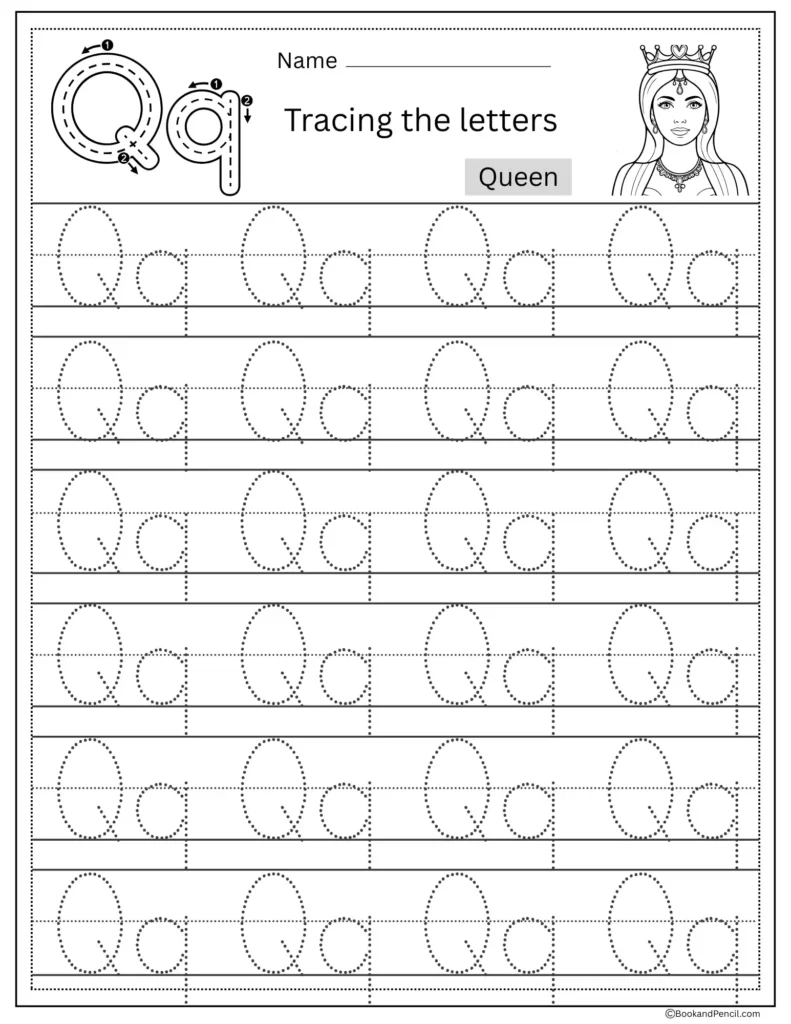
This Tracing Letter Q Worksheet helps children practice forming uppercase Q and lowercase q while building important handwriting foundations. Unlike many letters that rely only on straight lines or simple curves, the letter Q combines a circular shape with a tail stroke. This requires children to develop circle formation skills, directional awareness, and accurate stroke placement.
Designed for preschool, pre-K, and kindergarten learners, this letter tracing worksheet supports early handwriting development, fine motor control, and letter recognition through guided tracing practice.
Trace Letter Q and Color Shape
Practice Uppercase and Lowercase
Tracing Letter Q q
#Similar Next
Previous
Love This Worksheet?
✔ A–Z Uppercase and Lowercase Practice
✔ Fun Handwriting Activities
✔ Perfect for Preschool and Kindergarten
✔ Instant PDF Download
Regular Price: $3.99 → Today: $1.99
Learning How to Form Uppercase Q and Lowercase q
Both uppercase Q and lowercase q begin with a circular shape similar to the letter O. The difference is the addition of a tail that transforms the shape into a completely different letter.
When practicing uppercase and lowercase letters, encourage children to:
- Complete the circle first before adding the tail.
- Use a smooth, continuous motion when forming the circular portion.
- Keep the circle evenly shaped rather than stretched or flattened.
- Add the tail in the correct position and direction.
- Maintain consistent sizing between repeated letters.
For lowercase q, children also learn descender control because part of the letter extends below the writing line. This introduces awareness of different writing zones and helps prepare learners for other descending letters.
Why Letter Q Builds Important Handwriting Skills
The letter Q provides valuable practice in combining two separate handwriting actions:
- Creating a controlled circular shape.
- Adding a correctly placed tail stroke.
This combination strengthens:
- Circle formation skills
- Pencil control
- Directional consistency
- Visual discrimination
- Letter-shape accuracy
- Fine motor coordination
Because the tail must be placed correctly, children learn that small details can change a letter’s identity. This helps improve attention to letter formation and overall handwriting quality.
Common Letter Q Mistakes Children Make
Many early writers experience similar challenges when learning the letter Q.
Common errors include:
- Forgetting to add the tail entirely
- Placing the tail on the wrong side of the circle
- Drawing a tail that is too long or too large
- Confusing uppercase Q with O
- Confusing lowercase q with p
- Making circles that vary greatly in size
- Creating uneven spacing between the circle and tail
When correcting mistakes, encourage children to focus on completing the circular shape first and then adding the tail carefully. Short practice sessions often produce better results than long handwriting drills.
Developing Fine Motor Control Through Tracing
A well-designed letter Q tracing printable supports the small muscle movements required for handwriting.
Teachers and parents can encourage children to:
- Hold the pencil with a comfortable grip.
- Trace slowly rather than rushing.
- Follow the dotted path carefully.
- Practice circular movements before writing independently.
- Pay attention to where the tail begins and ends.
Repeated tracing helps improve hand strength, stroke control, and writing confidence.
Connecting Letter Q to Phonics Skills
Handwriting practice becomes more meaningful when paired with phonics instruction.
The letter Q is commonly associated with the /kw/ sound found in words such as:
- Queen
- Quilt
- Quail
- Quarter
- Question
Children can also learn that the letter Q is frequently followed by the letter U in many English words. During tracing activities, ask learners to identify words that begin with the Q sound and listen for that sound in spoken language.
This connection between writing and phonics strengthens early literacy development.
Tips for Using This Alphabet Tracing Worksheet
This alphabet tracing worksheet can be used effectively in classrooms, homeschool settings, literacy centers, and independent practice.
Helpful strategies include:
- Demonstrate the letter formation before tracing begins.
- Practice one row at a time to maintain focus.
- Encourage verbal cues such as “circle first, tail second.”
- Review uppercase and lowercase forms together.
- Combine tracing practice with phonics discussions.
- Use brief daily sessions to reinforce consistency.
Regular practice helps children develop stronger handwriting habits while improving letter recognition.
Letter Q Learning Activities
Queen Picture Matching
Provide pictures of queens and other objects. Ask children to identify which pictures begin with the letter Q sound and discuss the beginning sound they hear.
Quilt Pattern Coloring
Create a simple quilt-style coloring activity using squares and patterns. While coloring, review the letter Q and practice saying Q words aloud.
Q Word Hunt
Invite children to search books, classroom displays, or word cards for words that begin with Q. This reinforces both phonics and letter recognition.
Circle-and-Tail Craft
Have children cut out paper circles and attach small tails to create large letter Q models. This hands-on activity reinforces the two key parts of letter formation.
Building Confidence With Letter Q Practice
This Tracing Letter Q Worksheet gives young learners structured practice with circle formation, tail placement, and letter differentiation. By tracing uppercase Q and lowercase q, children strengthen handwriting skills, improve fine motor control, and develop greater awareness of letter shapes and orientation. Consistent practice helps learners recognize the difference between similar letters such as Q, O, q, and p, supporting both handwriting accuracy and early reading success.
Download the Tracing Letter Q Worksheet PDF
Click and 📥 Download the Letter Q Worksheet and watch your little one dive into the magic of letters, sounds, and creativity one activity at a time. Or back to all alphabet tracing worksheets collection


Popular Downloads ⭳