Free Cursive Letter B Worksheet — Printable PDF Practice Sheets
Learn how to write cursive letter B with our free printable cursive letter B worksheets. This set of five practice sheets covers uppercase and lowercase letter B tracing, grid-based letter practice, combined uppercase and lowercase recognition, and a full cursive passage rich with the letter B. Every worksheet is a free PDF download that opens instantly in your browser. No account needed and no membership required.
Mastering both the tall stem of lowercase b and the two rounded bumps of uppercase B takes focused practice, and these worksheets provide exactly the structured repetition needed to build that skill confidently. Whether you are a student in Grade 1 working through cursive for the first time, a homeschool learner moving through the alphabet at your own pace, or an adult brushing up on handwriting fundamentals, these five sheets give you everything needed to practice cursive B from guided tracing through to fluent independent writing.
Letter Tracing and Word Practice
Uppercase Grid Practice
Lowercase Grid Practice
Upper and Lowercase
Passage Writing Practice
What These Cursive Letter B Worksheets Include
This collection of five worksheets takes learners through every stage of writing cursive B, from first guided tracing all the way to writing the letter fluently within connected passage sentences.
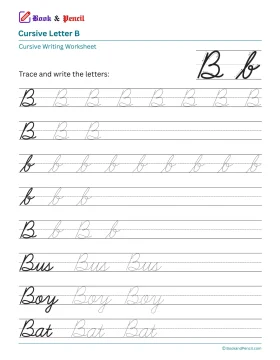
Worksheet 1 — Letter Tracing and Word Practice
uppercase cursive B and lowercase cursive b across full rows using dotted letter guides. A combined row alternates between uppercase B and lowercase b to build natural recognition of both forms together. Three real words are included for word-level tracing practice: Bus, Boy, and Bat.
Worksheet 2 — Cursive Passage for Letter B
A short cursive passage packed with the letter B for tracing and independent rewriting: “A big brown bear sat by a bush. Betty bought blue ball and a bag. Ben and Beth both began to bounce.” This passage places the letter B naturally in uppercase and lowercase positions across connected sentences, building both stroke fluency and reading recognition of cursive B in real text.
Worksheet 3 — Uppercase Grid Tracing
A grid-format sheet with individual boxes for tracing the uppercase cursive B. Three rows of traced uppercase letters are followed by four rows of blank grid boxes for independent writing practice without any tracing guide.
Worksheet 4 — Uppercase and Lowercase Grid Practice
A grid-format sheet that alternates between uppercase B and lowercase b in each box. Three rows of traced alternating letters followed by four rows of blank grid boxes build the learner’s ability to switch between both forms naturally in a single writing session.
Worksheet 5 — Lowercase Grid Tracing
A grid-format sheet focused entirely on the lowercase cursive b. Three rows of dotted lowercase letter tracing followed by four rows of blank independent practice boxes.
How to Write Cursive Letter B
Cursive lowercase b is one of the ascender letters, meaning it rises above the midline up to the headline. The stroke begins at the baseline with a smooth upward swing that rises all the way to the headline. From the top, the stroke curves back down along the right side to the baseline, then swings forward and upward in a small bump that closes at the midline to form the rounded body of the letter.
Cursive uppercase B begins with a tall vertical stroke descending from the headline to the baseline. From the baseline, the pen swings back upward along the left side of the stem, then curves outward to the right to form the upper rounded bump at the headline zone. The stroke continues downward and then curves outward again to form the lower and slightly larger rounded bump that closes at the baseline.
Tips for Writing Cursive Letter B
Keep the ascending stroke of lowercase b tall and straight. The upward stroke of lowercase b should reach cleanly to the headline without leaning or curving too early. A common mistake is starting the curve back down before reaching full height, which results in a b that looks too short and can be confused with other letters.
Make the two bumps of uppercase B different sizes. Uppercase cursive B has two rounded bumps that are not the same size. The lower bump should be visibly wider and fuller than the upper bump. Many learners make both bumps equal, which produces a B that looks flat and structurally unbalanced.
Pay attention to the exit stroke on lowercase b. After forming the rounded body of lowercase b, the exit stroke needs to swing smoothly to the right at midline height. In words like bus, boy, and bat, this exit stroke connects b to the letter that follows. If it drops too low, connecting letters will sit at inconsistent heights across the word.
Frequently Asked Questions (FAQs)
How do you write a lowercase cursive b?
Lowercase cursive b starts at the baseline with a smooth upward stroke rising to the headline. The stroke curves back down to the baseline, then swings forward and upward to form a small closed bump at the midline. The letter finishes with a rightward exit stroke at midline height.
Why does cursive lowercase b have an ascending stroke?
Cursive lowercase b is classified as an ascender because its tall upward stroke rises above the midline to the headline. This height makes b visually distinct from similar-looking letters and is an important feature to preserve during practice.
How does cursive lowercase b connect to the letters that follow it?
Cursive lowercase b exits with a rightward stroke at approximately midline height, connecting naturally to letters like a, u, o, and e. Practicing words like bus and bat helps learners develop this joining stroke in a natural context.