Free Cursive Letter D Worksheet — Printable PDF Practice Sheets
Learn how to write cursive letter D with our free printable cursive letter D worksheets. This set of five practice sheets covers uppercase and lowercase letter D tracing, grid-based letter practice, combined uppercase and lowercase recognition, and a full cursive passage built around the letter D. Every worksheet is a free PDF download that opens instantly in your browser. No account needed and no membership required.
Cursive letter D is one of the most visually distinctive letters in the alphabet because both its uppercase and lowercase forms involve a combination of the familiar oval entry stroke and an ascending extension that gives the letter its characteristic tall and elegant appearance.
Letter Tracing and Word Practice
Uppercase Grid Practice
Lowercase Grid Practice
Upper and Lowercase
Passage Writing Practice
What These Cursive Letter D Worksheets Include
This collection of five worksheets takes learners through every stage of writing cursive D, from first guided tracing all the way to writing the letter fluently within connected passage sentences.
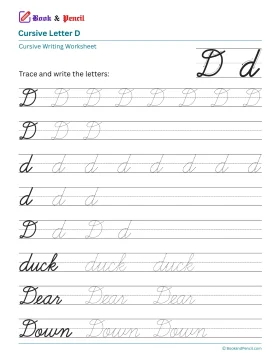
Worksheet 1 — Letter Tracing and Word Practice
Trace the uppercase cursive D and lowercase cursive d across full rows using dotted letter guides. A combined row alternates between uppercase D and lowercase d to build natural recognition of both forms together. Three real words are included for word-level tracing practice: duck, Dear, and Down.
Worksheet 2 — Uppercase Grid Practice
A grid-format sheet with individual boxes for tracing the uppercase cursive D. Three rows of traced uppercase letters are followed by four rows of blank grid boxes for independent writing practice without any tracing guide.
Worksheet 3 — Lowercase Grid Practice
A grid-format sheet focused entirely on the lowercase cursive d. Three rows of dotted lowercase letter tracing followed by four rows of blank independent practice boxes.
Worksheet 4 — Uppercase and Lowercase Practice
A grid-format sheet that alternates between uppercase D and lowercase d in each box. Three rows of traced alternating letters followed by four rows of blank grid boxes build the learner’s ability to switch between both forms naturally in a single writing session.
Worksheet 5 — Passage Writing Practice
A short cursive passage packed with the letter D for tracing and independent rewriting: “Dan and Daisy drew a duck near the deep dark den. The dog dug a ditch and dropped a dusty dime.” This passage places the letter D naturally in both uppercase and lowercase positions across connected sentences, giving learners the experience of writing cursive d in rapid succession within words like dug, ditch, dropped, and dime.
How to Write Cursive Letter D
Cursive lowercase d starts with a small oval shape similar to cursive a and c. After forming the oval, the stroke rises upward in a tall loop that reaches the headline before curving back down to the baseline. The letter finishes with a smooth exit stroke to connect with the next letter. Its unique look comes from combining a rounded oval with a tall upward stem.
Cursive uppercase D begins with a looping stroke near the headline and then sweeps downward before curving broadly to the right. The large rounded arc creates the open body of the letter and returns upward toward the headline. The main challenge is keeping the wide curve smooth and rounded instead of making it look stiff or angular.
Tips for Writing Cursive Letter D
Close the oval of lowercase d before beginning the ascending stroke. A common problem with lowercase cursive d is that the oval portion is left open or incompletely formed before the ascending stroke begins. The oval should be fully closed at the midline before the pen begins its upward climb toward the headline. An incomplete oval makes the letter difficult to distinguish from other letters and disrupts the visual clarity of words like duck and down.
Keep the ascending stroke of lowercase d straight and tall. The ascending stroke of lowercase d should rise cleanly and nearly vertically from the top of the oval to the headline without leaning heavily to the left or right. A stroke that leans too far in either direction gives the letter an unstable appearance and can cause it to look like a different letter entirely when written within words.
Practice the broad right curve of uppercase D as a single unbroken motion. The sweeping right curve of uppercase D is the defining feature of this letter and it must be formed in one continuous stroke without pausing, lifting, or changing direction mid-arc. Pausing during the curve creates a visible corner or kink that breaks the smooth rounded appearance. Practicing this sweeping stroke in slow deliberate movements before attempting full-speed writing builds the muscle memory needed to produce it consistently.
Use the passage words to practice lowercase d in connecting contexts. The passage “Dan and Daisy drew a duck near the deep dark den” puts lowercase d into direct contact with a wide variety of following letters including u, r, a, e, and o. Tracing these connections slowly on Worksheet 2 gives learners practical experience with how the exit stroke of lowercase d flows into different letter entry strokes, which is one of the most useful connection exercises available at the letter D stage.
Frequently Asked Questions (FAQs)
How do you write a lowercase cursive d?
Lowercase cursive d starts with a small closed oval between the baseline and midline. From the top of the oval, the stroke rises in a tall loop to the headline, curves back down along the right side, and ends with a smooth connecting exit stroke.
How does cursive lowercase d connect to the letters that follow it?
Cursive lowercase d ends with a smooth rightward exit stroke that connects easily to letters like u, e, o, and a in words such as duck and down.
Is cursive lowercase d related to other oval-based cursive letters?
Yes. Cursive lowercase d shares its oval entry stroke with cursive a, c, g, o, and q. All of these letters begin with the same leftward curving arc that forms an oval or partial oval between the baseline and midline.