
Number Words Quiz for Kindergarten – Free Online Practice
A free online quiz that turns numbers into words — 60 numeral-to-word matching questions in 3 levels, for ages 4 to 6.
If you are looking for a number words quiz kindergarten children actually enjoy, you are in the right place. Each question asks your child to connect a number with its written name — 7 becomes seven, and twelve becomes 12. It is free, it works on phones, tablets and computers, and there is no signup. Whether you search for a number words quiz, a numbers to words quiz or spelling numbers games, this page gives your child sixty different ways to learn number words, from a simple one two three quiz all the way up to twenty.
Math: Kindergarten Number Words
Great Work!
You completed the quiz!
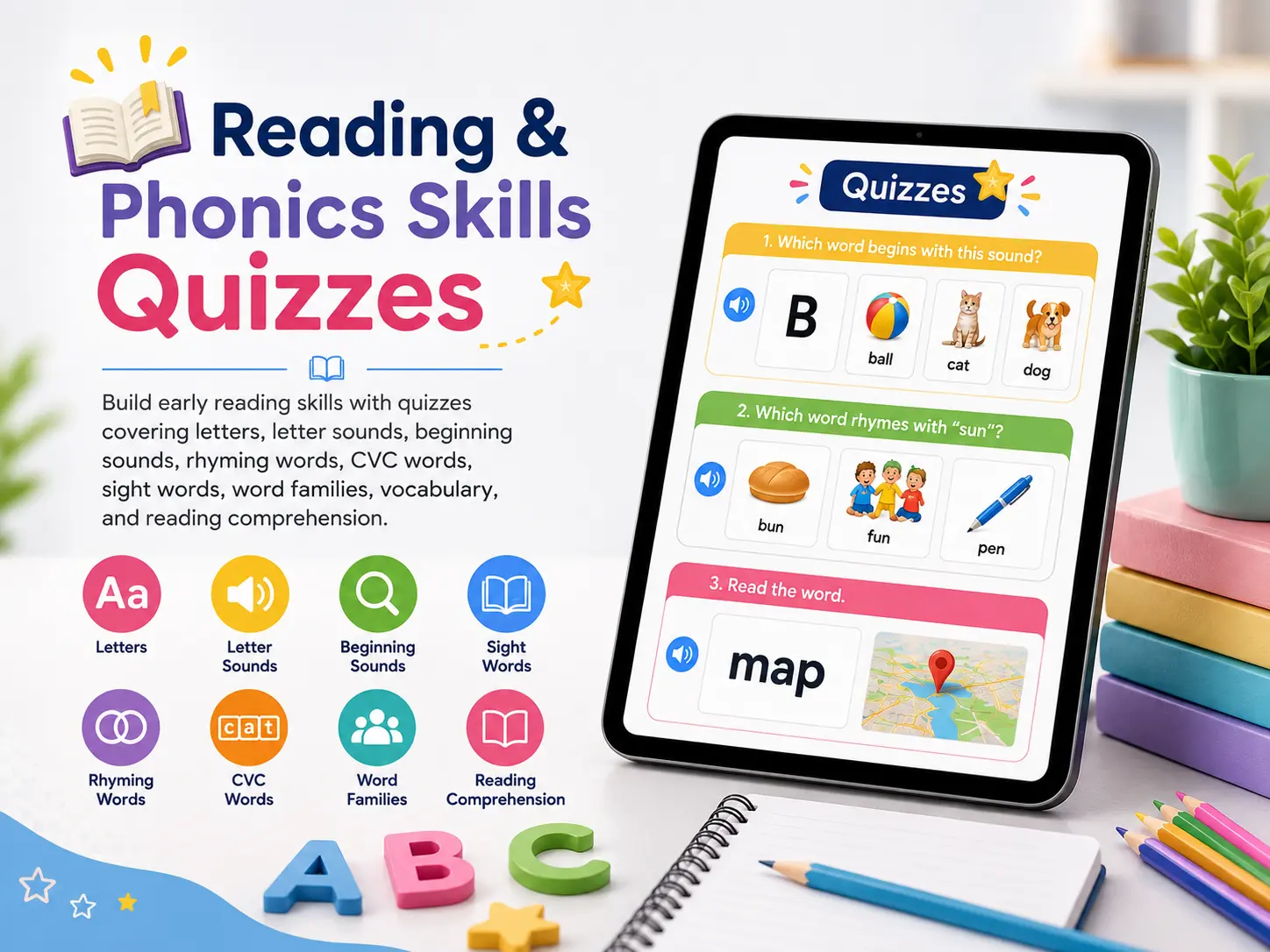
Kindergarten Reading & Phonics Skills
Build early reading skills with quizzes covering letters, letter sounds, beginning sounds, rhyming words, CVC words, sight words, word families, vocabulary, and reading comprehension.
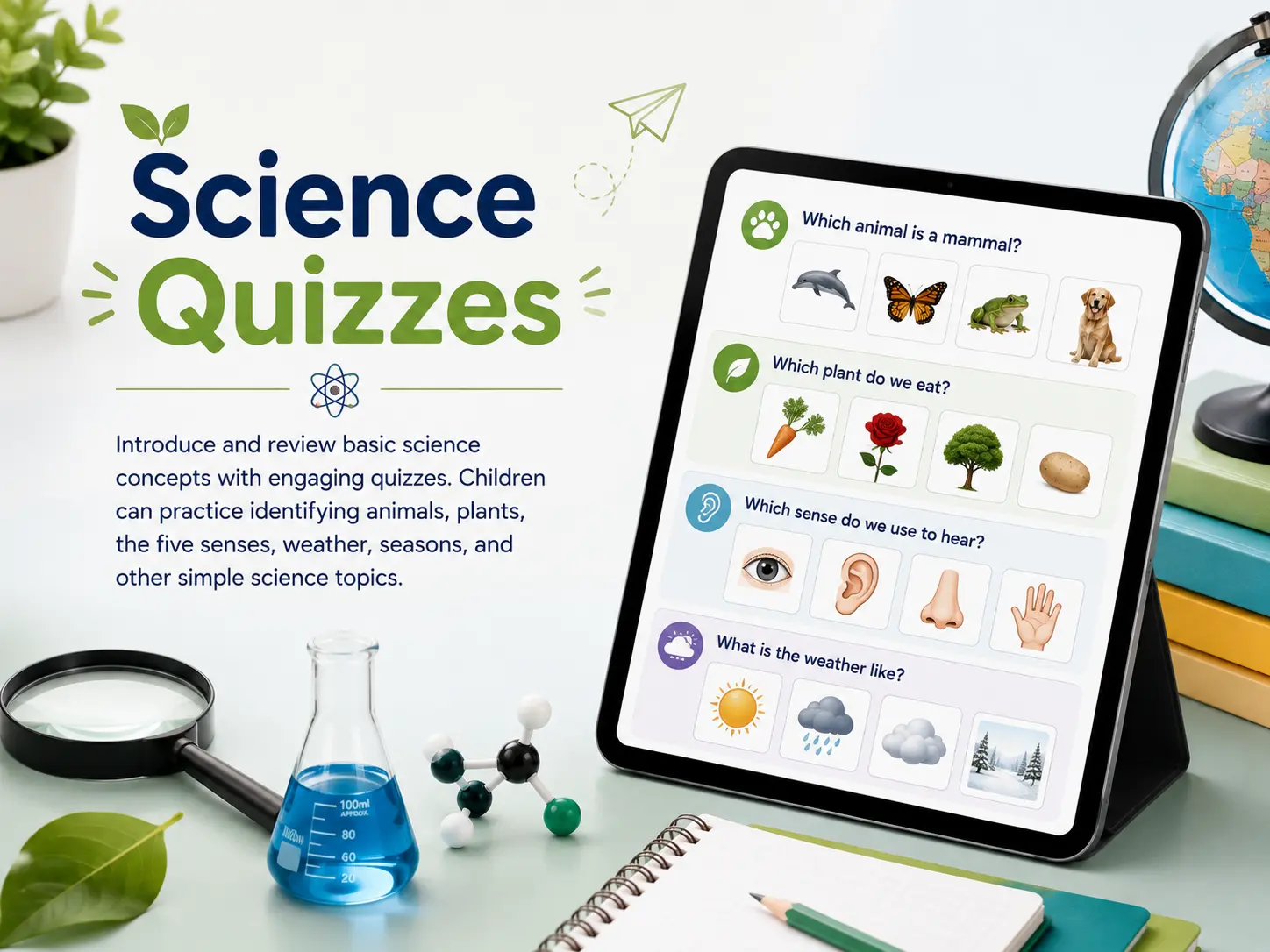
Kindergarten Science Quizzes
Introduce and review basic science concepts with kindergarten science quizzes. Children can practice identifying animals, plants, the five senses, weather, seasons, and other simple science topics through age-appropriate questions.
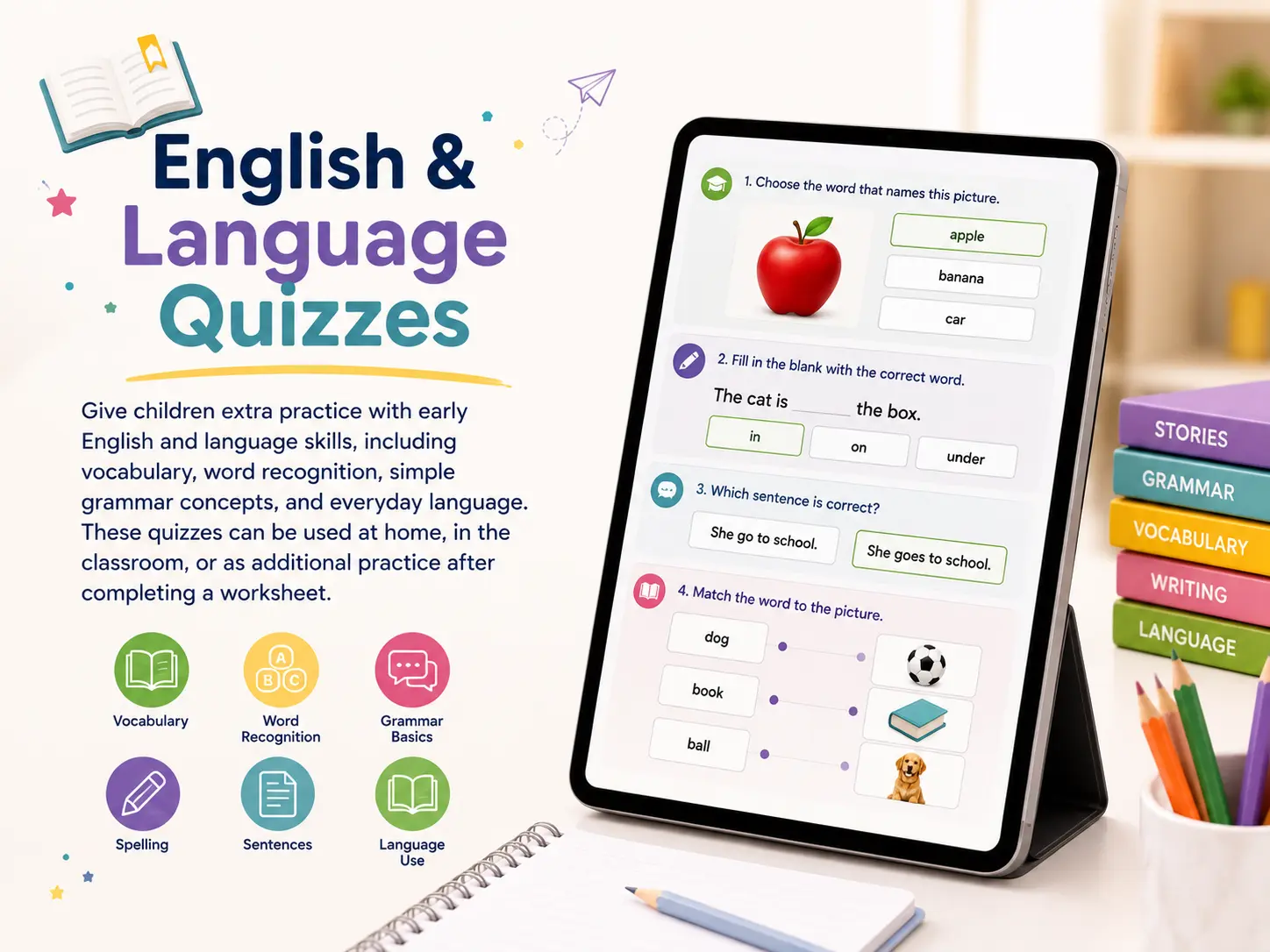
Kindergarten English & Language Quizzes
Give children extra practice with early English and language skills, including vocabulary, word recognition, simple grammar concepts, and everyday language. These quizzes can be used at home, in the classroom, or as additional practice after completing a worksheet.
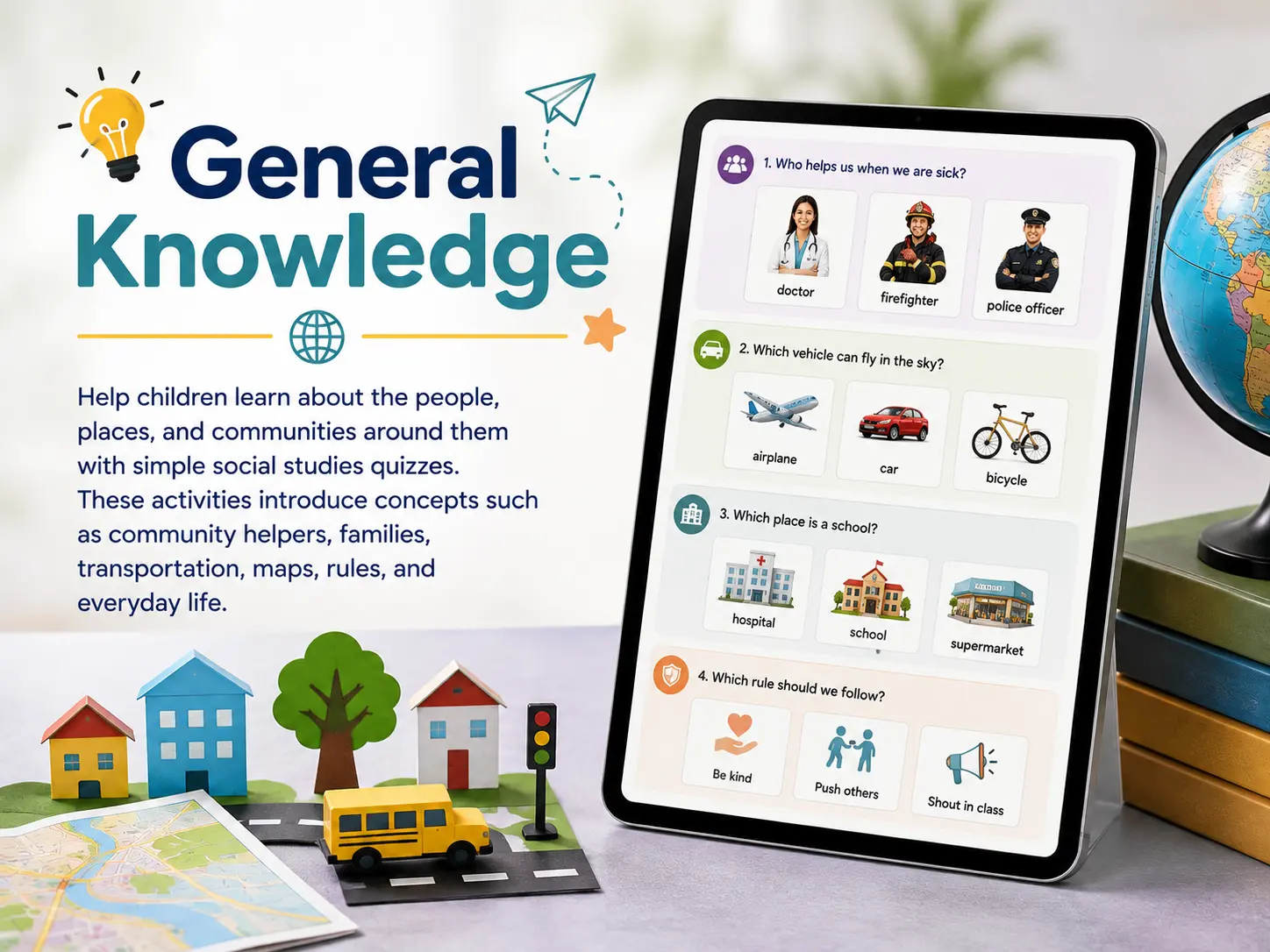
Kindergarten General Knowledge
Help children learn about the people, places, and communities around them with simple kindergarten social studies quizzes. These activities introduce concepts such as community helpers, families, transportation, maps, rules, and everyday life.
Free Kindergarten Quizzes by Subject
Choose a subject below to find free kindergarten quizzes and practice activities. Each section focuses on age-appropriate skills commonly introduced during kindergarten.
What this number words quiz covers
This number words quiz kindergarten learners can actually finish covers the words one to twenty. Every question connects a numeral with its written name — a true number names quiz for kindergarten — in one direction or the other: your child might match 7 to seven, or read the word twelve and pick 12. Nothing here asks children to count objects — this quiz is about the names of numbers, the words children will meet in story problems and spelling lists all through Grade 1.
The three levels work like stepping stones. Easy stays with one to ten, with picture counting and simple matching so young children meet each word gently. Medium brings in the teen words — eleven to twenty — with first letters, missing letters and rhymes. Hard turns children into spelling detectives: eight or eightt, fifteen or fiveteen, and words read backwards in a mirror. By the end, this number words quiz kindergarten learners finish will have tested every word from one to twenty.
Because it lives inside our kindergarten math quizzes collection, this number words quiz sits alongside practice for counting, comparing and adding — the full set of early math skills in one place.
How the quiz works
Playing takes less than a minute to start. As a free online quiz for kids, there is nothing to install or sign up for. Press start, pick a level, and answer each question by tapping one of four choices. Every answer gets instant feedback, so your child knows right away whether seven was the right word for 7. That instant loop is what makes a number words quiz kindergarten children stick with more effective than a printed worksheet.
The three levels feel different on purpose. Easy asks one short question at a time with friendly characters like Lily the frog. Medium plays tricks with teen words that sound alike. Hard is all detective work — spelling traps, backwards words and two-step stories. A child can replay any level as often as they like; with 60 questions, the kindergarten number words practice never runs dry.
Skills your child practices
Matching numbers to words looks simple, but this number words quiz kindergarten teachers recommend trains several skills at once:
- Word recognition — seeing twelve and knowing it means 12, instantly.
- Spelling patterns — noticing how thirteen, fourteen and fifteen share their -teen ending.
- Listening carefully — many questions are read aloud, so children learn to catch the number word hiding inside a sentence.
- Thinking flexibly — going from number to word and back again, instead of only one direction.
- Stamina — working through 20 or 30 questions builds the focus Grade 1 will ask for.
Age and grade guide
| Age | Grade | What to expect |
|---|---|---|
| 4–5 | Pre-K | Start with Easy. Read every question aloud and let your child tap the word they hear. |
| 5–6 | Kindergarten | The sweet spot. Most children can work Easy and Medium with a little help on the teen words. |
| 6–7 | Grade 1 | Use Medium and Hard as spelling practice — the trap answers are exactly the mistakes Grade 1 makes. |
Every child is different. If the Easy level feels too simple after a few questions, jump straight to Medium — the teen words are where the real learning starts. And if Hard feels frustrating, there is no shame in replaying Medium until the words feel automatic. Whatever level fits today, this number words quiz kindergarten families replay stays fun — confidence first, challenge second.
How to use the quiz at home or in the classroom
At home
Ten minutes a day with a number words quiz kindergarten parents can run from the couch is enough. Read the story questions aloud with expression, and when your child misses one, ask them to spell the right word letter by letter — hearing themselves say T-W-E-L-V-E is what makes it stick. Keep a pencil and paper nearby for the spelling questions so they can try writing the word too. Short daily sessions with this number words quiz kindergarten parents run from the couch build spelling faster than one long weekend session.
In the classroom
Use the quiz as a five-minute station during math centers, or project one level for the whole class and let children call out answers together. The three levels make differentiation easy: struggling readers take Easy with a buddy, while confident spellers tackle Hard on their own. The instant feedback means you are free to circulate instead of marking.
Tips to help your child do their best
These five habits make this number words quiz kindergarten children play more productive:
- Read it, say it, spell it. For every new word: read it on screen, say it out loud, then spell it letter by letter.
- Clap the parts. Twelve becomes twel-ve, twenty becomes twen-ty. Clapping syllables untangles look-alike words.
- Hunt the traps. When a wrong answer looks almost right (fiveteen, eightt), study it — knowing why it is wrong teaches more than the right answer alone.
- Write the word. After the quiz, have your child write five words from memory. Handwriting cements spelling.
- Quit while it is fun. Stop at the first sign of frustration. A fresh brain tomorrow beats a tired brain today.
Answer key for parents and teachers
Level 1 — Easy (questions 1–10)
- B — Four. The number 4 matches the word “four”.
- C — Six. Count the stars: there are six.
- A — 8. The word “eight” means the number 8.
- C — Three. Lily holds three balloons, so the gap needs “three”.
- A — Seven. Counting on in words: five, six, seven.
- D — Two. The trap word “to” sounds the same but is not a number word.
- B — Nine. Count Ben’s footballs carefully: nine in total.
- C — 10. The word TEN on the door means the number 10.
- A — Five. One hand has five fingers.
- D — One. The number 1 matches the word “one” — learned by sight, not by sounding out.
Level 2 — Medium (questions 1–20)
- C — Twelve. The number 12 matches the word “twelve”.
- B — 15. The word “fifteen” means the number 15.
- D — Fourteen. Ten hearts and four more make fourteen — count on in words.
- A — Thirteen. After twelve comes thirteen.
- B — Sixteen. The page after fifteen is sixteen.
- C — Eighteen. The number 18 matches “eighteen” — not the trap word “eight”.
- D — Twenty. It starts with Tw- and is the biggest word here: twenty.
- B — 17. SEVENTEENTH means the 17th date.
- A — Eleven. Count the dots: eleven in total.
- C — V. TWEL_E is missing the letter V — say “twelve” slowly to hear it.
- D — 19. The word “nineteen” means the number 19.
- B — Nine. That is the correct spelling; the others are traps.
- B — Ten. T-E-N unmixed spells “ten”.
- D — Nine. Of these words, only “nine” starts with N.
- C — Eight. “Eight” rhymes with “late”.
- A — 17. The sign says SEVENTEEN, so it is bus stop 17.
- B — E. _IGHTEEN is missing its first letter: E.
- C — Fourteen. That is the correct spelling of 14.
- B — Sixteen. It sits between fifteen and seventeen.
- C — Twenty. Two full groups of ten make twenty.
Level 3 — Hard (questions 1–30)
- B — Eight. Correct spelling — “eightt” has an extra T.
- C — Twelve. Correct spelling — watch the V before the E.
- D — Two. Spell each word slowly: only “two” has no letter E.
- B — Fifteen. Five changes shape: f-i-f, not f-i-v.
- A — Fourteen. It hides between thirteen and fifteen.
- C — 5. S-E-V-E-N has five letters.
- B — Eighteen. First 10 + 8 = 18, then find the word for 18.
- A — W. T_ENTY is missing the letter W.
- C — Thirteen. That is 13 — “thirty” means 30.
- D — Two. OWT flipped around reads “two”.
- B — Eight. In ABC order, “eight” comes before nine, seven and twelve.
- C — Eighteen. Two days before the twentieth: twenty, nineteen, eighteen.
- A — Seventeen. Ten stars and seven more make seventeen.
- C — Seventeen. Counting back in words: twenty, nineteen, eighteen, seventeen.
- D — Seven. It is the only one of these words that ends in N.
- C — Two. Starts with T, ends with O, and is very small: “two”.
- B — Nine. Correct spelling — the others hide extra letters.
- B — Eighteen. Eight + teen drops one T: “eighteen”.
- C — Thirteen. After twelve, before fourteen, ends in -teen.
- D — 14. The sentence says FOURTEEN children.
- B — T. The two missing letters are T-W; T comes first.
- D — Thirteen. With eight letters, it is the longest here.
- A — Four. “Four” rhymes with “door”.
- C — Eight. Counting by 2s in words: two, four, six, eight.
- A — Eleven. One less than twelve is eleven.
- C — Twelve. 5 + 7 = 12, and the word for 12 is “twelve”.
- D — Seven. The others start with T; “seven” is the odd one out.
- B — Sixteen. Ten ducks and six more make sixteen.
- D — Twenty. Correct spelling of 20 — not “twentty”.
- C — Fourteen. Count on from eleven: twelve, thirteen, fourteen.
What to practice next
A number words quiz kindergarten children enjoy builds the names of numbers — the foundation everything else in math is written with. Once the words feel easy, keep going:
- Number order. Our missing number quiz for kindergarten practices what comes before and after — the perfect partner to word forms.
- Counting. The counting quiz turns quantities into numbers, the step just before naming them in words.
- Comparing. Try the comparing numbers quiz for greater than and less than.
- Adding. When words and order both feel solid, the addition quiz is the natural next mountain.
You can find them all, plus quizzes for every grade, in our kindergarten quizzes collection.
Frequently asked questions
What is a number words quiz?
A number words quiz matches numbers to their written names. Your child might see 7 and pick seven, or see the word twelve and pick 12. It teaches the word forms of numbers, which is a different skill from counting.
What age is this number words quiz for?
This number words quiz for kindergarten is made for ages 4 to 6. Younger children can start with the Easy level while a parent reads the questions aloud, and confident readers can move up to Medium and Hard.
How many questions are in the quiz?
There are 60 questions in three levels: Easy has 10, Medium has 20 and Hard has 30. A child can play one level at a time, and each level works the words in a different way so practice never gets boring.
Does the quiz save my child’s answers?
No. The quiz never asks for a name, email, age or any personal detail. It does not use cookies or tracking, it stores nothing, and nothing is sent anywhere. Everything happens in the browser and disappears when the page is closed.
How can I use this quiz at home with my child?
Try ten minutes a day: let your child play one level, then ask them to spell the trickiest word out loud, because saying the letters is where the spelling sticks. You can also write the words one to twenty on cards and play matching pairs at the kitchen table.
How can teachers use this quiz in the classroom?
It works well as a five-minute warm-up before a math lesson, as a station in math centers, or as a quick check after teaching number words. The three levels make it easy to give every child the right level of challenge.
My child mixes up twelve and twenty. What helps?
That is completely normal — twelve and twenty look and sound alike at first. Say both words slowly together and clap once for each part: twel-ve, twen-ty. Then point at 12 and 20 side by side so your child sees that the starting letters are different.
What should my child practice after this quiz?
After number words, the natural next steps are number order with missing numbers, counting objects, and comparing numbers. Each skill has its own free quiz, linked in the What to practice next section below.
Is the quiz free?
Yes. The full 60-question quiz is free, with no signup and no account needed. Just press start and play.
How is this different from a number words worksheet?
A worksheet is printed once and finished, while this quiz gives instant feedback, three difficulty levels and 60 fresh questions, so a child can practice the same words many times without getting bored.
Made for parents and teachers by Book and Pencil. Last updated October 2026.