Addition on a Number Line Worksheets– Free Download
Kids don’t always “get” math when it’s just numbers on a page. But with addition on a number line, something clicks. They can see the jump, the movement, the why. You’ll find printable worksheets here that use this simple method to make learning more visual.
Number Line Addition – Jump and Add, Circle the Right Number!
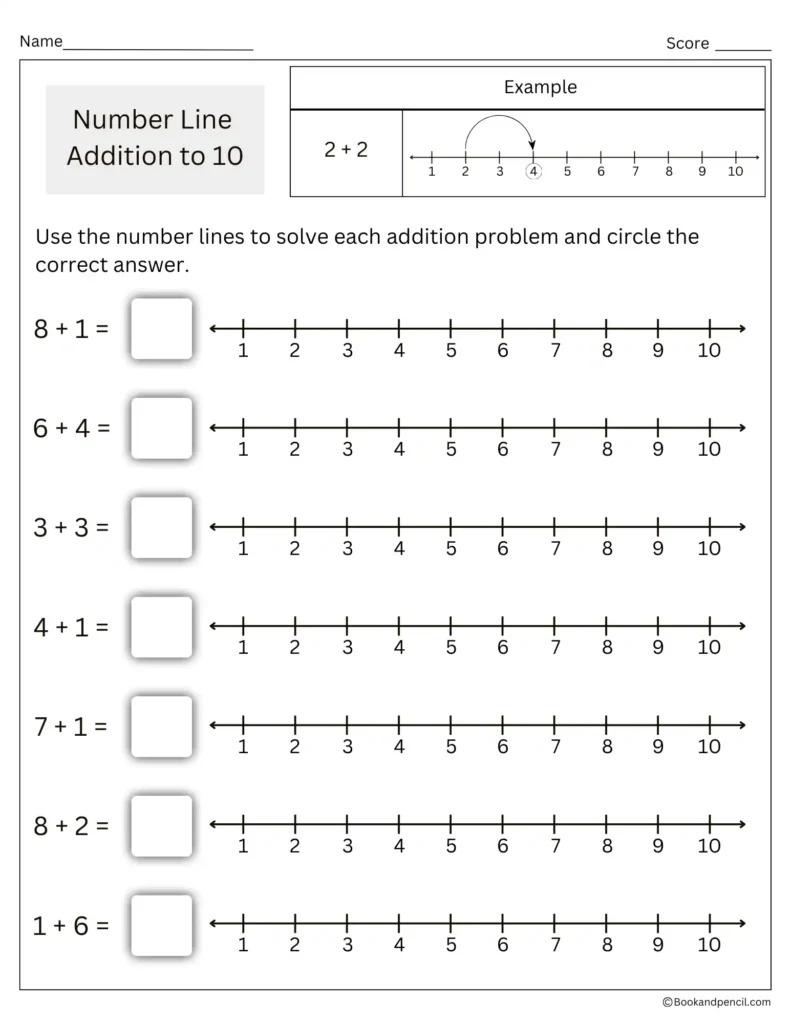
Number Line Addition to 10
- Kids solve seven simple addition problems using number lines that go from 1 to 10.
- The top example (4 + 2) shows how to count forward on the number line and circle the answer.
- Each problem has its own number line for students to count and find the sum, with space to write and circle the correct answer.
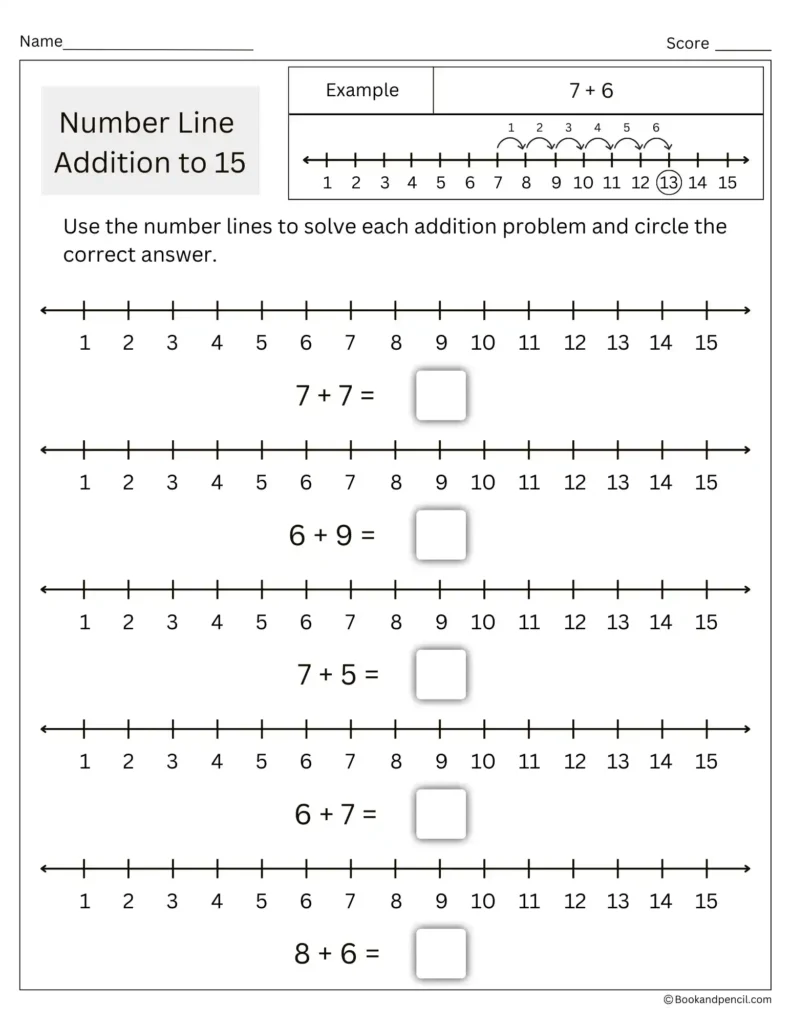
Number Line Addition to 15
- Start by looking at the example (7 + 6) at the top. It shows how to jump forward on the number line to find your answer.
- Next, solve six problems below, each with its own number line from 1 to 15.
- Count your jumps, write your answer in the box, and circle it right on the number line.
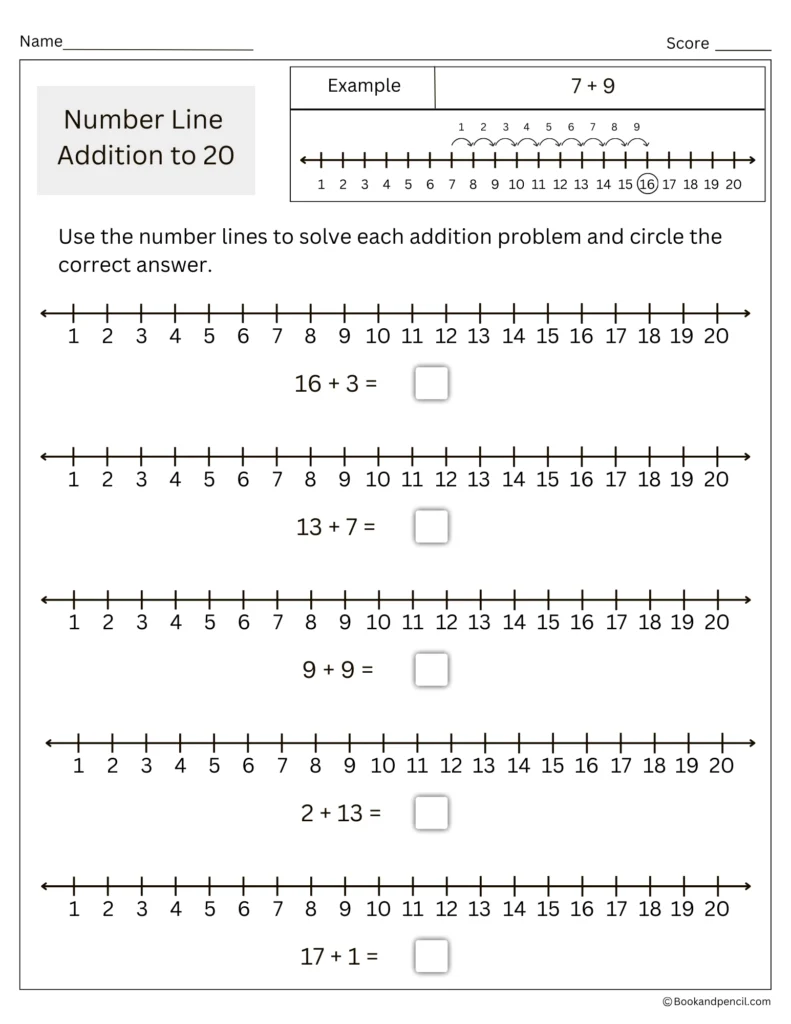
Number Line Addition to 20
- Begin with the example (7 + 9) at the top. It shows how to hop along the number line to reach the answer.
- Then, solve seven addition problems below, each with its own number line from 1 to 20.
- Make your jumps, write the sum in the box, and circle the answer directly on the number line.
Find the Missing addend Worksheets
In these find the missing addend worksheets, students identify the number that must be added to complete each addition sentence. The missing addend activities use number lines to help learners determine unknown values accurately. Students practice how to find unknown numbers in addition sentences by completing each equation based on the given total.
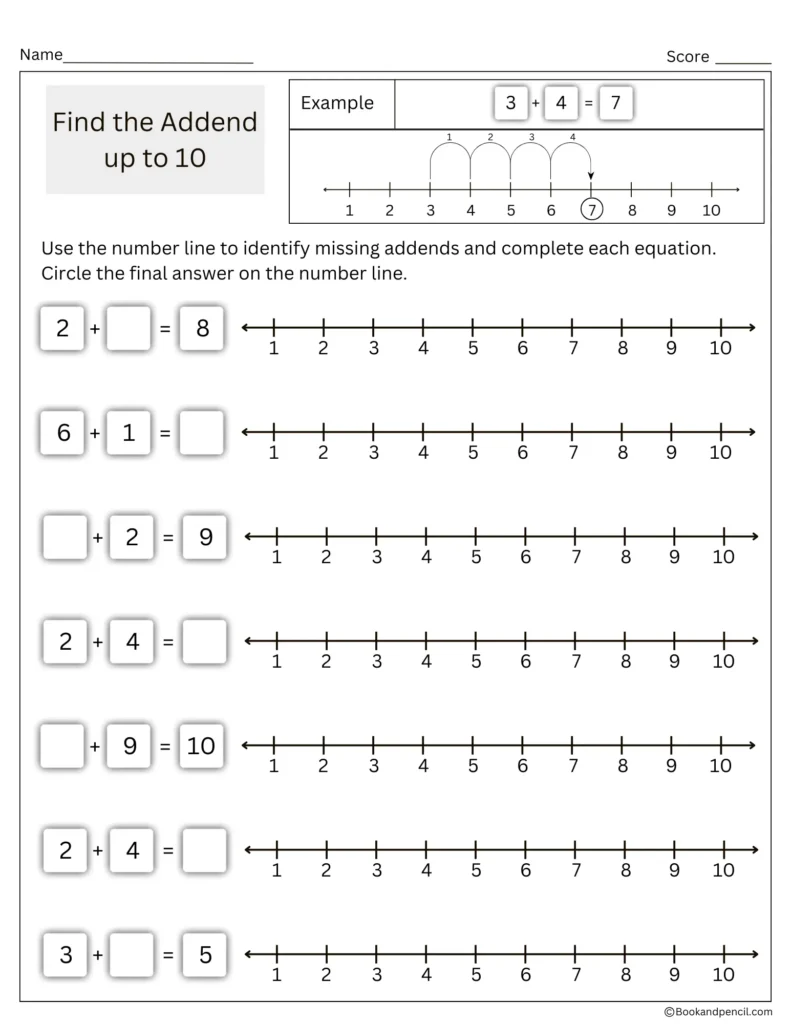
Missing Addend on a Number Line up to 10
- Students solve missing addend problems using number lines that go from 1 to 10. The top example (3 + 4) shows how to start at 3, count forward on the number line, and circle the final answer.
- Each equation includes one given addend, one missing addend, and the total, with space provided to write the unknown number.
- A separate number line is included for each problem so students can count forward step by step to complete the addition sentence.
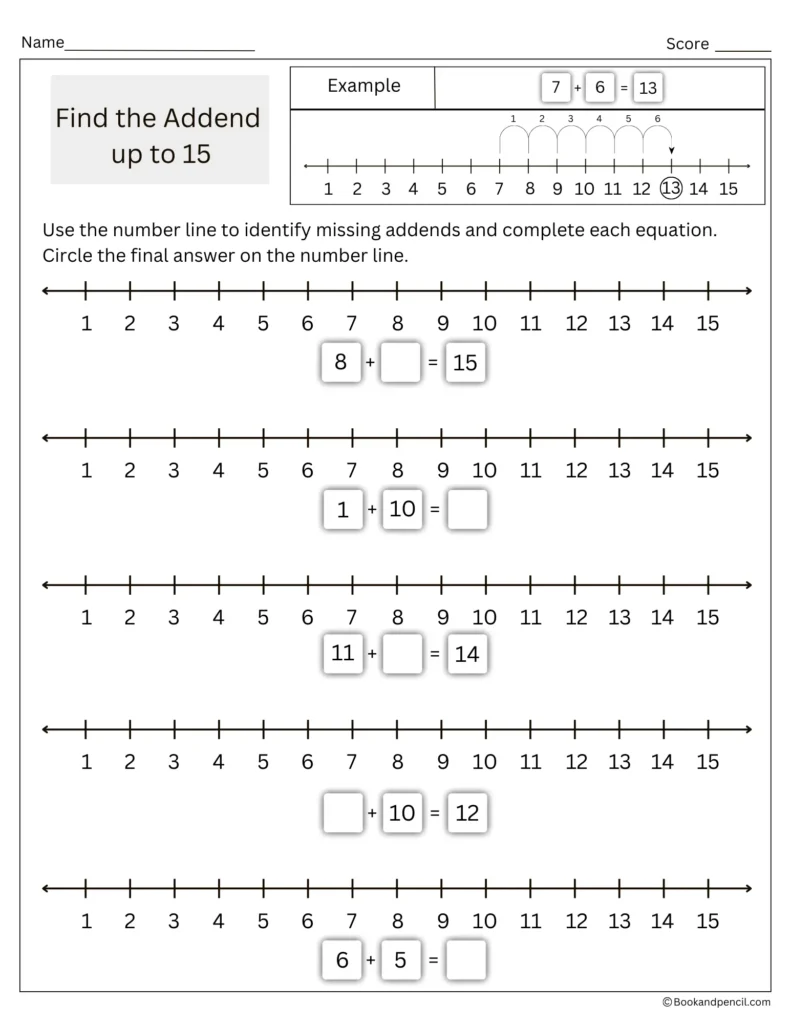
Number Line Addition to 15
- Students solve missing addend problems using number lines that go from 1 to 15. The top example (7 + 6) shows how to start at the given addend, count forward on the number line, and circle the total.
- Each equation presents one known addend, one missing addend, and the final sum, with space to write the unknown number.
- A separate number line is provided for each problem so students can count forward accurately to complete the addition sentence.
Kindergarten Number Line Addition Worksheets (Shape & Picture-Based)
These kindergarten number line addition worksheets guide students to solve addition problems by counting forward along a number line. Learners use visual models such as shapes and objects to understand how numbers increase when adding.
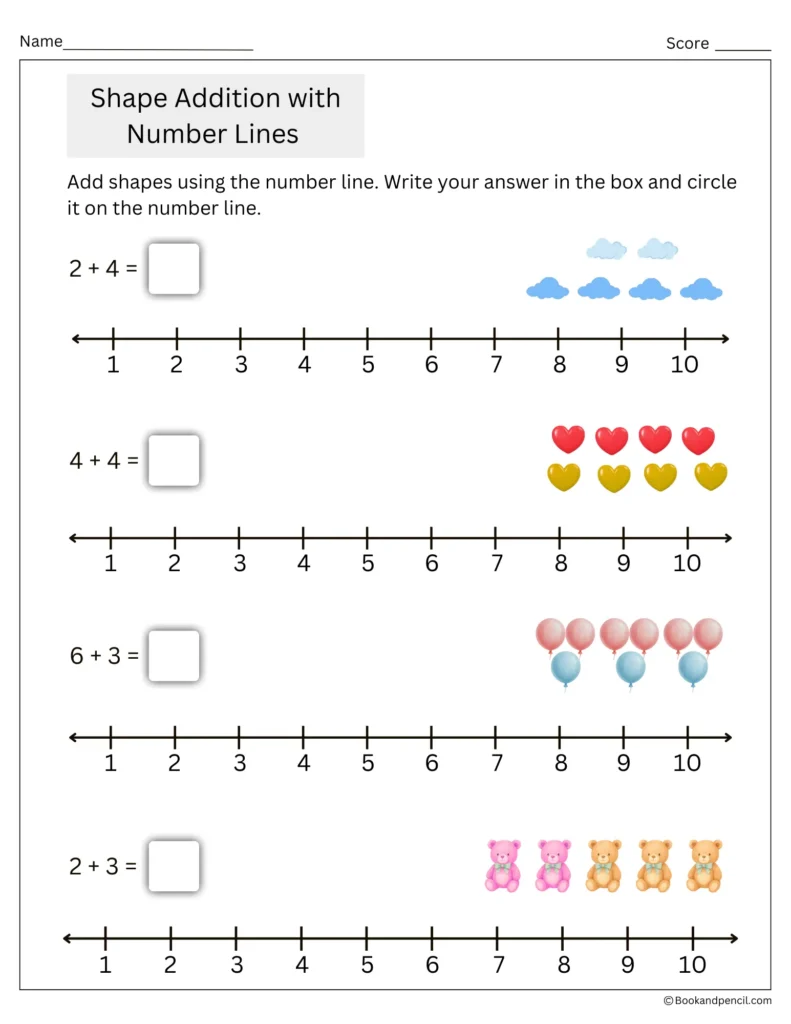
Picture-Based Number Line Addition Practice
Students identify each addend using picture groups, then follow the number line step by step to solve single digit addition problems and determine the correct total for each equation.
Learners write the answer and circle the final number reached to demonstrate how movement along the number line supports accurate single digit addition.
Teachers should focus on strategy use rather than speed, making this worksheet suitable for guided practice, intervention, or visual learning support.
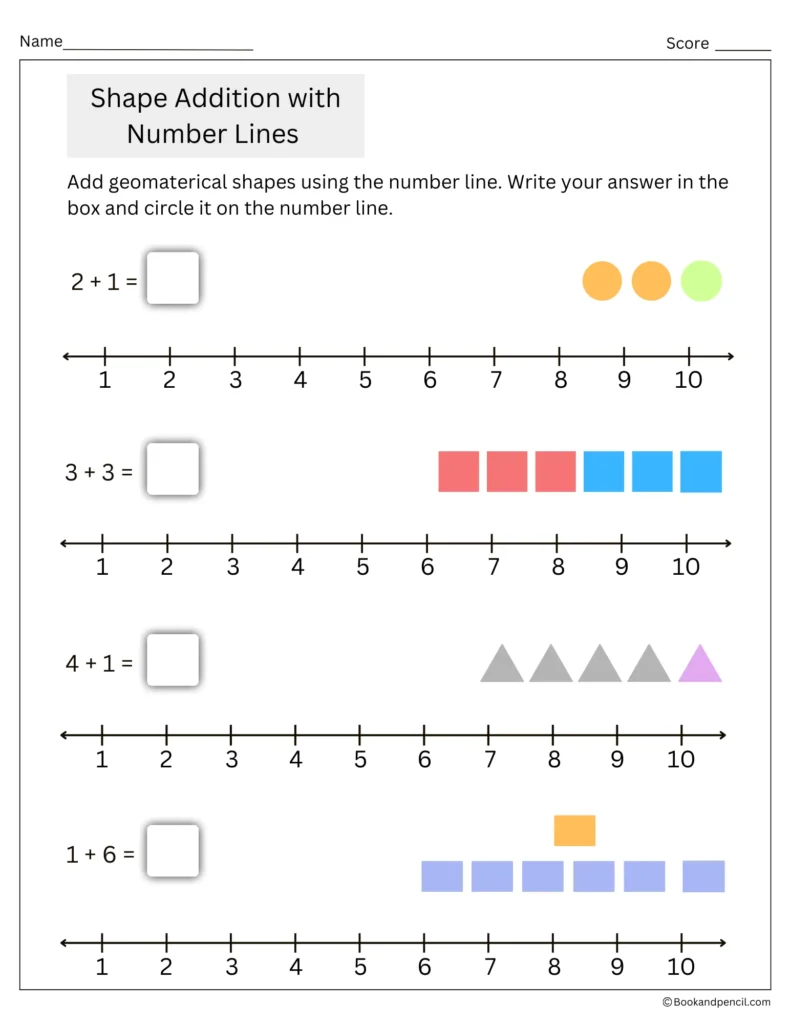
Shape Addition with Number Lines (Geometric Sets)
Students count two different groups of geometric shapes, then use the number line to combine both groups by counting forward from the first quantity.
After completing the forward count, students record the sum and mark the final position on the number line to visually confirm the solution.
Teachers can use this worksheet to check conceptual understanding by asking students to explain how the shapes connect to each counted step.
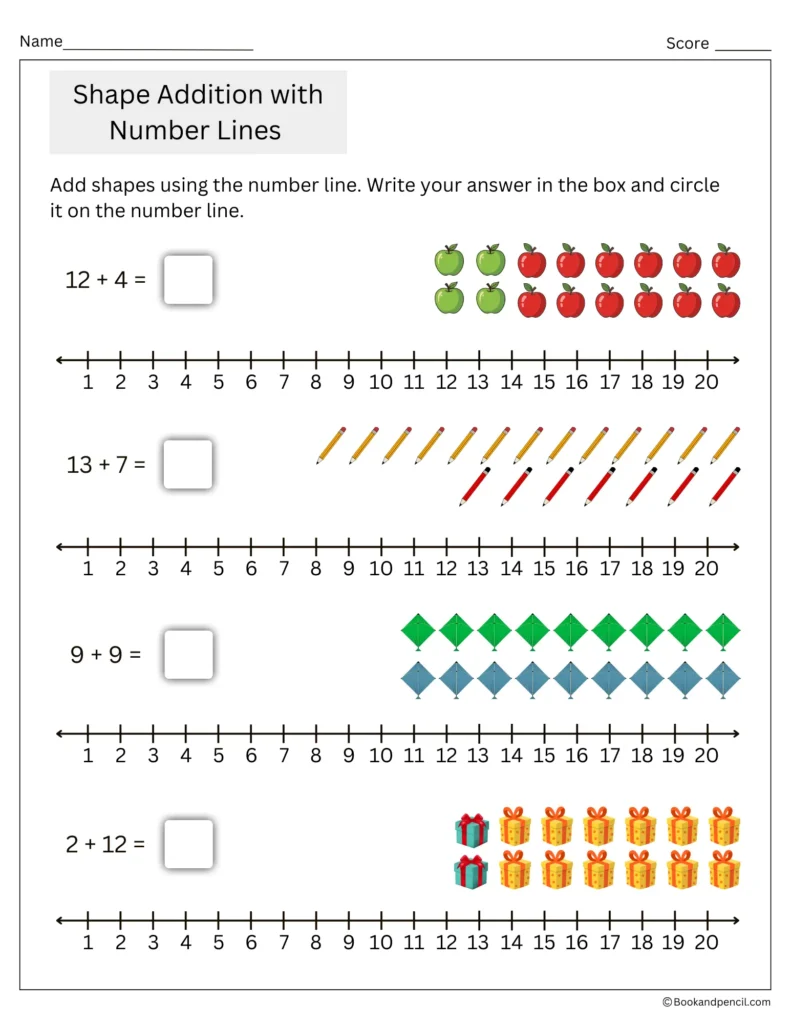
Addition on the Number Line to 20 (Objects-Based)
Students start at the given two-digit number and move forward on the number line while counting the pictured objects (such as apples, pencils, kites, or gifts) to model each addition problem.
Learners write the total in the answer box, then circle the ending number on the number line to show the result of counting forward.
Teachers should emphasize correct starting points and monitor counting accuracy, as this worksheet is designed to strengthen number sense and addition fluency beyond 10.
How to Graph an Addition Problem on a Number Line – A Visual Strategy
Using visual addition strategies like number lines helps build number sense, encourages active learning, and supports early problem-solving skills — especially in kindergarten and grade 1.
Example:
To solve 5 + 4, a child can:
Start at number 5 on the number line
Make 4 jumps forward (each jump represents +1)
Land on 9, which is the correct answer
This approach is called the addition jump method.
How to Graph an Addition Problem on a Number Line – Step-by-Step
Step 1: Draw a Number Line
Draw a straight line and mark it with numbers — usually from 0 to 10, or up to 20, depending on the problem.
Step 2: Identify the First Number
Look at the first number in the equation. For example, in 4 + 5, you’ll start at 4.
Step 3: Make Forward Jumps
From your starting point, jump forward by the second number. In this case, jump 5 steps from 4.
Step 4: Find Your Answer
The number you land on is your answer.
So, 4 + 5 = 9.
Tip: Use arrows to show each jump on the number line. This helps children follow the movement and understand how addition works visually.