
Ordinal Numbers Quiz for Kindergarten – Free Online Practice
A free online quiz that turns 1st, 2nd and 3rd into a game — 60 questions in 3 levels, for ages 4 to 6.
If you are looking for an ordinal numbers quiz kindergarten children actually enjoy, you are in the right place. Each question asks about places — who is 1st in the race, which duck is 3rd in line, what comes just after 5th. It is free, it works on phones, tablets and computers, and there is no signup.
If you are looking for an ordinal numbers quiz kindergarten children actually enjoy, you are in the right place. Each question asks about places — who is 1st in the race, which duck is 3rd in line, what comes just after 5th. It is free, it works on phones, tablets and computers, and there is no signup. Whether you search for an ordinal numbers quiz, a first second third quiz for kindergarten or 1st 2nd 3rd practice games, this page teaches positions sixty different ways.
Math: Kindergarten Ordinal Numbers
Great Work!
You completed the quiz!
Free Kindergarten Quizzes by Subject
Choose a subject below to find free kindergarten quizzes and practice activities. Each section focuses on age-appropriate skills commonly introduced during kindergarten.
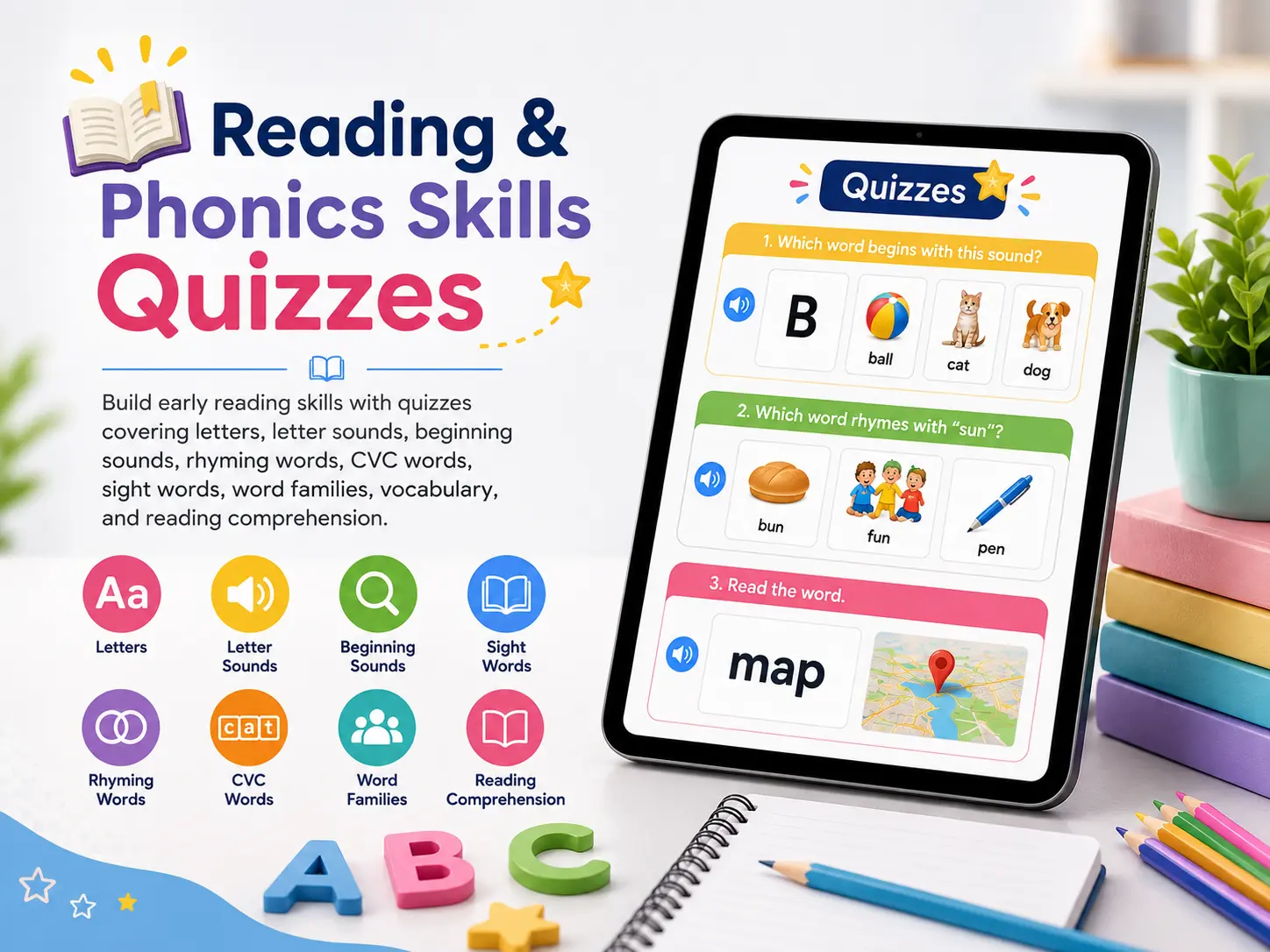
Kindergarten Reading & Phonics Skills
Build early reading skills with quizzes covering letters, letter sounds, beginning sounds, rhyming words, CVC words, sight words, word families, vocabulary, and reading comprehension.
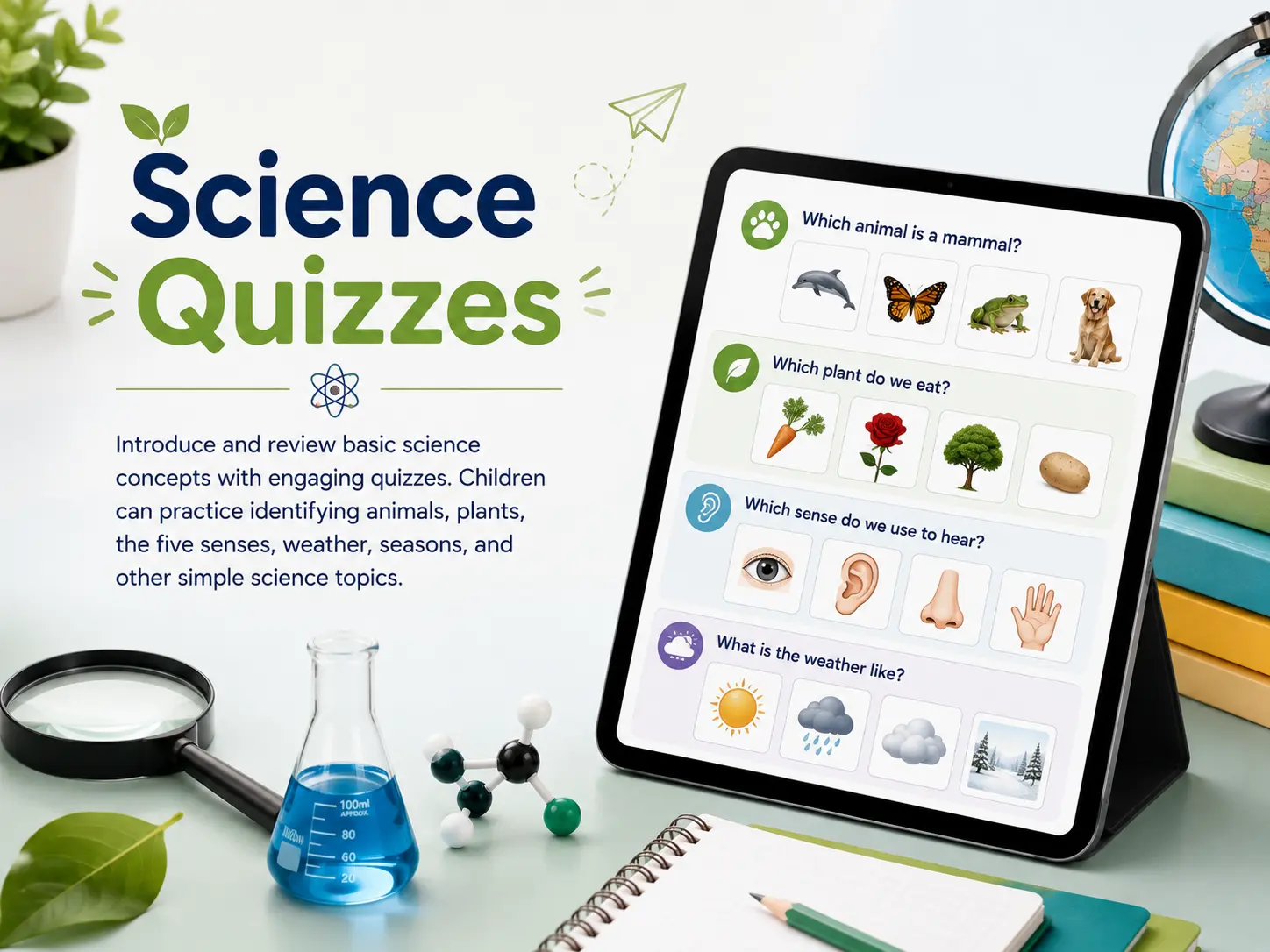
Kindergarten Science Quizzes
Introduce and review basic science concepts with kindergarten science quizzes. Children can practice identifying animals, plants, the five senses, weather, seasons, and other simple science topics through age-appropriate questions.
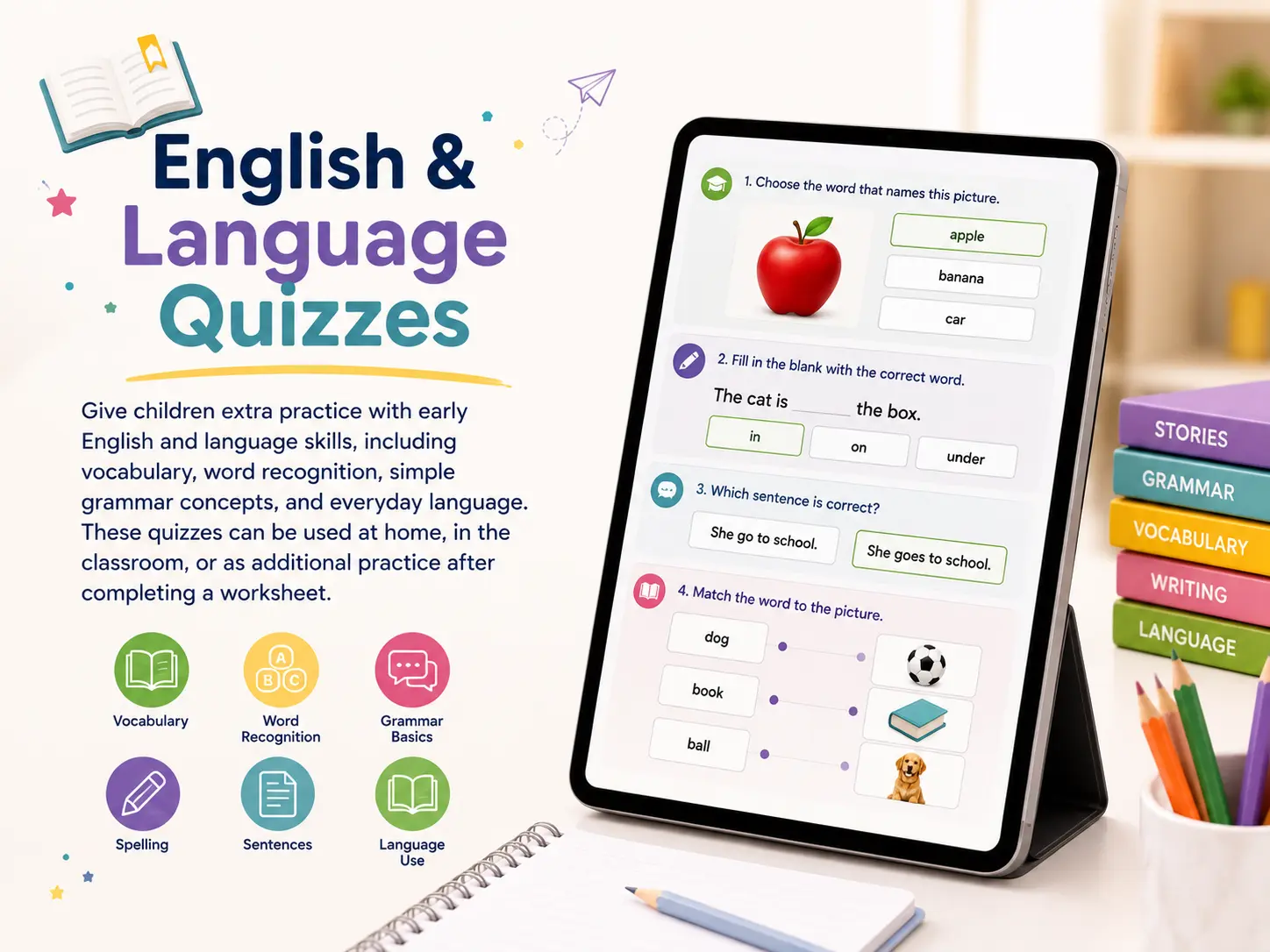
Kindergarten English & Language Quizzes
Give children extra practice with early English and language skills, including vocabulary, word recognition, simple grammar concepts, and everyday language. These quizzes can be used at home, in the classroom, or as additional practice after completing a worksheet.
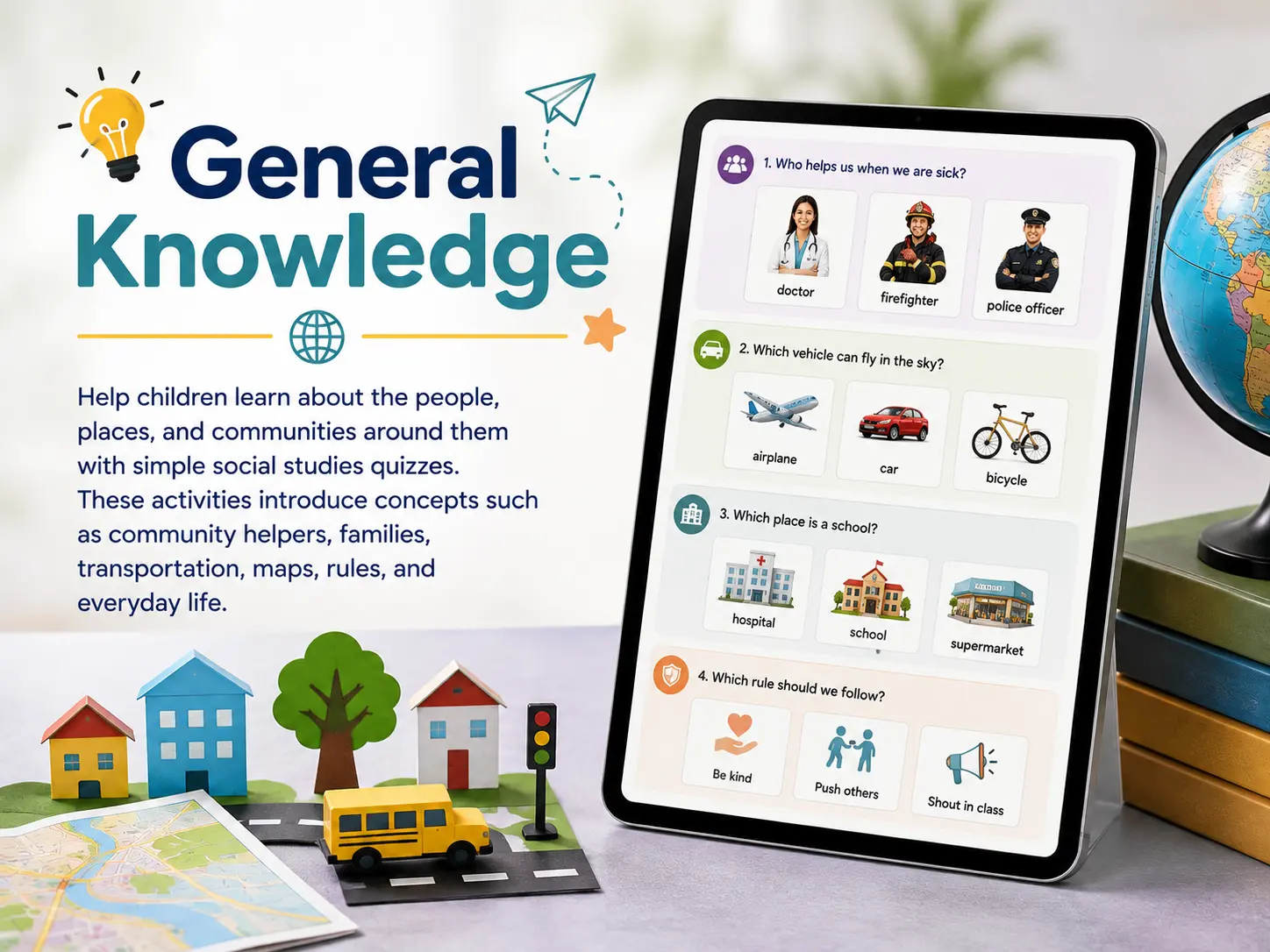
Kindergarten General Knowledge
Help children learn about the people, places, and communities around them with simple kindergarten social studies quizzes. These activities introduce concepts such as community helpers, families, transportation, maps, rules, and everyday life.
What this ordinal numbers quiz covers
If you typed ordinal numbers quiz kindergarten into Google, you want more than a definition — you want practice that sticks. This quiz teaches positions the way children actually meet them: who finished 1st in the race, which duck is 3rd in the row, what place comes just after 5th. Every question uses a short story or a picture line, so even children who cannot read yet can play while a grown-up reads aloud.
The quiz grows with your child. Easy starts with 1st to 5th — first, second, third, fourth, fifth — using races, queues and animal lines. Medium stretches to 10th and adds counting from the right end, just-before and just-after places, and calendar days. Hard goes all the way to 20th with detective riddles, spelling traps like eighth and twelfth, and two-step queue puzzles. It sits inside our kindergarten math quizzes collection, right next to our missing number quiz for kindergarten. It is the ordinal numbers quiz kindergarten kids ask to play again.
How the quiz works
Playing takes less than a minute to start, and there is nothing to install or sign up for. Press start, pick Easy, Medium or Hard, and answer each question by tapping a choice. Every answer gets instant feedback, so your child knows right away whether their thinking about places was right.
A full run is 60 questions, but nobody has to finish in one sitting. Ten minutes a day on one level beats one long session — short, repeated practice is how position words move into long-term memory, and that is why an ordinal numbers quiz kindergarten children can replay daily works so well. When a level feels easy, move up; when it feels hard, stay and replay. One rule runs through the whole quiz: unless a question says otherwise, always count from the left, and in a race the front is the winner’s side. You can find this quiz and more in our kindergarten quizzes hub.
Skills your child practices
An ordinal numbers quiz looks simple, but it trains several skills at once. If you want even more kindergarten math practice, browse our free quizzes for kindergarten:
- Position vocabulary: first through twentieth, in full words and in digits (1st, 2nd, 3rd…).
- Direction sense: counting from the left and from the right — and knowing which end you started from.
- Before-and-after thinking: just before 9th, just after 5th, and the place hiding between 7th and 9th.
- Spelling: the tricky words eighth, ninth, twelfth and twentieth that show up in Grade 1 writing.
- Two-step reasoning: working out one place, then using it to find another — the heart of the Hard level.
Work through those five skills and this ordinal numbers quiz kindergarten page turns into a warm-up instead of a challenge.
Age and grade guide
| Age | Grade | What to expect |
|---|---|---|
| 4–5 | Pre-K | 1st to 5th with pictures; read the stories aloud together |
| 5–6 | Kindergarten | 1st to 10th, just before and just after, counting from both ends |
| 6–7 | Grade 1 | 1st to 20th, spelling eighth, ninth and twelfth, two-step riddles |
Every child is different. If the Easy level feels too simple after a day or two, jump straight to Medium — the stretch from 5th to 10th is where most children start thinking hard. And if Hard feels impossible, that is fine too: the three-clue riddles in Level 3 challenge many first graders. Let your child set the pace and replay favourite questions on this ordinal numbers quiz kindergarten page.
How to use the quiz at home or in the classroom
At home
Ten minutes a day with an ordinal numbers quiz works better than one long weekend session. Sit with your child for the first few rounds and read the stories aloud — ordinal questions are listening questions first. When they miss one, do not just give the answer: ask “which end did you count from?” Most mistakes are direction mistakes, not counting mistakes. Save this ordinal numbers quiz kindergarten link where your child can tap it daily.
In the classroom
Use the quiz as a five-minute warm-up before a math lesson on order and positions, or as a station in math centers where pairs take turns reading questions aloud. The Easy level suits the start of kindergarten; bring out Medium when you teach days of the week, and Hard for calendar dates and two-step word problems. Pair it with more activities from our free quizzes hub for easy rotation planning.
Tips to help your child do their best
These five habits make any ordinal numbers practice more productive:
- Always name the end first. Say “we count from the left” before every question — direction mistakes cause most wrong answers.
- Say the full words. First, second, third — not just 1st, 2nd, 3rd. The words are the actual learning goal.
- Act it out. Line up toys and let your child point to the 4th one, then the 2nd from the right.
- Use real life. “You are 3rd in line.” “We live on the 2nd floor.” “Friday is the 5th day of the week.”
- Celebrate the tricky spellings. Eighth, ninth and twelfth deserve their own cheer when your child gets them right.
Answer key for parents and teachers
Level 1 — Easy (questions 1–10)
- C (1st) — Ben crosses the line before everyone, so he is first.
- B (3rd) — three ducks in a row; the last duck is in 3rd place.
- D (2nd) — one girl stands in front of Lily, so Lily is 2nd.
- B (The blue car) — red is 1st, blue is 2nd, yellow is 3rd.
- A (3rd) — say it out loud: 1st, 2nd, then 3rd comes next.
- C (4th) — Lily lands on stones 1, 2, 3, then one more: the 4th.
- A (2nd) — the cat sits right behind the dog, who is 1st.
- D (The 5th candle) — the candle lit last of all is the 5th.
- B (First) — “first” is the word that means 1st.
- C (2nd) — the silver medal goes to the runner just after the winner.
Level 2 — Medium (questions 11–30)
- B (7th) — seven kittens in a row; the very last one is 7th.
- C (6th) — the place just after 5th is 6th.
- A (8th) — the place just before 9th is 8th.
- D (4th) — three children in front of Zara, plus Zara herself, makes 4th.
- B (5th) — count five stars from the right: the far-left star is 5th.
- C (Sixth) — “sixth” is the word that means 6th.
- B (5th) — four friends finished before Ali, so Ali is 5th.
- D (5th) — with 4 flowers before and 4 after, the middle flower is 5th.
- B (4th) — one place after Mia’s 3rd is 4th.
- A (5th) — Monday is 1st, so Friday is the 5th day of the week.
- C (7th) — three floors above the 4th floor is the 7th floor.
- D (5th) — five crayons; the far-right one is 5th when counted from the left.
- B (8th) — 7 books before Ben’s book, plus his book, makes 8th.
- C (Fifth) — first, second, third, fourth, then fifth.
- B (6th) — the engine counts as 1st, so carriage 5 sits in 6th place.
- B (8th) — the place squeezed between 7th and 9th is 8th.
- C (10th) — nine children stand before Omar, so Omar is 10th.
- A (5th) — the dog is 1st from the left, which is 5th from the right.
- C (3rd) — the place that is after 2nd and before 4th is 3rd.
- D (2nd) — only one runner is ahead of Lily, so Lily is 2nd.
Level 3 — Hard (questions 31–60)
- B (15th) — fifteen penguins in a line; the very last one is 15th.
- C (Eighth) — 8th as a word is “eighth”, with one t in the middle.
- D (10th) — 3rd from the right end of 12 books is 10th from the left.
- B (5th) — a new child at the very front pushes everyone back, so Mia moves from 4th to 5th.
- C (8th) — two places after Ben’s 6th is 8th.
- B (The 14th) — Sports Day is 2 days after the 12th, which is the 14th.
- B (Twelfth) — after ninth, tenth and eleventh comes twelfth.
- C (4th) — the front child leaves the line, so Omar moves up from 5th to 4th.
- A (17th) — the place squeezed between 16th and 18th is 17th.
- D (12th) — after 10th and before 13th, but not 11th, leaves 12th.
- B (10th) — the winner is 1st from the front, which is 10th from the back.
- C (12th) — 11 blocks below the red block, plus the red block itself, makes 12th.
- B (Ninth) — 9th as a word is “ninth”: nine drops its e.
- C (8) — 14 children minus 5 behind minus Lily herself leaves 8 in front.
- C (1st) — Sam is last in a line of 7, so from the back Sam is 1st.
- A (The 19th page) — the page just before the 20th page is the 19th.
- A (17th) — count back: 20th, 19th, 18th, then 17th.
- C (5th) — the red circle is 1st from the left, which is 5th from the right.
- A (12th) — the first gap between 11th and 13th is 12th.
- D (9th) — the second gap, sitting after 8th, is 9th.
- B (The 3rd child) — the winner stands in the middle of five children, which is the 3rd child in the photo.
- C (The 7th floor) — up 5 from the 3rd floor is the 8th, then down 1 is the 7th.
- B (20th) — the word “twentieth” means 20th.
- D (14th) — 13 seeds planted before it, plus the sunflower seed, makes 14th.
- A (15th) — the place with 14th just before it and 16th just after it is 15th.
- B (4th) — the green bead is 3rd from the left, which is 4th from the right.
- C (20th) — Ben is last in a queue of twenty children, so he is 20th.
- A (20th) — the place that comes just after 19th is 20th.
- D (12th) — 11 children in front of Zara, plus Zara herself, makes 12th.
- A (5th) — Lily is 4th, Ben is two places after her in 6th, and Mia one place before Ben is 5th.
What to practice next
Ordinal numbers are one piece of kindergarten math. Once places feel solid, the natural next step is our missing number quiz for kindergarten — finding the missing number in a sequence uses the same ordering brain muscles. Then try the counting quiz for one-to-one counting practice, the comparing numbers quiz for greater than and less than, and the addition quiz when your child is ready to combine numbers.
All of these live in our kindergarten math quizzes collection, so you can move from skill to skill without hunting around — keep this ordinal numbers quiz kindergarten page in the rotation.
Frequently asked questions
What are ordinal numbers?
Ordinal numbers tell the position of something in a line or list: first, second, third, fourth, fifth, and so on. While counting numbers say how many, ordinal numbers say which place — who finished 1st, who is 3rd in the queue, which floor is the 2nd floor.
What age is this ordinal numbers quiz for?
This ordinal numbers quiz for kindergarten is made for ages 4 to 6. Younger children can start with the Easy level while a parent reads the questions aloud, and confident learners can move up to Medium and Hard.
How many questions are in the quiz?
There are 60 questions in three levels: Easy has 10, Medium has 20 and Hard has 30. A child can play one level at a time, and each level feels different so practice never gets boring.
Does the quiz save my child’s answers?
No. The quiz never asks for a name, email, age or any personal detail. It does not use cookies or tracking, it stores nothing, and nothing is sent anywhere. Everything happens in the browser and disappears when the page is closed.
How can I use this quiz at home with my child?
Try ten minutes a day: let your child play one level, then ask ‘how did you know?’ after a right answer. Line up toys and ask for the 3rd one or the 2nd from the right — real objects make places click faster than any screen.
How can teachers use this quiz in the classroom?
It works well as a five-minute warm-up before a math lesson, as a rotation station in math centers, or as a quick check after teaching positions and order. The three levels make it easy to give every child the right level of challenge.
My child mixes up 2nd and 3rd, or says ‘twoth’. What helps?
That is completely normal. Second and third are the trickiest words because they do not sound like two and three. Say the full words together — first, second, third — like a chant, and point at real positions in a line while you say them.
What should my child practice after this quiz?
After ordinal numbers, the natural next steps are missing numbers in a sequence, comparing numbers with greater than and less than, and simple addition. Each skill has its own free quiz, linked in the What to practice next section below.
Is the quiz free?
Yes. The full 60-question quiz is free, with no signup and no account needed. Just press start and play.
How is this different from an ordinal numbers worksheet?
A worksheet is printed once and finished, while this quiz gives instant feedback, three difficulty levels and 60 fresh questions, so a child can practice positions and order many times without getting bored.
Made for parents and teachers by Book and Pencil. Last updated October 2026.